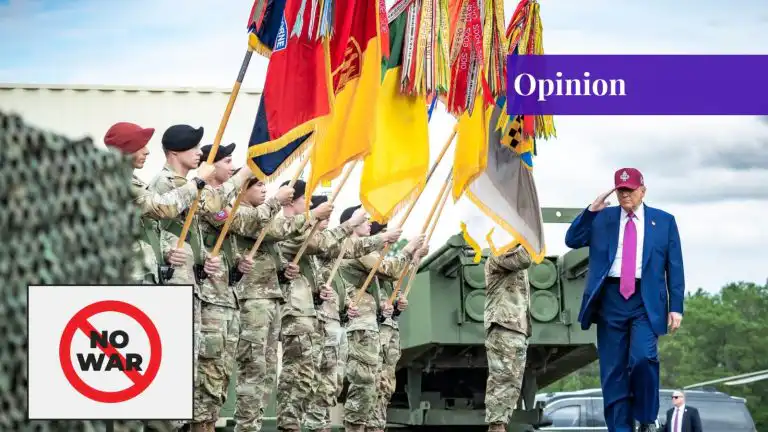
The United States has pendulumed between hostile and peaceful relations with Iran because of its contradictory relationship with the Islamic Republic. The United States has pursued its diplomatic relationship with Iran through a pattern of applying forceful measures while showing diplomatic restraint, which resulted in an official policy that used aggressive language but maintained operational safety. The image of US aircraft carriers that move through dangerous waters together with Trump’s statement about military action shows how the military shows power through battleships despite political leaders wanting to maintain peaceful relations.
The current relationship between the United States and Iran shows a clear division between political language and real-world state behavior.
The Role of Rhetoric in International Politics
International politics uses rhetoric as a powerful tool that manages perceptions through signaling and controlling escalation. Trump uses his Iran rhetoric to combine elements of both threats and reassurances. He has threatened Iran with “fire and fury like the world has never seen” because he wanted to protect US interests. He has made it clear that he wanted to avoid military conflict despite his multiple statements about it.
The tweet from Trump dated 2019 contains the following statement about Iran. The statement compares Iranian actions to their recent threats against America, which will result in Iran’s demise.
After Iran bombed American military bases in Iraq, days after General Qassem Soleimani died, Trump used a more restrained style of speaking. Trump declared that Iranian forces had stopped fighting because this development benefited all parties who were involved, and it brought peace to the entire world. The United States government used two different methods to show its military power. The United States government uses forward military deployment because it serves as an effective weapon against potential adversaries. The United States government displays its military power through its aircraft carriers and missile defense systems, and its joint exercises with regional partners.
The approach of using military presence to deter adversaries comes with certain dangers. The former US Secretary of Defense James Mattis explained his definition of deterrence when he said that aggressors would need to face greater costs than their expected benefits. The problem arises when deterrence blurs into provocation. From Iran’s perspective, US naval patrols near its territorial waters are not defensive measures but existential threats. Iranian officials have consistently framed American military deployments as violations of sovereignty and regional stability.
Iranian Foreign Minister Javad Zarif once tweeted, “US militarism in our region has only brought instability, extremism, and endless war.”
The US military presence in our region has resulted in increased instability, fundamentalist violence, and ongoing military conflicts. The military imagery in US policy execution creates a contrast with Trump’s peace-predicting statement.
The Domestic Political Dimension
The analysis of Trump by researchers requires examination of his domestic political goals, which drove his Iran policy. The American public has developed a negative view towards Middle Eastern military operations because of the extended duration of US military operations in Iraq and Afghanistan. Trump used this public sentiment to present himself as a commander who would bring military conflicts to a conclusion.
In a 2020 speech, he declared, “We are not the policemen of the world. It is time for other nations to step up.”
The narrative appealed strongly to voters who had become tired of foreign military involvement. Trump had to establish his strength because any indication that he lacked security competence would damage his national defense image against Iran, which had been his country’s long-term enemy. The administration established a military strategy that announced impending military action, yet they used it in an extremely limited manner.
Iran’s Calculated Response
The Iranian government established its operational strategy through deliberate methodological approaches. Tehran started to decrease its nuclear obedience after the United States exited the Joint Comprehensive Plan of Action (JCPOA) because it wanted to maintain its nuclear program while avoiding triggering a significant American reaction.
The Iranian government responded to Soleimani’s assassination through military action. Iran used missile attacks, which resulted in no American deaths, to demonstrate its determination but stopped short of reaching dangerous levels where war would begin. An Iranian commander stated that, “Our response was strong enough to show power, but wise enough to avoid war.”
The two sides maintained their military restraint because they understood that actual combat would bring about disastrous results, which both sides wanted to avoid.
The Illusion of Control
The statement made by Trump that “hopefully no need for military action” suggests that the United States has complete power to decide whether a war will begin. Conflicts emerge because of unplanned forces that drive existence rather than through planned activities that people create.
The political scientist Robert Jervis issued a warning which alert people to the following danger. The Middle East region faces permanent security threats because its military forces demonstrate power through aircraft and naval assets. A single naval incident, a drone strike, or a proxy clash has the power to create a chain reaction, which Washington and Political scientist Robert Jervis famously warned, “The most dangerous wars are those that no one intended.”
Conclusion
Trump’s military action against Iran demonstrates his policy of no war and his belief that military action against Iran will not be necessary because most people want to avoid another Middle Eastern conflict, which would lead to widespread destruction. Yet hope alone is insufficient. The practice of diplomatic relations, together with diplomatic channels and effective de-escalation methods, must exist because, without these elements, the language of restraint becomes unstable.
The United States and Iran maintain a trust deficit, which creates a situation where military posturing and peaceful rhetoric create contradictory messages. The two parties need to establish permanent contact because both need to process their peace statements with evidence of military operations at sea.
The active prevention of war creates peace through international politics, whereas peace through international politics requires a complete end to all military conflicts.
If you want to submit your articles and/or research papers, please visit the Submissions page.
To stay updated with the latest jobs, CSS news, internships, scholarships, and current affairs articles, join our Community Forum!
The views and opinions expressed in this article/paper are the author’s own and do not necessarily reflect the editorial position of Paradigm Shift.