
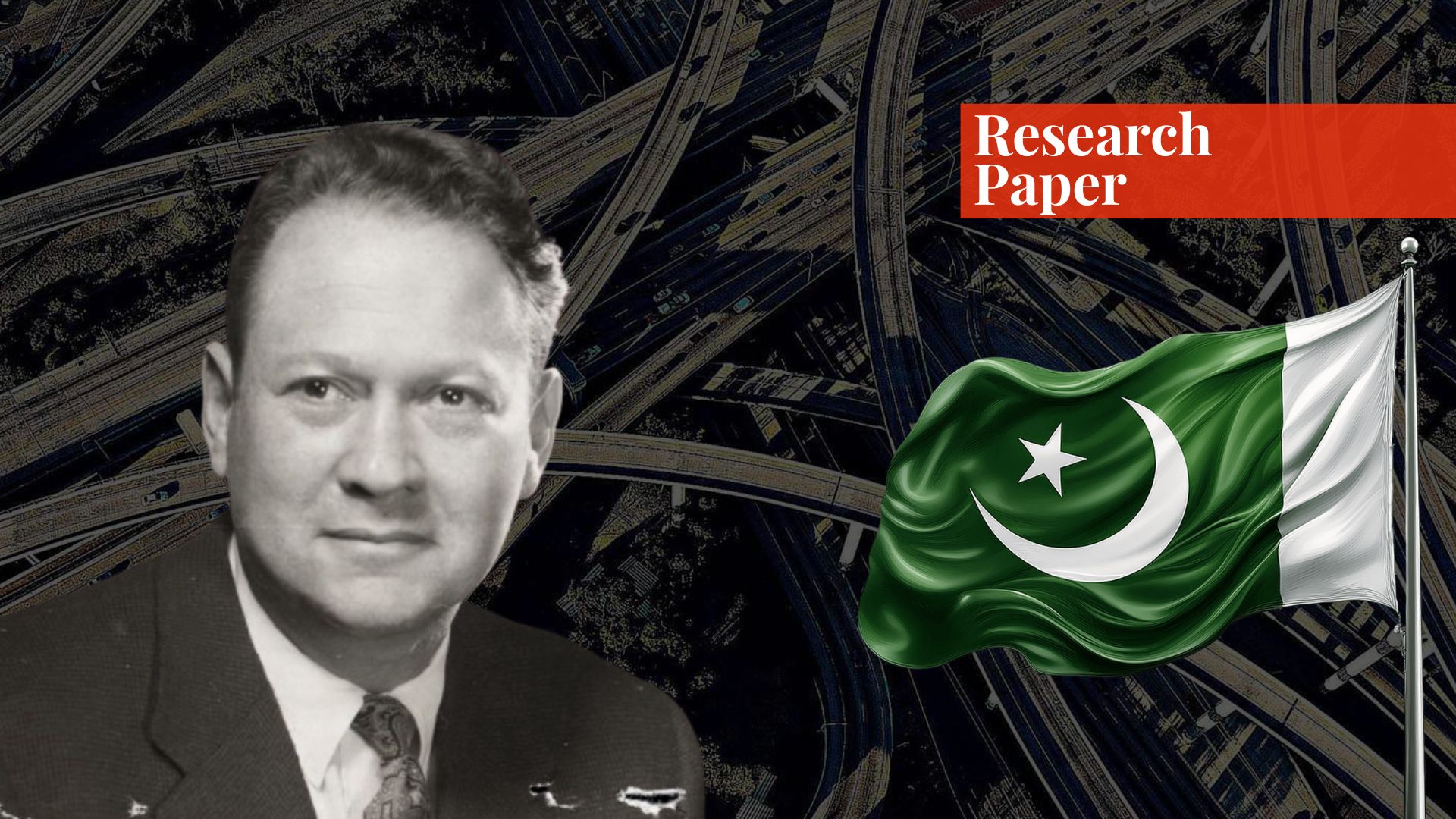

The “Modernization Thesis” of Daniel Learner is a foundational theory in the study of developing societies. His 1958 book, The Passing of Traditional Societies: Modernizing the Middle East, provides a framework for understanding how traditional societies undergo a transformative process of change. In his book, he implied that the Western model of modernization exhibits a certain sequence and components that have a global impact through an increase in urbanization literacy rates, which in turn leads to increased media exposure. The surge in media exposure is expected to lead to higher economic growth and increased political participation. By adopting the secular model followed by the West, all continents of the world, despite variations in race, color, and creed, can be modernized.
This essay comprehensively argues against the Learner’s Modernisation thesis as the right framework for Pakistan’s development. It is contained on three premises. Firstly, this essay argues that Learner’s modernization thesis overlooks the historical and political context of society and fails to provide a sufficient number of indicators necessary for modernization, as seen in Western societies. Secondly, Learner’s thesis imposes that Westernization is the only name of modernization, and by following the footsteps of Western societies, the rest of the world can develop. It promotes ethnocentrism, undermines the cultural and social values of a region, and exhibits otherization. Thirdly, his thesis provides a linear and Western-centric model with an oversimplification of change and fails to explain the issues of inequality, inflation, poverty and environmental degradation, which makes it a misfit in Pakistan’s case of development.
This essay will begin by recalling the historical experiences of the Pakistani state in relation to the political context and how Learner’s model doesn’t hold up in such grievances. Further, this essay will challenge the elitist model of development presented by him as a mere tool to impose hegemony and undermine the socio-cultural aspect of non-Western societies. Lastly, this essay will explore the wider realm of factors in Pakistan like illiteracy, involvement of the military, corruption, and religious influence, which elucidates that Learner’s linear and oversimplified model of modernization is not an appropriate development framework for Pakistan and rather a much more nuanced and more grounded ways of development is required in Pakistan’s case.
Theoretical Perspective
Learner’s model of development has been critiqued as an elitist, western and alien concept for post-colonial states like Pakistan, which have their own historical background, colonial history and complex political relations. Edward Said, a literary critic, presented a post-colonial theory published in his book Orientalism in 1978, which highlighted how the East is stereotyped, viewed and dominated by the West. It is a discourse that necessarily shows how there is a construction of “occident” and “orient” to create a difference between us as Europeans vs them as non-Europeans, which is one other way to create cultural hegemony. Gramsci, as mentioned in his book, has called this cultural leadership hegemony the idea of European identity as superior in comparison to the East (Said 7). This development model is another form of reinforcement of European superiority over oriental backwardness. One of the other critiques of Learner’s thesis in the account of Pakistan is its deterministic approach. Learner’s thesis gives some indicators, such as economic progress, for the development of a nation.
In contrast, Ayesha Siddiqa has derived the term “milbus,” which shows the military’s involvement in various sectors like agriculture, real estate, industry and different businesses. Despite the rise in wealth and economy, it is centered in the hands of a few, and such a rise, rather than boosting development, exhibits inefficiencies and diversion of resources and perpetuates inequality. Such analyses show that despite having an economic boost, development is not ensured (Siddiqa, 2007).
Lack of historical and political context
Learner’s modernization thesis lacks a historical narrative, and it fails to address the dilemma of “The third world.” Pakistan, a country that emerged after the brutal partition of India, has had a tumultuous history of colonization, which has created a huge impact on Pakistan’s development path. After surviving the tragic event of partition, the shadows of colonial imperial power, resource depletion and leaving a strong military and bureaucratic control on the newly emerged state of Pakistan. The horrific shadows of colonization are still looming over Pakistan, which has changed the political, cultural, and social landscape of the country. With the extensive resource exploitation, loss of cultural identity and colonial structures, Pakistan has failed to grow and develop. The basic crises of Pakistan lie in the socio-economic history of Pakistan, with a widening gap between the ruling classes of Pakistan and the large masses of poor and powerless people.
The current manifestations point to the historical processes, which are the imperialist colonization of the Indian subcontinent, which has left a dark void in history to this day. Under this imperialist agenda, there was the creation of some elite groups in the country who had control of the resources and the wealth, thus becoming instrumental in the exploitation of their own society. This stratification has resulted in the continuation of the neo-colonial structures in the country (Gardezi, 1970). Learner’s model does not cater to how post-colonial states with such a historical context, with a recovering economy and lack of resources, get onto a path of modernization.
The history of Pakistan has been shaped by a tumultuous past, with its own contradictions and challenges, which have also shaped its political culture. Despite attaining emancipation from a ruling imperial power, the political structures of Pakistan were not entirely developed. With relentless interference of the military in political matters, strong bureaucratic hold, and abrogation of consecutive constitutions, the political landscape of Pakistan has gone rotten. This strong military rule has resulted in the development of “The Garrison State,” a concept introduced by Ishtiaq Ahmed in his book, which highlights Pakistan’s travails and its love affair with the army. The poorly equipped institution became the strongest one in the country, and the incompetent politicians and their factionalism created instability in the region. This situation has led to the suspension of two constitutions, 33 years of martial law, i.e., four military coups in 1958-1971, 1977-1988 and last but not least, from 1999 to 2008 and governor’s rule, continued suppression of mass media and the political parties, extra-judicial capturing of activists and political workers (Ahrari, 2013).
Pakistan went through authoritarian rules and military coups, media literacy failed miserably, and conservative and Islamic views were propagated. Since the last military coup, which ended in 2008, Pakistan has been considered a hybrid regime with some elements of electoral democracy coexisting with continuing military influence. Without explaining such a complex socio-political culture, the development road of Pakistan can not be anticipated. Learners model fails to explain the trajectory of development in the case of Pakistan because it does not focus on the historical and political aspects of the nation, tries to fit all societies into one model of development, and doesn’t take into account what went down in history, what sort of political structures exist, who is the ruling class, how the political system works. Hence, Learner’s development model under these shortcomings fails to address development with such historical and political dynamics.
Ethnocentric bias
Learner’s development model shows ethnocentric bias, and it places the Western world on a superior level and makes it a model for the rest of the world to follow, which shows ethnocentrism and degradation of the cultural and social values of other nations. It imposes a Eurocentric teleology and completely dismisses other alternative realities. This binary of Western vs Non-Western devalues the traditions, history and social conditions of the non-Western world. As Edward Said has pointed out in his book “Orientalism,” how the West creates “The other” and imposes its own hegemony and tries to make it legitimate by naming the “other” as exotic, static and irrational. Edward Said has defined Orientalism as “Orientalism can be analyzed as the corporate institution for dealing with the Orient — dealing with it by making statements about it, authorizing views of it, describing it, teaching it, settling it and ruling it” (Said, 1978).
The ethnocentric bias, as expressed in his book, is that what the West is, the Middle East wants to become. He further added that Western society still provides the most developed model of societal attributes like power, wealth, skill and rationality, which the Middle East and other societies aspire to achieve. He reiterated that the West is a useful model that can be used for the reconstruction of modern societies (Learner 47). This exhibits the xenophobia presented by Learner in his model by undermining the traditional culture, indigenous values and morality of a certain society. Pakistan is a society that has diverse ethnicities, multi-cultural and traditional values that are respected in the society. Devaluing and eradicating such values, as Learner has suggested, will disrupt the roots of Pakistani society, and an alien rule similar to colonial times will be imposed. Pakistan is majorly an agrarian society, with some pointing it out as a feudal society which entails these features, as highlighted by Hamza Alavi. Unfree labor, extra-economic coercion, a fusion of economic and political power at the point of production, the self-sufficient economy of the village and there is simple production with no accumulation of surplus makes it a feudal society (Alavi, 2008). With such a feudal rule and the working class under unfree labor, the idea of Learner’s development seems like a hoax, and the deeply rooted feudalistic framework provides aid only to the elite class in becoming more developed at the brunt of the working class. This proves that Learner’s Western-centric modernization thesis proves futile in the case of Pakistan.
Oversimplification of development
Learner’s model provides an oversimplified model of development. He gave a sequence that, by having more urbanization, society would become secular, and political participation would increase. But in the case of Pakistan, religion plays a major role in politics and the social fabric of the society. All the political parties in Pakistan are Islamicized, and parties like Jamat-e-Islami and Tehreek-e-Labbaik Pakistan are Islamic fundamentalists. The religious groups in Pakistan, mostly Shia Muslims, dominate the political, social and economic sectors of the country. The political landscape of Pakistan is dominated by the clergymen and the clerics, who have radicalized a huge portion of the masses. This increased Islamization has resulted in extreme protests and demonstrations.
The Constitutions of Pakistan have some Islamic provisions, and all the Islamic principles related to inheritance laws and marriage are imposed on the population. During Zia’s Islamization era from 1977 to 1988, Zia’s government enacted the Hudood Ordinance and introduced Islamic punishments for adultery, fornication and theft. He introduced Shariah courts in the country and expanded the Madrassah system. The introduction of blasphemy laws during his dictatorship allowed people to be criminalized if they criticized Islam. It fueled the religious fervor. Zia’s Islamization regime marked a dark point in Pakistan’s history (Din 26-29). Under such an Islamic-controlled political system with such a huge influence of religion on the social and political landscape, Learner’s development model can not work to provide a secular model to Pakistani society.
Learner pointed out that a developed society would have an empowered and participatory public. But it did not happen in the case of Pakistan. The political system in Pakistan is based on dynastic politics. The youth and the masses do not take part in politics actively due to undemocratic political systems and dynastic politics. With a direct ban on student unions, the political participation of young minds has been greatly reduced. So, the indicator presented by Learner is that urbanization and literacy will result in an increase in political participation, and the society will turn into a secular one, but this did not happen in the case of Pakistan (Mustafa, 2023). Despite having diverse urban centers and extensive media channels, Pakistan’s political landscape became very religious, where the politicians used religion as a tool to attract the masses and to form an emotional connection with the public, and it has resulted in a rigorously Islamic society. Hence, the development model of Learner fails miserably in this case.
Learner’s model does not explain the underlying issues like rising inequality, corruption, inflation, poverty, environmental crises, and external influences. According to the World Bank report, there is 39.2% poverty using the lower middle-income poverty rate of US$3.2 per day for the fiscal year 2024-25. The rising population growth and slower economic growth have contributed to low human development and low social development, and Pakistan ranks 150 out of 189 countries on the Human Development Index(HDI). It has been reported that if certain measures are not taken, rising poverty can lead to the default of the country. For a country where such a huge gap exists, development seems like a dream, and Daniel’s method does not address how to eradicate poverty (Rasul, 2024).
Learner’s thesis pinpointed that by having media exposure, the masses would get more educated. The literacy rate would increase. But in Pakistan’s case, with the progression of time and with the development of various news and media channels, there still has not been any exposure to the masses. First, the media channels provide biased information and give a state-controlled narrative. Despite the exposure through the media channels and the development of news channels, media outlets and entertainment shows in the industry, the development process did not occur, and it did not increase the literacy of the masses. If the media of Pakistan tried to give a different and new perspective, it was suppressed and turned down. Different acts like the abduction of journalists, censorship and state-controlled media did not let actual journalism grow. The PECA, Prevention of Electronic Crimes Act and the PEMRA, Pakistan Electronic Media Regulatory Authority Act, are used for the criminalization of online content. Such acts target journalists, activists and members of civil society, particularly. Such a ban and censorship on media channels undermines the legitimacy as well as the autonomy of the independent channels. Learner’s thesis failed to anticipate such a situation, and even despite having multiple media outlets and media exposure, it did not result in any political participation and an increased literacy rate of the masses.
Linear path of development
Learner’s development model provided a linear path to follow for all societies to get on a path of development. In his book, he mentioned that Western societies became modern and developed when people started moving from farms to flats and from fields to factories. Through this physical mobility, a natural process of development began, and they started growing new institutions and developed in a very natural way (Learner 48). This whole idea of moving to urban centers and becoming developed is futile and does not work if applied to Pakistan’s trajectory of development. Pakistan has several highly developed metropolitan cities and modern urban centers, including Karachi and Lahore. But the situation in those cities is horrendous. The slums of Lahore and Karachi are second to none. The few highly developed societies, such as DHA’s and Bahria’s, do not define and are not the face of the cities. Such urban centers, rather than promoting development, perpetuate more inequality in the region. It does appear as a sign of development, but rather brings the working class down a grade. The richest 10% of society have the maximum share of the wealth, while the other classes fail to meet their basic needs. This rising inequality stunts growth and leads to a surge in crime rate, increased vulnerabilities and a stagnated economy. Without considering these inequalities, Learner’s model proves to be futile.
Conclusion
All the aforementioned arguments can be used to justify the statement that Daniel Learner’s modernization thesis doesn’t offer a cogent model for the case of development in Pakistan because it perpetuates ethnocentrism, devalues indigenous culture, and oversimplifies change and development by providing a linear path. For a country like Pakistan, development is possible by taking into account its complex historical background, the current political landscape, and diverse identities. By rethinking the models of modernization and incorporating social justice, human rights, and stable democratic institutions, a more inclusive and democratic model can be formed. Having a more nuanced and participatory form of modernization model, where the identities and cultural heritage of societies are understood, would be pivotal in bridging the gaps and reducing the inequalities.
References
- Ahrari, Ehsan. “The Pakistan Garrison State: Origins, Evolution, Consequences (1947–2011) by Ahmed Ishtiaq (review).” Mediterranean Quarterly, 2013. Accessed May 26, 2025.
- Alavi, Hamza. “India: Transition from Feudalism to Colonial Capitalism.” Journal of Contemporary Asia, April 2, 2008. https://www.tandfonline.com/doi/abs/10.1080/00472338085390251. Accessed May 27, 2025.
- Din, Nasir Ud. “Islamization of Laws in Pakistan during the Rule of General Zia Ul Haq.” No. 1 (July–December 2014). https://islamika.aiu.edu.pk/wp-content/uploads/2020/11/Islamization-of-Laws-in-Pakistan-issue-1-v1-j3.pdf. Accessed May 27, 2025.
- Gardezi, Hassan N. “Neo-Colonial Alliances and the Crisis of Pakistan.” Pakistan Forum 1 (1970). https://www.jstor.org/stable/2569010?seq=1. Accessed May 26, 2025.
- Lerner, Daniel, and David Reisman. The Passing of Traditional Societies: Modernizing the Middle East. New York: The Free Press, 1958. Accessed May 25, 2025.
- Mustafa, Zubeida. “Student Unions.” Dawn, February 10, 2023. https://www.dawn.com/news/1736357. Accessed May 27, 2025.
- Rasul, Golam. “Addressing Poverty and Inequality in the Mountains of Pakistan.” Vol. 2, September 11, 2024. https://link.springer.com/article/10.1007/s44282-024-00086-0. Accessed May 27, 2025.
- Said, Edward W. Orientalism. New York: Pantheon Books, 1978. https://monoskop.org/images/4/4e/Said_Edward_Orientalism_1979.pdf. Accessed May 25, 2025.
- Siddiqa, Ayesha. Military Inc.: Inside Pakistan’s Military Economy. New Delhi: Random House Publishers India Pvt. Limited, 2017. https://archive.org/details/militaryincbyayeshasiddiqa. Accessed May 25, 2025.
If you want to submit your articles and/or research papers, please visit the Submissions page.
To stay updated with the latest jobs, CSS news, internships, scholarships, and current affairs articles, join our Community Forum!
The views and opinions expressed in this article/paper are the author’s own and do not necessarily reflect the editorial position of Paradigm Shift.

She is a climate activist and is currently a student at Beaconhouse National University.