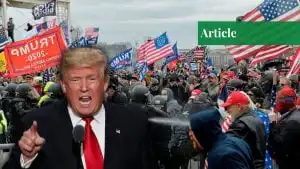

Donald Trump turned 79 on the morning of June 14, 2025. His critics noted that he had organised a military procession through Washington that included jets, armoured vehicles, and the full ceremonial weight of American military might, dressed more for a private celebration than a national event. The administration was unprepared for what transpired concurrently in 2,100 locations across all fifty states: an estimated five million Americans entered the streets with signs that read, “No Kings.” That day was the beginning of what has grown to be the biggest sustained civic resistance movement in modern American history.
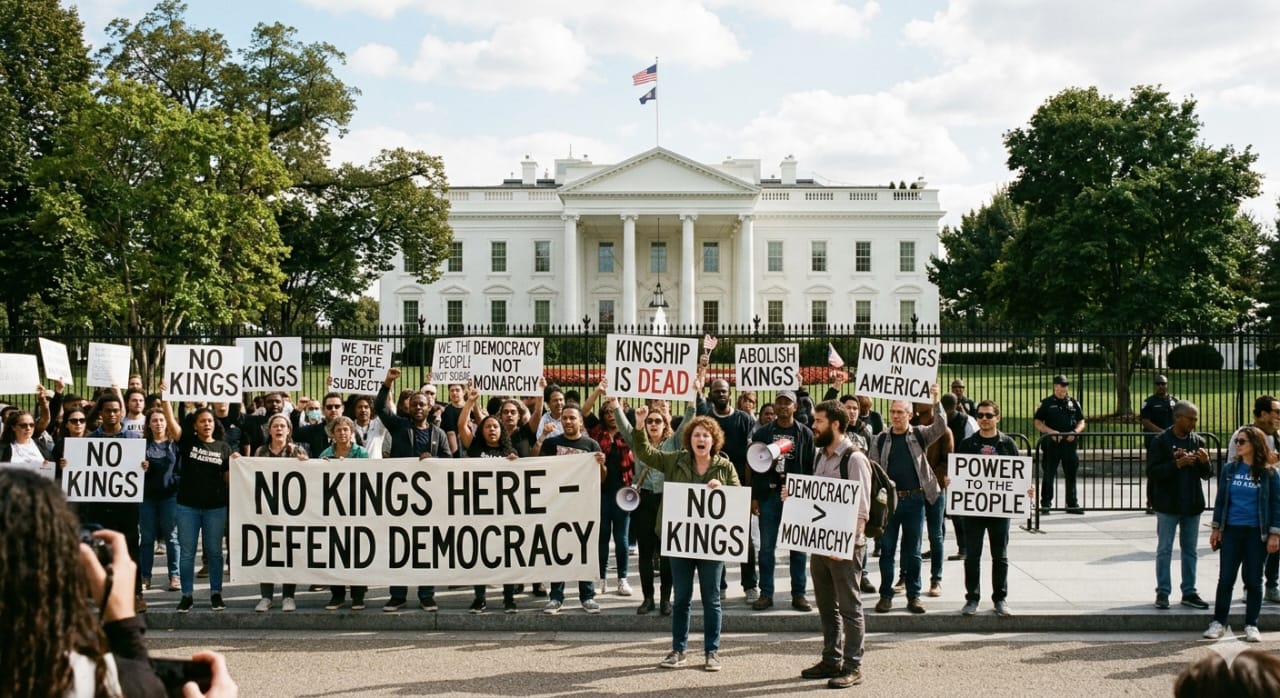
The language choice was neither accidental nor dramatic. The organisers behind the 50501 Movement, whose name encodes their founding ambition of fifty states, fifty protests, one movement, deliberately reached back to 1776. The rejection of King George III was seen in the American constitutional imagination as a declaration of civilisation as well as a political action. To invoke the monarchy now would be to accuse premise rather than policy, to claim that what was happening in Washington was not aggressive governance but rather something more dangerous and structurally older. On handmade cardboard in rural Kentucky and laser-printed banners in Manhattan, the name spread simultaneously and uncoordinatedly with the speed of something that already existed in the political unconscious.
In The Origins of Totalitarianism (1951), Hannah Arendt noted that the most perilous political changes are those that disguise themselves as legitimate; the authoritarian seldom declares himself as such but instead, enters the system by methodically undermining institutions from within. Even though the majority of the No Kings demonstrators have never read Arendt, they are reacting to precisely the phenomenon described in the book. As of June 2025, America’s Liberal Democracy Index score had dropped the most in a single year since the ratification of the Constitution in 1789. The measured value of legislative restraints on executive power had decreased by almost one-third. Civil rights ratings had dropped to levels seen in the late 1960s. The streets were responding to data rather than just feelings.
At its beginning, the movement did not reach its peak. It expanded, getting bigger and wider geographically with every repetition. An estimated seven million people attended a second round of protests on October 18, 2025, at about 2,700 locations, fourteen times larger than the total number of Trump’s inaugurations. Then, on March 28, 2026, No Kings III shattered all previous records. More than 3,300 events took place across all fifty states, with an estimated eight to nine million participants, making it the largest single-day nonviolent protest in recorded American history.
No Kings III’s main rally took place in Minneapolis-Saint Paul, Minnesota, rather than New York or Los Angeles, the cities that American political commentary naturally attracts. That decision was thoughtful and deeply meaningful. The Twin Cities, the location of Operation Metro Surge, a federal immigration enforcement campaign that claimed the lives of American citizens Renée Good and Alex Pretti after they were shot by federal agents during raids in January, have come to represent what the movement refers to as the administration’s domestic brutality. Bruce Springsteen performed at the state capitol before tens of thousands, playing a ballad he had written in their memory. Good and Pretti’s deaths accomplished what abstract constitutional arguments never accomplish: they provided the movement with a tangible, unchangeable event to unite around. They turned a fear of democratic deterioration into a name-based sadness.
The disdainful attitude from the White House was instructive. The protests, according to spokeswoman Abigail Jackson, are “Trump Derangement Therapy Sessions” and “the only people who care about these… are the reporters who are paid to cover them.” The official answer to the eight to nine million people who had just taken over their nation’s streets was a one-liner. The administration’s portrayal of mass opposition as pathology rather than politics is a diagnostic aspect of the democratic disintegration experts have been watching, so it is worthwhile to consider whether this represented true confidence or intentional provocation.
No Kings III’s geography, more than its size, may have been its most analytically significant feature. Nearly half of all protests took place in Republican-leaning constituencies; Idaho, Wyoming, Utah, Montana, Texas, and Florida each recorded dozens of events. These aren’t cities for protest; these are places that have traditionally produced Republican supermajorities without opposition, and they turned up. Midterm elections are decided in the backyards of Republican congressional seats, where the protest is taking place.
With each stage, the movement’s grievance architecture has grown, absorbing fresh outrages without losing its fundamental consistency. Immigration enforcement, particularly the executions in Minneapolis and the larger Operation Metro Surge, became the focal point of the June 2025 protests. By October, the scope had expanded to include further aspects of democratic regression, including the judiciary’s subordination and the repression of congressional monitoring. Executive aggrandisement, as described in How Democracies Die (2018), is the covert, legal consolidation of power that has supplanted coups as the main cause of democracy’s demise in the twenty-first century. This mechanism is specifically named in the movement’s name: no king ascends to the throne by claiming it; he enters through the buildings of the organisations he was chosen to lead.
By March 2026, the conflict in Iran had become another grievance. The conflict is extremely unpopular during the protests, which are currently in their fourth week. The latest Quinnipiac poll recorded 59% disapproval of Trump’s handling of the Iran war, and a Reuters/Ipsos survey placed his overall job approval at 36%, the lowest figure of his second term. For most American households, inflation brought on by the war and tariffs is not an abstract concept; it is the cost of groceries, gas, and school supplies. In Portland, a demonstrator held a poster that said, “So bad, even introverts are here.” People who had never carried a banner, screamed a message, or attended a rally showed up because the barrier separating them from public political life had vanished.
The organisers of the movement have not been ignorant of what lies beyond the street. Approximately 2.5% of adult Americans are among the eight to nine million protestors. In order to transform the energy of the march into the discipline of the voting booth, the organisers have announced voter registration drives, community organising training, and candidate recruiting frameworks. They know exactly how many people they are aiming for. The key question for the next seven months will be whether they can convert eight million marchers into eight million targeted votes in the appropriate congressional districts.
This mobilisation’s political effects are already quantifiable. Democrats have won several special elections in districts, including one Florida state house seat that includes Trump’s Mar-a-Lago home, which has unusual symbolic meaning. His Republican Party now faces the genuine prospect of losing both chambers of Congress in November, with suburban districts registering surging opposition voter registration at rates that political operatives on both sides are watching with unusual attention. In Minneapolis, Senator Bernie Sanders said that although it would be conceptually incorrect to turn a civic resistance movement into a party infrastructure, the Democratic Party is circling this energy with obvious hunger. Republican-leaning attendees in Idaho and Montana have been able to attend No Kings without feeling like they are entering a Democratic rally because the organisation has been strategically and purposefully careful to portray itself as a constitutional defence rather than a partisan campaign.
No Kings has demonstrated how mass mobilisation can transform public grief and discontent into electoral and organisational, and frame grievances around immigration enforcement, judicial independence, and the unpopular Iran conflict. It is unclear whether this energy will result in noticeable changes in the 2026 midterm elections, but its steady expansion highlights a resilient civic stubbornness, regular people reiterating that the American republic derives its legitimacy from the collective insistence on accountable governance rather than from unbridled executive authority. The movement is proof of the people’s unwavering ability to reject “kings” in support of constitutional principles in a time of gradual democratic regression.
If you want to submit your articles and/or research papers, please visit the Submissions page.
To stay updated with the latest jobs, CSS news, internships, scholarships, and current affairs articles, join our Community Forum!
The views and opinions expressed in this article/paper are the author’s own and do not necessarily reflect the editorial position of Paradigm Shift.

Abdul Basit | MS International Relations | Researching soft power, cultural diplomacy and global politics | Writing on geopolitics, foreign policy and defence affairs.