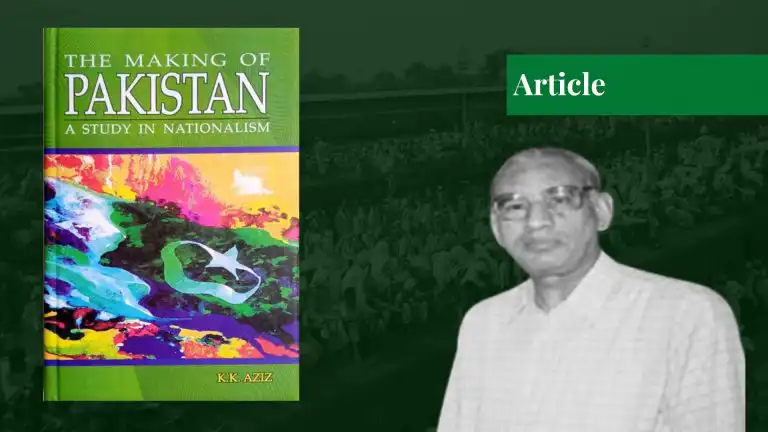
The history of partition has always been seen through the skeptical lenses of Indian nationalism, where the elite Muslims felt threatened of losing their generational wealth, raising demand for a separate state in the name of the two-nation theory to defend it. This view of partition and other such views which debunk the Muslim nationalism have been clearly pulverized by Khursheed Kamal Aziz, also known as K.K Aziz, in his book The Making of Pakistan: A Study in Nationalism.
K.K Aziz’s diction of writing represents clear, logical, and well-concluded arguments that keep the readers hooked to the passages. Rather than describing the chains of events, he connects them with the theoretical lens of nationalism, which he clearly explains in the introductory part of his book. He considers nationalism as the state of mind, a consciousness that develops over a span of time. He summarizes this logic in the following words: “We know that we are a nation, therefore we are a nation”. It is this state of mind that the reader should keep in mind throughout the reading to understand the genesis of Muslim nationalism in India. Without it, one cannot understand the driving force behind different events.
He provided 13 common beliefs that construct this creed of nationalism. The first 3 are the emotional bases of nationalism: common group feeling, love for fellow nationals, and common hostility to others. The next 3 represent a political and social apparatus of nationalism, which are the possession of common territory, sovereign government, and the common social, moral, or economic institutions. The next 4 work as the spiritual equipment for any nationalism, such as cultural characteristics, religion, common history, and heroes. The last 3 represent the time loop of affinity, which are the glorious past, contemporary devotion to the group at present, and aspiration for future prosperity. Through the coming chapter of K.K. Aziz’s book, these features of nationalism are clearly articulated, which will help any reader in tracing why, when, and how the events gave birth to Muslim nationalism in India.
In Chapter 1 of the book, The Historical Factors-I, K.K Aziz argued that the alienation in the post-mutiny period sowed the first seed of Muslim Nationalism in India. This chapter further tracks the circumstances and personalities that led to the future events, such as Sir Syed Ahmed Khan and the feeling of separatism. This was further aggravated by the Partition of Bengal and the Hindu’s zealous opposition to it, driven by the fear of economic loss and the British Muslim appeasement. This chapter summarizes the era from 1858 to 1922 into three different timelines: political aloofness (1858-1905), schooling in constitutional politics (1905-1911), disorder and sedation (1911-1922), or in a different tone as the state of neutrality, the rift with the Hindu majority, and the cooperation with Hindus, respectively.
The next chapter on similar lines of history provides further cases of events and instances that depict the transition of Muslim nationalism from the nascent stage to the era of maturity. This chapter covers the period from the Montego-Chelmsford reforms to the partition era, providing the different episodes of cooperation and betrayal by the majority Hindu politics. This chapter also elucidates why the denial of a separate electorate in the Nehru report should be termed “a blessing in disguise” for Muslim nationalism. Other than these things, the position of author also revolves around the conditions before the 1945-46 elections such as the Congress ministries and other such factors like the issues of strong versus weak center between the congress and the Muslim league that culminated in the divergent and extreme ends of spectrum in the election manifestos like promises of Pakistan versus Akhand Hindustan of the respected parties.
In the 3rd chapter of the book, the author illuminates the political factors that led to the various policies pursued by the Muslim leaders. For instance, the author traces the pragmatic feature of the policy of loyalty to the British by Sir Syed and other such Muslim political leaders of that time. It also elucidates how the imperial pride and the extra-territorial attachments with Persia, the Turkish caliphate, and the Arabs influenced the Muslims’ sentiments in India. The author not only discusses political factors behind the Muslim nationalism in this chapter but also provides insights into how and why the Congress-led Indian nationalism was nothing short of Hindu nationalism, in which Muslims were only bystanders.
The following chapter provides the religious connotation of the different nationalistic feelings in India. The author utilized the views from the three religions: Islam, Hinduism, and Christianity. From these perspectives, the author has delved into the nationalist sentiments and into what type of proposition different sentiments were driving their spirituality.
In the 5th chapter, K.K Aziz has provided the cultural drivers of nationalism; in fact, the culture has been termed as “the root of separatism” in Hindustan by the author. Utilizing Sir Ernest Barker’s definition of culture as “mental construction”, the author has provided how this factor played with the sentiments of Muslims in India. He has explained how the cultural organizations, the language sentiments, education, literature, philosophy, and art _ the trunks of any culture _ played their role in augmenting the nationalistic sentiments. He has provided the insights of the Muhammadan Educational Conference, the Brahmo Samaj, the Vidya Mandir scheme to Patronize Hindi language, different educational institutes such as the Anuman-i-Himayat-i-Islam, and other such case studies to vindicate his arguments in this chapter.
The 6th chapter of the book can be considered the soul of K.K. Aziz’s work. This chapter provides the ‘psychological factors’, which should always be seen as precursors for any movement, that played an important part in the creation of a separate Muslim homeland. The author has explained how the myths and symbols, such as the myth of the martial race, the Muslims as foreign aliens, and the symbols, including clothes, caps (Gandhi cap and Jinnah cap), the symbols of slogans (Bharat Mata ki Jai, Allah o Akbar, and Pakistan Zindabad) played the role of an important enzyme in this period. Other such psychological factors covered by the author have been the sense of security that was present in the minds of the common man from both sides, reflected in the divergent policies of their leaders. From this chapter, one can conclude that the feeling of insecurity essentially gave birth to Pakistan.
Chapter 7 finally elucidated the Two-Nation theory, a foundation of the partition of Hindustan. The author in this chapter has justified the two-nation theory through the external and internal evidence and has vindicated the proposition of this theory. This chapter also provides the role of separate electorates in augmenting this thought, debunks the credibility of nationalist Muslims who were promoted by the Congress to nullify the two-nation theory idea, and the role played by Congress in making Muslim’s consciousness of separatism.
In the last chapter, with the name of Epilogue, the author has provided insights into the normal lives of the majority of Hindus and Muslims during this period. He has also covered the different possibilities other than the partition and the most important question of the period, whether Pakistan was inevitable.
Writing on historical events, especially the controversial partition of the sub-continent, is an arduous task because of the presence of emotional vigor and different interpretations of events. However, during the reading, the reader will realize that the author has, indeed, done justice to the history by constructing the logic-based premises of his arguments, which are considered essential for any book on history. Instead of providing a description of events, the author, by firstly selecting the theme of the Muslim nationalism of partition, which not only requires case studies and circumstances but also a theoretical framework, has provided his readers with an important analytical and psychological framework of the history.
Despite the detailed study of Muslim nationalism, one can criticize the author’s work by completely neglecting the role of geopolitical factors such as the threat of the Soviet Union from the North, differences within the lines of Muslims concentrated in the different regions of the sub-continent, and the downplaying of the political rift in interests between the Muslim League and the Congress. The reader can also point out the lack of data on the views of the majority population, which showcases the missing link in the people’s history of the subcontinent.
All in all, “The Making of Pakistan: A Study In Nationalism” is a good read for the one who not only wants the description of events but also the psychological, the theoretical, and the analytical insights of the partitions, especially from the lens of Muslim Nationalism in India.
If you want to submit your articles and/or research papers, please visit the Submissions page.
To stay updated with the latest jobs, CSS news, internships, scholarships, and current affairs articles, join our Community Forum!
The views and opinions expressed in this article/paper are the author’s own and do not necessarily reflect the editorial position of Paradigm Shift.

Syed Shahzaib Shah is graduated in International Relations from the Shah Abdul Latif University, Khairpur Mirs. His areas of interest include the history of Pakistan, Foreign policy of major powers, theories and approaches, arms control and disarmament, and strategic studies.