

Introduction
International law has rules for almost everything, whether it be trading disputes, armed conflicts, or maritime boundaries; however, when it comes to nuclear weapons, those rules often seem to be lagging behind reality. The treaties exist, and the language is formal, but the practice on the ground looks far messier. Take a simple thought experiment. Imagine State A possesses nuclear weapons, and its closest ally, State B, signs a defense pact with it. Now imagine State B not only seeks protection under State A’s nuclear shield but even wants the option to request a nuclear strike on its behalf.
To make it trickier, State B is a signatory to the Treaty on the Non-Proliferation of Nuclear Weapons. What would international law say about such an arrangement? Is it legal cooperation, unlawful proliferation, or something that falls into a grey zone no treaty has yet defined? Where does the international law regime on nuclear weapons actually stand: disarmament or a total ban?
This hypothetical situation is not far removed from real-world debates. It goes right to the center of two of the most controversial practices in global nuclear politics, namely, nuclear sharing and the nuclear umbrella. The former deals with a situation where a state allows another to host or participate in its nuclear arsenal (for instance, nuclear weapons hosting by Belarus for Russia), and the latter implies a preposition where allies rely on the deterrence of another’s weapons, such as South Korea and Japan’s dependence on the US. Together, these practices expose the uncomfortable truth that law and politics do not always align in the nuclear age.
What Counts as “Nuclear Sharing”?
In the area of international security, the term nuclear sharing plays an important role. According to some scholars, it means an agreement where a nuclear-armed state shares with its non-nuclear allies some aspect of its nuclear posture, and does not just mean simply handing its nuclear assets to the other state. This may include hosting nuclear weapons on their territory, allowing joint exercises and pilot training, or giving allies a role in planning nuclear missions, etc. The weapons remain under the control of the nuclear power; however, the allies do not remain entirely passive either.
The most cited example is the North Atlantic Treaty Organization (NATO). Since the Cold War, the United States has stationed nuclear bombs in several NATO member states, such as Germany, Belgium, Italy, the Netherlands, and Turkey. Allied forces are trained to use these weapons in war; however, only the government in Washington can officially order their use. This setup is often criticized for walking dangerously close to the line drawn by the Non-Proliferation Treaty, which prohibits nuclear transfer to non-nuclear states. On the other hand, NATO has long insisted that its practice is consistent with the treaty because the weapons remain under US custody unless war breaks out.
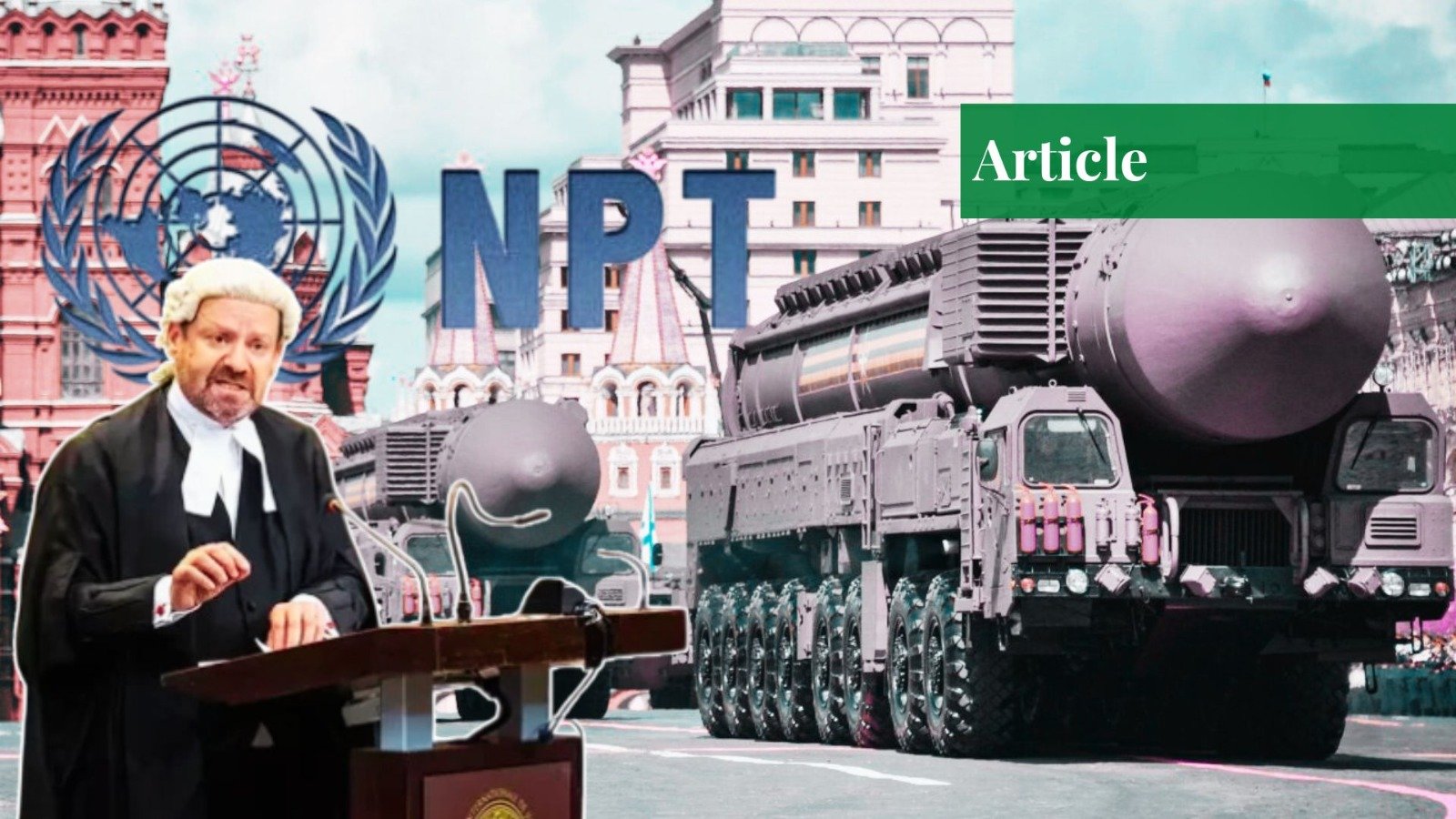
In recent years, Russia has also engaged in a similar practice by moving tactical nuclear weapons into Belarus, which is described by Moscow as strengthening deterrence. However, to many observers, it mirrors the image of NATO’s own nuclear sharing, another case where weapons are stationed in a host state that does not officially own them. The fact that both NATO and Russia use such arrangements shows that this practice is not an anomaly but an accepted (if legally contested) as part of global nuclear politics.
This raises an important question for the hypothetical posed earlier: if State A keeps complete control of its nuclear arsenal but agrees to use it at the request of State B, does that count as nuclear sharing? The legal texts do not provide a clear answer to it. Some would argue that even the promise of using nuclear weapons on behalf of another state amounts to sharing, since it implicates the non-nuclear state in nuclear strategy. Others would say it falls closer to the logic of the nuclear umbrella, where protection is promised but no physical transfer occurs. Either way, the ambiguity highlights how nuclear practice often stretches legal categories in ways the drafters of past treaties never fully anticipated.
The Nuclear Umbrella Dilemma
A nuclear umbrella is essentially a promise where one state with nuclear weapons pledges to defend another state without them. The weapons are not transferred or stationed in the ally’s territory, but the protection of deterrence is extended across borders. This is the arrangement the United States has offered to its NATO partners, as well as to allies like Japan and South Korea, who rely on Washington’s nuclear arsenal without ever owning a bomb themselves.
At first glance, this might look simpler and cleaner than nuclear sharing, but the line quickly blurs. If the ally is deeply involved in planning, strategy, or joint exercises, the distinction between being protected and participating becomes less obvious. Some analysts argue that even requesting or expecting a nuclear strike on one’s behalf pulls a state closer to the logic of sharing, since it implicates them in nuclear use without ever transferring custody. In the hypothetical scenario of States A and B, this tension is evident, as State B does not technically possess the weapons. Still, its dependence on them is so direct that it challenges the spirit of the non-proliferation bargain.
This reliance creates a deep contradiction. Many umbrella states publicly commit to the goals of nuclear disarmament and the legal obligations of the NPT, yet at the same time depend on the nuclear protection of their allies. As Paul Meyer notes, these countries are facing more pressure to give up relying on nuclear weapons for protection and to realize that depending on nuclear deterrence might actually be riskier than safe. But letting go of this shield also raises obvious fears of vulnerability, creating a dilemma between security through deterrence and legitimacy through disarmament. This is what makes the nuclear umbrella such a contested concept, and it is precisely what the State A–State B thought experiment forces us to confront.
The NPT Framework: What It Allows and What It Doesn’t?
The Non-Proliferation Treaty (NPT) is often described as the foundation of global nuclear order, standing on its three basic pillars, which are the agreement of non-nuclear states to never acquire weapons, the commitment of nuclear states to gradual disarmament, and the cooperation of all parties in the peaceful use of nuclear energy (UNODA). Theoretically, this arrangement was meant to prevent the spread of nuclear weapons while slowly winding down existing arsenals.
However, when it comes to practices like nuclear sharing, the treaty shows some grey areas. Article I of the NPT prohibits nuclear-armed states from transferring weapons or control to others, and Article II bars non-nuclear states from receiving them. Yet NATO has long argued that its nuclear sharing arrangements do not breach the treaty, as they remain under US control in peacetime, but at the time of war, the NPT might no longer apply. But critics view this as a loophole, as even if the law isn’t technically broken, planning and training for a transfer go against the treaty’s main goal of preventing such transfers.
In 2017, a majority of UN member states adopted the Treaty on the Prohibition of Nuclear Weapons (TPNW). It stemmed from the humanitarian initiative aimed at a legal ban on nuclear weapons altogether, prohibiting not just acquisition or transfer but also banning use, threat of use, testing, stationing, hosting, and even assistance with nuclear weapons. Nuclear-armed states and their allies did not join this treaty and argued that deterrence remains essential in today’s security environment and that the ban undermines the NPT by creating parallel obligations without nuclear state participation.
Critics of the ban warned that this division could weaken the fragile consensus at NPT Review Conferences, where unity is already difficult to maintain. This has resulted in an increased schism where the ban treaty represents the frustration of non-nuclear states who see the NPT as frozen, while nuclear states and their allies cling to deterrence as a necessary evil.
Now returning to the thought experiment of State A and State B, the legal uncertainty becomes harder to ignore. On paper, the NPT would forbid any transfer of nuclear weapons or control, but NATO’s decades-long practice shows how such rules can be bent in practice. From the perspective of the TPNW, the arrangement would be flatly illegal, yet neither State A nor State B is bound by it (when they are not signatories to it). What remains is a political reality that security guarantees outweigh treaty language, and the fine line between nuclear sharing and the nuclear umbrella blurs whenever allies begin to rely on each other’s nuclear firepower.
If you want to submit your articles and/or research papers, please visit the Submissions page.
To stay updated with the latest jobs, CSS news, internships, scholarships, and current affairs articles, join our Community Forum!
The views and opinions expressed in this article/paper are the author’s own and do not necessarily reflect the editorial position of Paradigm Shift.

Ayesha Youssuf Abbasi is a lawyer, legal researcher, and doctoral scholar currently pursuing a fully funded Ph.D. in international law under the Chinese Government Scholarship (CSC) at Zhongnan University of Economics and Law, China. Originally from Islamabad and enrolled with the Islamabad Bar Council, she has taught law at Bahria University Islamabad, the International Islamic University Islamabad, and the Rawalpindi Law College. Her research spans artificial intelligence and law, international humanitarian law (IHL), public international law, and the rights of women and children. Bringing a multidisciplinary lens to these fields, she contributes to contemporary debates on global governance, legal reform, and social justice.