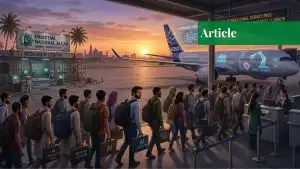
Let’s take a moment to imagine a Pakistan where factories operate with zero waste, farms produce record crops, and government services are delivered efficiently with minimal paperwork. Suppose small businesses could thrive globally using AI-powered marketing and analytics tools? What if a doctor in Pakistan could detect cancer at its earliest stage in seconds? What if farmers in Pakistan could predict crop yields months in advance?
Now, come to reality, because this is exactly what the National AI Policy 2025 is planned to achieve. From healthcare to agriculture, from education to enterprise, this “milestone in Pakistan’s digital transformation” policy is designed to build a resourceful, faster-growing future.
So, what is this AI policy trying to do, and how does it affect our lives? Let’s familiarize ourselves with some background to make it easy to understand.
Why AI, Why Now?
The AI revolution has already been activated, and Pakistan has stepped onto the global stage. AI has revolutionized the industries, economies, cultures, and healthcare setup globally. Countries are rushing to utilize their potential for healthcare, education, governance, and business.
The growing IT workforce and thriving freelance sector have long been users of AI technologies in Pakistan. In this context, supporting people, promoting new ideas, and ensuring the fair and ethical usage of AI are the core of this policy.
On July 30, 2025, under the leadership of Prime Minister Shehbaz Sharif, the federal cabinet approved the National AI Policy 2025. The policy is explicitly designed to democratize access to AI, enhance social services and innovation and employment opportunities, especially for Pakistan’s young workforce.
As the Prime Minister said, “Our youth are the greatest asset of Pakistan,” and equipping them with AI skills is a national concern.
Under the policy framework, an AI Innovation Fund will be initiated to encourage new ventures and businesses by the private sector in the fields of education, research, healthcare, and industrial enterprises. Until 2028, 3,000 AI scholarships will be provided every year.
National AI Policy 2025 – Core Strategic Goals
1. AI Awareness & Readiness
This national artificial intelligence policy aims to generate AI awareness programs, incorporate AI concepts from early phases of STEM education, and similarly aim to upskill both youth and working professionals through mass training initiatives about the successful adoption of AI, as it starts with public understanding and readiness. This effort guarantees that the public is aware of AI and truly ready to use AI responsibly.
2. Data Standardization & Accessibility
A robust AI environment based on access to clean, consistent data. To resolve this issue, the policy empowers the development of national data repositories and uniform data formats across public organizations. The researchers and innovators will be able to experiment and develop AI-based solutions by means of real-world data with the establishment of sandbox environments and computational data lakes.
3. Computational Infrastructure, Research & Development Enablement
High-performance computing requires powerful AI systems. So, this policy requests investment in a mutual computer setup, including AI-integrated cloud platforms and computing groups accessible to academia, industry, and startups.
It also offers public and private collaboration to inaugurate Centers of Excellence in AI for developing, testing, and scaling local AI solutions, especially in sectors of national relevance.
4. Ethical AI Use and Governance
The foundational pillar of the National AI Policy 2025 is the ethical use of AI. The draft advises the formation of an AI governing executive to administer the principles for data protection, algorithmic equality, and responsibility. In this regard, transparency and human oversight are essential to prevent misuse, bias, and intolerant outcomes in AI placement across sectors.
5. Sectoral Transformation and Inclusive Development
AI integration is not just limited to tech centers; however, it’s intended to alter entire domains such as healthcare, education, agriculture, energy, governance, and climate resilience. The policy shapes targeted roadmaps that aim to democratize AI assistance from remote diagnostics to smooth crop management. It gives equal AI opportunities for women, people with disabilities, and marginalized communities.
6. Innovation Ecosystem and Global Partnerships
To foster advancement, the policy targets to form an exciting network with an AI Innovation Fund, risk capital collaboration, and evolution support. It also underlines global associations like joining international meetings, embracing interoperable criteria, and incoming partnerships for joint research and investment. With this pillar, Pakistan will not only be recognized as a user of AI but also as an energetic global collaborator.
Sectoral Impacts from the National AI Policy 2025
1. Healthcare
With the help of AI, doctors will not just improve patient outcomes nationwide but also be able to detect diseases earlier with greater accuracy than ever before. AI will connect the rural population to access high-quality care & treatment through telemedicine, reducing travel costs and wait times. National health dashboards will be developed to monitor patient outcomes, but also help in better resource planning and outbreak prevention.
2. Education
Personalized AI learning platforms will design lessons based on each student’s needs. Creating education more appealing and effective. AI tools will help teachers track progress and close learning gaps. This initiative will help bridge the quality divide between urban and rural area schools.
3. Agriculture
The farmers can monitor the soil health, detect diseases in crops, and optimization of irrigation schedules can be possible with AI-powered tools. These intuitions will increase harvests while reducing waste. In the long run, AI in agriculture will enrich food security and productivity for farmers.
4. Manufacturing Industry
Smart mechanization will improve production effectiveness and ease downtime in factories. Predictive preservation powered by AI will help avoid costly breakdowns. This revolution will make Pakistani productions more economical globally.
5. Financial Services and Security
AI-driven fraud detection will make digital payments secure. AI-generated customer service tools and data-driven offering decisions will develop access to financial services, particularly for small businesses and underserved people.
6. Governance and Public Services Delivery
Artificial intelligence will help government officials in data-driven, effective decision-making. Predictive analytics and AI chatbots will make civil services efficient and transparent, making it easy for the Government to be more available and responsive to citizens.
7. Economic Growth
The national AI policy focuses on creating thousands of advanced jobs through nurturing skilled AI personnel and supporting startups. AI-driven products and facilities will also increase trade and open the door for foreign investment.
8. Climate Change
AI models will improve the prediction of floods, droughts, and heatwaves, assisting in responding to disasters more quickly. These AI-powered tools will nourish the ability to deal with climate change challenges.
9. Global Competitiveness
Eventually, with this National AI policy 2025, Pakistan will become a regional AI Hub, competing with other neighboring nations in technology exports, innovation, and research leadership.
Between 2025 and 2030, the plan is to train people, build the necessary AI tools, and improve AI products and services. From 2030 to 2035, the goal is to grow more and become the top AI country in South Asia.
Conclusion – The Future Is Ours to Shape
The National AI Policy 2025 is a crucial step for Pakistan to become an expert in the domain of technology and innovation. It mainly focuses on enhancing tech skills among youths, building up research opportunities, and using AI to make services better and the economy stronger. By supporting tech education, protecting data, and fostering ethical use of AI, the policy aims to get Pakistan ready for a successful digital future for everyone.
The big question is: Will people find it easy to start using AI or catch up later?
If you want to submit your articles and/or research papers, please visit the Submissions page.
To stay updated with the latest jobs, CSS news, internships, scholarships, and current affairs articles, join our Community Forum!
The views and opinions expressed in this article/paper are the author’s own and do not necessarily reflect the editorial position of Paradigm Shift.

Hooria Akbar is an independent researcher and content writer with a strong interest in contemporary issues across AI, technology, society, and emerging trends. She writes research-informed articles, thought pieces, and blogs on a wide range of topics, aiming to present complex ideas clearly and engagingly for diverse audiences.