
Historical Background of Pak-Afghan Tensions
The root cause of Pak-Afghan tension is the creation of the Durand Line in 1893 by the British government. Afghanistan’s Amir Abdur Rehman Khan signed the Durand Line Agreement, represented by Sir Henry Mortimer Durand. After the independence of Pakistan in 1947, Afghanistan refused to recognize its international border, as it believed that due to this border, many Pashtun tribal areas were divided between Pakistan and Afghanistan. Also, Afghanistan was the only country to vote against Pakistan becoming a member of the United Nations.
During 1948-1954, the Waziristan rebellion started when Afghanistan provoked Waziristan’s people against Pakistan under the umbrella of Greater Pashtunistan. In September 1960-1961, during the rule of Mohammad Daoud Khan in Afghanistan, a direct military confrontation happened between the two states, known as the Bajaur Campaign. During this, many Afghan protestors attacked the Pakistani embassy in Kabul. Despite all this, Pakistan tried to maintain brotherly relations with Afghanistan.
During the 1979 Soviet Invasion of Afghanistan, Pakistan, with the US, supported Afghanistan and welcomed millions of refugees into Pakistan wholeheartedly. Despite this great hosting by Pakistan, the first Taliban government, 1996-2001, under the leadership of Ahmed Shah Masoud, Pakistan witnessed many clashes and hostilities from the Afghan government.
To eliminate threats from many terrorist groups, including Tehrik-e-Taliban and its factions, Pakistan allied with the US. The post-9/11 period saw great development in Pak-US relations as Pakistan provided military support to the US against Al-Qaeda and TTP. In 2021, with the Taliban’s 2.0 government, Pakistan saw hope that this new government would support Pakistan in eliminating TTP, but clashes between the two states rose, and their bilateral relations deteriorated.
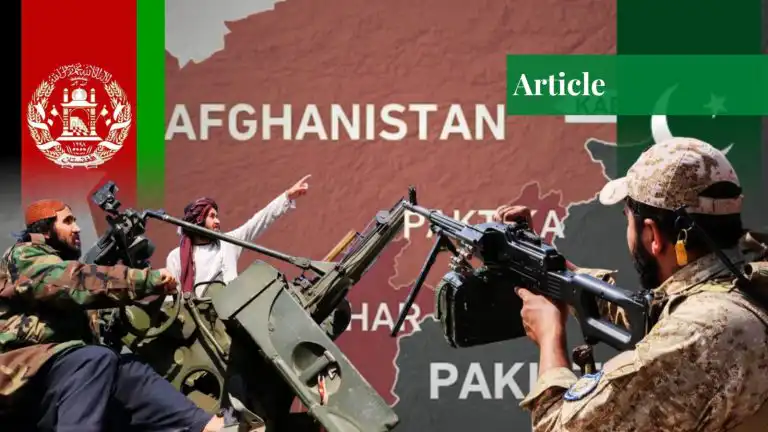
In October 2025, the Pakistan-Afghan military confronted directly at the Durand Line. Qatar immediately mediated the confrontation. Months after this mediation, the two states are again involved in a clash. On 16th February 2026, Afghanistan attacked Bajaur. TTP claimed responsibility for this attack. In retaliation, on 22nd February, Pakistan targeted militant infrastructure across the border. On 26th February, cross-border clashes were reported in multiple areas. This led to the commencement of a full-fledged military operation by Pakistani forces, known as Operation Ghazab Lil Haq.
“Afghanistan is more than the ‘graveyard of empires.’ It’s the mother of vicious circles.”
Maureen Dowd
Operation Ghazab Lil Haq
On the night of 26th February 2026, Pakistan launched a counter-terror operation named Operation Ghazab Lil Haq (wrath for the truth) against Afghanistan. During the operation, the major Afghan provinces were targeted. Many soldiers died on both sides. Khwaja Asif said, “Our patience has now run out. Now it is an open war between us.” Pakistan’s response combines aerial strikes, drone surveillance, and ground artillery.
“One should attack when the enemy’s army is weak.”
Chanakya Kautilya in his book Arthashatra
While the Taliban are using IEDs and mobile guerrillas, they are aligning with Sun Tzu’s principles of using terrain and deception to offset a stronger opponent. In this operation, Pakistan has an upper hand due to its clear command structure and standard conventional weapons, whereas the Taliban rely on asymmetric tactics and terrain.
This operation could redefine Pakistan’s role in regional security and its capacity to deter future cross-border threats. Pakistan has a long history of counterterror operations, such as Operation Zarb-e-Azb in 2014 and Operation Radd-ul-Fasaad in 2017. These operations were launched to eliminate threats like Tehrik-e-Taliban Pakistan (TTP). However, Operation Ghazab Lil Haq is a shift from internal counterterror operations to cross-border operations and blurs the line between domestic and cross-border operations. Still, the Ministry of Foreign Affairs has not declared war officially against Afghanistan.
Facts and Figures of Operation Ghazab Lil Haq
In this operation, Pakistan used combat aircraft and helicopters. F-16s, JF-17s, and 260+ helicopters were utilized. Advanced Chinese air-to-surface missile systems and anti-drone guns were used, including the HQ-9, HQ-16, HQ-7, Sufra, and GIDS Spider. Along with these, cruises and guided missions were used. At ground level, armored vehicles and rocket systems were used. Whereas Afghanistan used Russian and US-based weapons, including Mi-17 and Mi-24 helicopters, C-208 and A-29 aircraft, AK-47 and M16 rifles, M249 and M240 machine guns, AT-4 anti-tank rockets, and Russian ZU-23-2.
Pakistan claims to have destroyed many checkposts in Afghanistan’s major provinces of Kabul, Kandahar, Paktia, Nangarhar, Khost, and Paktika. According to some reports, Afghanistan has destroyed 19 Pakistani army posts, yet this has not been confirmed by Pakistani officials. During this confrontation, approximately 435 Afghan fighters have been killed, and more than 600 are wounded. While on the other side, 12 Pakistani soldiers are martyred, 27 wounded, and 1 soldier is missing till now.
When Trump was asked about Pakistan’s strikes against the Afghan Taliban, he said, “Well, I would, but I get along with Pakistan, as you know, very well. Very, very well.” He further added, “They have a great prime minister, a great general there, a great leader, and two of the people I really respect a lot, and I think that Pakistan is doing terrifically well,” referring to Prime Minister Shehbaz Sharif and Chief of the Army Staff Field Marshal General Asim Munir.
Far-fetched claims have been made by the Afghan government that “if Pakistan continues the war, the forces of the Islamic Emirate have the capacity to take decisive action in response.” Prime Minister Shehbaz Sharif and Field Marshal Asim Munir both said that “they will not tolerate cooperation between the Afghan Taliban and groups like the TTP.”
Regional Power Alignments
Indian Prime Minister Narendra Modi and Israeli Prime Minister Benjamin Netanyahu met in Jerusalem between 25th and 26th February 2026. The meeting focused on defense cooperation, technology, and strategic partnership. As per the Indian PM, India and Israel will also focus on economic integration. This growing India-Israel defense alliance has shaped Pakistan’s security perception. MOFA responded to this partnership by saying, “It remains ‘seized’ of expanding defense partnership as it could alter South Asia’s balance of power.”
Also, India retains influence in Afghanistan, which Pakistan perceives as a channel for indirect leverage. India, due to its interest in Afghanistan, can covertly provide weapons to Kabul. It is reported that Afghanistan has gained access to modern drones such as quadcopters. However, Pakistan has ways to counter these drones, as Pakistan has anti-drone jamming guns like Sufra and its variant Safrah-IIS with an operational radius of 1.5 km. Additionally, PAF has counter-UAV technology, such as the GIDS Spider-AD, which can jam drones beyond a range of 10 km.
“A person should not wait to strike until the enemy has struck; one must be vigilant and act in time to prevent harm.”
Chanakya Kautilya
Pakistan should act proactively against the Afghan threat, but in a controlled way rather than disruptively. Pakistan’s operation is also proactive, as Pakistan targeted Afghanistan’s posts before further attacks rather than just responding. Chanakya’s advice means acting strategically to prevent harm, rather than waiting passively for the enemy to attack repeatedly.
Conclusion
Operation Ghazab Lil Haq may prove to be more than a tactical response; it could redefine Pakistan’s regional security posture. Through this clash, Pakistan has again proven its ability to counter every enemy of the state. Controlled deterrence and engagement with neutral regional actors such as Uzbekistan provide options for balancing security needs with diplomatic tactics.
In this critical situation, Pakistan should adopt the “controlled deterrence” military doctrine. It focuses on selective targeting rather than further escalations. Drones and artillery will allow Pakistan to counter threats without collateral damage. However, Pakistan’s long-term security depends on calculated responses that strengthen deterrence without provoking full interstate conflict. As per Hussainn Haqqani, escalation can undermine Pakistan’s interests.
According to Sun Tzu, “In the midst of chaos there is also an opportunity.” We can see Iran and Israel have again entered into war. The Pak-Afghan clash can be analyzed through a lens that suggests the US may have engaged Afghanistan and Pakistan in conflict so that Pakistan cannot be vocal, even through the media, in its support of Iran. Ultimately, calibrated policy choices will determine whether this clash becomes a stabilizing shift or a vicious cycle.
“He will win who knows when to fight and when not to fight.”
Sun Tzu
If you want to submit your articles and/or research papers, please visit the Submissions page.
To stay updated with the latest jobs, CSS news, internships, scholarships, and current affairs articles, join our Community Forum!
The views and opinions expressed in this article/paper are the author’s own and do not necessarily reflect the editorial position of Paradigm Shift.

Syeda Farani Fatima is an undergraduate student of International Relations at the International Islamic University of Islamabad, with a strong interest in anti-corruption, counter-terrorism and geopolitics. Strongly committed to fighting corruption, terrorism, and supporting national reform through research and public service.