
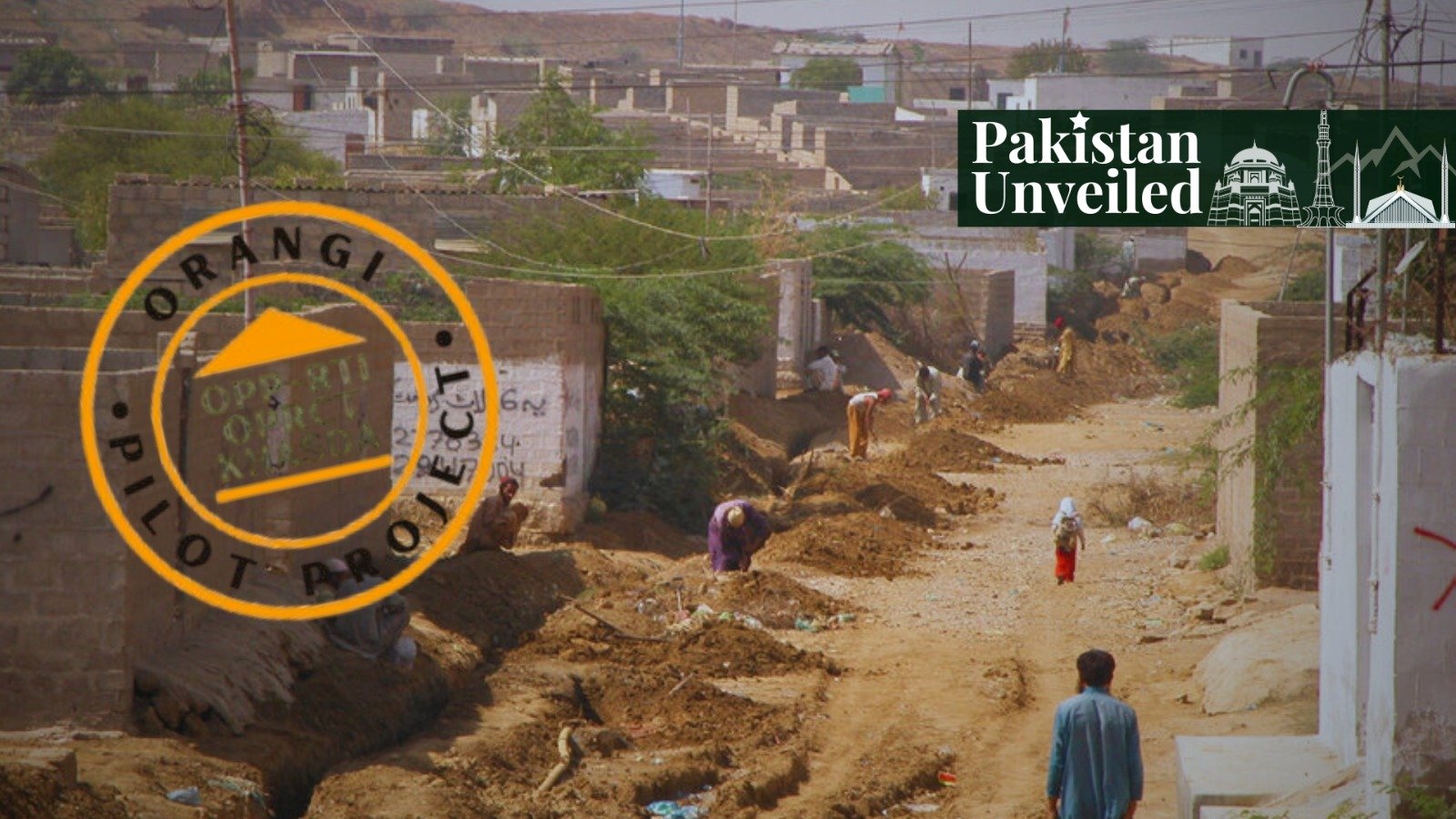

In recent years, the urban development discourse has had an increased focus on the role of citizens’ participation. Although initially development paradigms adopted top-down approaches, emerging trends encourage two-way communication methods that focus on engaging people and stakeholders in dialogue and decision-making processes.
The exemplary Orangi Pilot Project (OPP), launched in 1980 in the world’s largest informal settlement on the outskirts of Karachi, is a testament to the success of development projects utilizing genuine participation of the communities they seek to serve. In the face of Karachi’s persistent issues due to rapid unplanned urbanization, this article seeks to analyse how the OPP model can be replicated in the city’s wider urban development, ensuring citizen participation is treated as an essential step rather than simply a box-ticking exercise.
The Orangi Pilot Project
Orangi, a squatter settlement or katchi abadi in Karachi, faced a plethora of urban issues in the 1980s, mainly water supply and sanitation system related. Most households were disposing of human waste using bucket latrines and soak pits, while open sewers in lanes resulted in the spread of water-borne diseases in the neighborhood.
In 1980, Dr. Akhtar Hameed Khan moved to Karachi and began working on the improvement of sanitary conditions in Karachi’s suburbs. He laid the foundations of the Orangi Pilot Project, a first of its kind in the field of urban development. Many consider it one of the best urban development projects that adopted a participatory, bottom-up approach from the beginning. The project was designed as a self-help initiative, focusing on low-income households, made to encourage the community to find simple and affordable solutions grounded in local initiatives.
How OPP worked
The OPP was based on the ideology of community-led decision-making. Residents were involved in every step of the project, from identifying the problem to designing solutions and ensuring their effective implementation. For instance, they organized themselves into lane committees to collectively fund and build underground sewage lines. The OPP provided technical guidance and capacity building but avoided direct implementation to ensure community ownership. OPP engineers and architects would only prepare the designs and layout maps and hand these over to the lane managers, who would implement the plan. If they required any assistance, they could always approach the OPP technical staff.
Results show that the OPP was a great success and has served as a model for urban development projects across the world. Over 90% of residents in Orangi gained access to low-cost sanitation, leading to overwhelming improvements in health and reducing disease prevalence. The project reduced dependency on external aid, saving families up to 90% of the costs of conventional government-provided infrastructure. The OPP model has been replicated in 160 Karachi settlements, over 10 Pakistani cities, Central Asia, Nepal, and South Africa. It fostered a sense of community ownership and strengthened grassroots governance structures.
Gaps in Karachi’s Urban Development
Karachi can be deemed an extremely inequitable city with large housing, land, and infrastructure disparities. Almost every highly urbanized and “posh” area in Karachi is attached to a subsequent katchi abadi, from which most of the informal labor is sourced. These katchi abadis lack basic amenities like clean water, sanitation, electricity, gas, and proper infrastructure, with mostly makeshift, poorly built homes. Government bodies such as the Karachi Metropolitan Corporation (KMC) and the Sindh Building Control Authority (SBCA) are responsible for regulation and planning of the city, while companies like ACC represent the significant role of the private sector in implementing development projects.
Despite nearly two-thirds of the country’s revenue being generated in Karachi, it remains one of the most neglected cities of Pakistan. Both bad governance and administrative issues form a huge barrier to the city’s progress. Even though the OPP is an example of community involvement, most of Karachi’s urban development reflects the opposite. The exclusion of citizens from project design and policy-making and the lack of incentives to participate in a project are major reasons for development project failures. Additionally, many public projects and reforms have failed under the weight of resistance; not because the ideas were inherently flawed, but because they were implemented without addressing the needs of the citizens and the systemic barriers faced by the very people they aim to help. The absence of citizen engagement creates a cycle of resistance.
Usually, government projects tend to involve the public through hearings or surveys only after major decisions have already been undertaken. Participation is treated as simply a requirement that must be fulfilled without truly understanding its importance in the success of development projects. Moreover, the urban poor and informal settlers – who typically bear the highest cost of these projects – are usually excluded from mainstream platform spaces that are instead filled by well-known groups or NGOs. Since there are conflicting responsibilities and unclear roles, it’s often difficult for people to get involved meaningfully. Unlike a number of countries, no strong laws in Pakistan require cities and towns to follow participatory planning or budgeting.
Participatory Approach and Community Empowerment
As the government continues to fail to fulfill its responsibilities, from service provision to improving infrastructure, the people, through civil society activism, must step up to reclaim their power and ensure that their voices are heard. Good governance can only be achieved through the real and meaningful participation of the citizens. Citizen participation allows for local practices and innovative solutions to be incorporated in development projects that are appropriate to the cultural context. Furthermore, people are more likely to take ownership and have trust in the government. Participatory approaches allow for greater transparency, accountability, and also garner the support of local communities.
The participatory approach strengthens community initiatives through the provision of technical, health, and social guidance alongside credit for micro-enterprises. It encourages partnerships with the government for development based on local resources. To apply this approach in a community, there must be an analysis of unresolved problems of the area, people’s self-help initiatives using local knowledge, bottlenecks in the existing initiatives, and then finally, through a process of action research, evolving viable solutions promoting participatory action. In short, the aim is to develop a low-cost package of advice, guidance, and facilitating community organizations for self-help initiatives and partnership with the government. The community must be considered an equal partner in development.
Conclusion
Fragmented approaches and token participation need to be replaced by genuine citizen participation to drive sustainable urban development in Karachi. Lessons can be drawn from successful case studies like the Orangi Pilot Project that have been replicated internationally.
Participation allows for a pathway for marginalized communities to engage in the improvement of their communities. As development practitioners and scholars, efforts should be directed towards supporting underrepresented people and challenging the status quo. Sustainable development through community participation should ensure that both local choices and fairness are prioritized.
If you want to submit your articles and/or research papers, please visit the Submissions page.
To stay updated with the latest jobs, CSS news, internships, scholarships, and current affairs articles, join our Community Forum!
The views and opinions expressed in this article/paper are the author’s own and do not necessarily reflect the editorial position of Paradigm Shift.

Jawairiya is a final-year Development Studies student at Bahria University Karachi with a passion for social justice, inclusive development, and community empowerment.