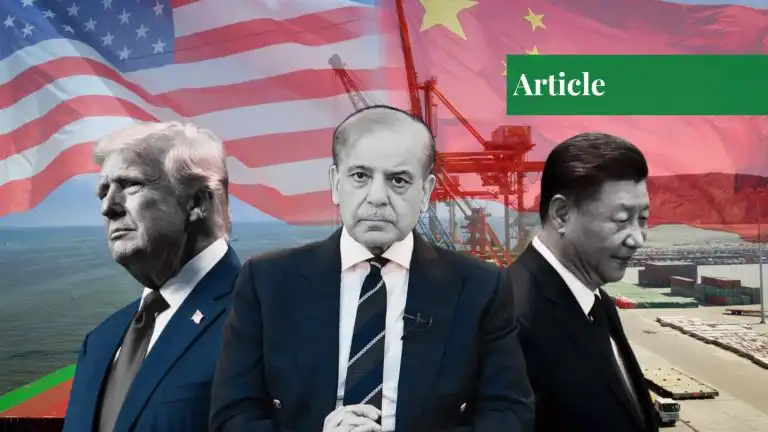


The United States and China compete against each other in their battle for global supremacy, which creates major consequences for all smaller nations, especially those located within South Asia’s strategic territories. The two largest global economies battle for dominance, which positions Pakistan between their competing interests regarding its trade and economic development. The South Asian state must navigate benefits and risks while safeguarding economic growth, strategic autonomy, and long-term development. Pakistan maintains a careful approach that enables it to gain advantages from both global powers while stopping itself from becoming too reliant on either nation.
As realist scholar John J. Mearsheimer argues, “Great-power politics is driven by competition for power and influence, and smaller states are often forced to adapt rather than choose sides.”
Pakistan’s Economic Context and Trade Challenges
Pakistan’s economy has faced persistent structural problems because of its ongoing trade deficit, its limited capacity to export different products, and its need to secure funding from outside sources. The government declared its primary export development goal through its national development strategy, Uraan Pakistan, which aims to extend agricultural and manufacturing, and mineral export activities while attracting more foreign investments. Former finance minister Miftah Ismail also discussed that Pakistan’s economic vulnerability is not merely fiscal, it is strategic. Highlighting how economic weakness limits diplomatic autonomy
Pakistan established its trade strategy because it recognized that its economic activities extended beyond economic benefits into geopolitical matters. The government of Islamabad aims to achieve maximum advantages through international relations with global powers while controlling international political pressure risks. The Pakistani government uses this term to describe its strategic hedging approach, which enables it to sustain relations with both the US and China without showing a clear preference for any particular country.
The Chinese Dimension: Opportunities and Constraints
China continues to function as Pakistan’s main trade partner while supplying most of its investment needs because the China-Pakistan Economic Corridor functions as an essential part of China’s Belt and Road Initiative. Pakistan utilizes more than ten billion dollars, which China has provided to CPEC for developing its infrastructure, energy, and transportation systems. Chinese President Xi Jinping described CPEC as “a demonstration project of the Belt and Road Initiative and a model of win-win cooperation.”
The present study shows that the increasing rivalry between the United States and China has created a challenging geopolitical environment for Pakistan, which needs to evaluate the Belt and Road Initiative as a complete system, but especially the China-Pakistan Economic Corridor (CPEC), which delivers essential infrastructure funding yet causes problems with debt repayment capacity and territory control.
The trade patterns show both the strong economic ties between the two countries and the existing difficulties between them. The trade relationship between China and Pakistan shows an imbalance because Pakistan imports more from China than it exports to China, which creates a situation that forces Pakistan to depend on Chinese products while its export opportunities remain restricted.
A Pakistani trade analyst also discusses that the problem with China requires us to decrease our dependence on them while we increase our exports of high-value products. Pakistan needs to develop its export industry beyond basic goods because this will help it establish better trade relationships with other countries.
The American Track: Trade Deals, Tariffs, and New Opportunities
The United States and Pakistan maintain a security partnership that focuses mainly on counter-terrorism efforts, yet their economic relationship remains limited. The two nations have established a new trade agreement that will increase their economic activities through improved trade and investment operations.
The two nations signed a major trade deal in June 2025, which established tariff reduction standards and energy development partnership terms between Islamabad and Washington. The agreement establishes mutual tariff decreases, which will allow Pakistani textiles and leather products and surgical instruments to reach more U.S. markets, and both nations will work together to study Pakistan’s previously underused oil reserves.
Former U.S. President Donald Trump heralded the agreement as a push toward deeper economic ties, while Pakistan’s Prime Minister Shehbaz Sharif described it as a “historic trade partnership” that could unlock new avenues for bilateral cooperation.
The United States and Pakistan used their general trade agreement to create a new investment partnership that focuses on Pakistan’s critical mineral mining operations. In 2025, the country exported its first consignment of refined rare earth minerals to the United States through a $500 million strategic partnership, which both nations established to connect Pakistan’s resource assets with American supply networks.
The strategy requires determined efforts to address existing trade imbalances. Pakistan needed to prevent the US from imposing 29% tariffs on its exports, which existed because Pakistan had a trade surplus. Pakistan used this trade imbalance to improve its economic relationship with the United States by increasing its import levels and creating investment opportunities.
Strategic Balancing and Hedging
Pakistan maintains its diplomatic relationship with China by using balancing and hedging methods, which stop the country from developing into a complete alliance with China. The research indicates that Pakistan uses diplomatic efforts that focus on specific issues to establish partnerships with both countries while using China’s economic strength to maintain some trade and security ties with the US.
A scholar argues that Pakistan’s foreign policy strategy shows that the country needs to establish strategic partnerships with multiple countries that go beyond traditional alliance systems because of the modern multipolar world order.
The hedging strategy contains two main components:
- CPEC development will create economic benefits through increased Chinese investment and infrastructure development, improved access to markets, and enhanced connectivity.
- The US and Pakistan will strengthen their diplomatic ties through three main methods, which include reducing tariffs, establishing resource development agreements, and conducting comprehensive bilateral negotiations.
Pakistan seeks to establish diplomatic ties with Russia and the Gulf states while joining international organizations like the Shanghai Cooperation Organization (SCO) to develop its foreign relations.
Risks and Constraints
The trade strategy of Pakistan faces multiple challenges that continue to exist because of its operational design.
a. Economic Dependency Risks
The combination of rising Chinese investment and infrastructure development creates dual challenges that prevent Pakistan from achieving its economic independence because it needs to handle its debt obligations. Critics argue that Pakistan will lose its ability to develop new economic relationships because of its dependency on CPEC.
b. Security and Political Pressures
The Washington-Beijing geopolitical rivalry creates challenges for Pakistan because foreign powers have strategic needs that conflict with the country’s domestic objectives. For example, Pakistan might need to take public positions about the South China Sea and Taiwan issues, which could damage its relationship with one of the two involved parties.
c. Structural Trade Imbalances
Pakistan sustains its trade deficit, together with foreign exchange difficulties, because it fails to increase its export of high-value products to major markets, including China and the United States.
Conclusion
Pakistan uses its trade strategy for United States-China relations to implement its diplomatic and economic strategies, which require correct decision-making. Islamabad maintains its strategic independence while it seeks to obtain economic advantages from both Washington and Beijing without selecting between the two superpowers. The current geopolitical situation works through its two separate Soviet Union to China relationship expansion and its United States trade and resource development renewal. According to one analysis, Pakistan uses balancing and hedging strategies to maintain flexible operations during worldwide power fluctuations while it works to achieve its national objectives.
Pakistan needs to solve its fundamental economic problems while creating new export markets and strengthening its local production abilities to achieve sustainable export-based economic expansion. The success of this strategy will ultimately depend on Islamabad’s ability to navigate great-power competition without undermining its own economic sovereignty and long-term development goals. As it is also said, Pakistan’s future lies not in choosing sides but in choosing interests.
If you want to submit your articles and/or research papers, please visit the Submissions page.
To stay updated with the latest jobs, CSS news, internships, scholarships, and current affairs articles, join our Community Forum!
The views and opinions expressed in this article/paper are the author’s own and do not necessarily reflect the editorial position of Paradigm Shift.