
Islamabad, December 15: Pakistan’s energy transition demands coordinated planning, improved forecasting, investment in grid readiness, and targeted climate finance. Without addressing structural barriers such as capacity payments and outdated tariff frameworks, the country will struggle to translate its renewable momentum into a sustainable and resilient energy system.
Experts emphasized this at a high-level roundtable while noting that sustainable progress will depend on coherent policy direction, utility-scale renewable integration, stronger distribution networks, and climate finance mechanisms that support both mitigation and adaptation priorities.

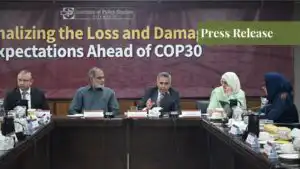
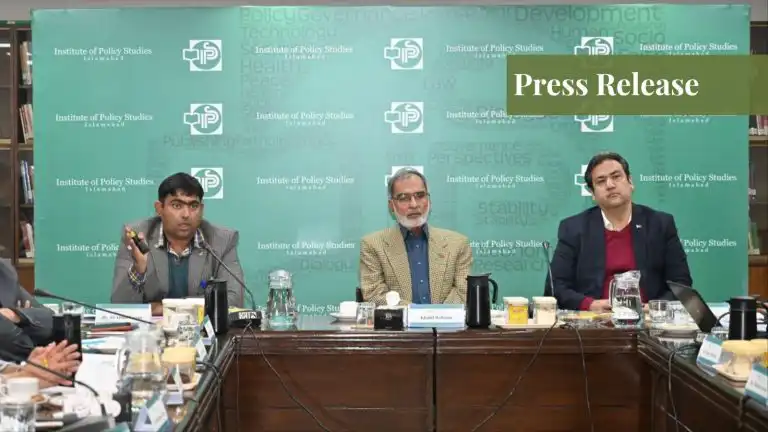
They were speaking at a forum titled “Pakistan’s Energy Transition: Current Standing, Challenges and the Road Ahead” held at the Institute of Policy Studies (IPS), Islamabad. The session brought together leading voices from government, climate finance, academia, distribution companies, and the renewable energy sector.
Key speakers included Dr. Sardar Mohazzam, former Managing Director of the National Energy Efficiency and Conservation Authority (NEECA); Mekaeel Malik, CEO of Climate Finance Pakistan; Faisal Sharif, Director of Environment and Sustainability at the Private Power and Infrastructure Board (PPIB); and Dr. Syed Ali Abbas Kazmi, Head of the Electrical Engineering Department at National University of Sciences and Technology (NUST). They were joined by Khalid Rahman, Chairman of the Institute of Policy Studies (IPS).
The discussion segment featured a panel of experts, including Hasnat Khan, Vice Chairman of the Pakistan Solar Association (PSA); Arqam Ilyas, Manager of Planning and Forecasting at the Lahore Electric Supply Company (LESCO); Tanvir Ahmed, Energy Officer and Country Focal Person at the United Nations High Commissioner for Refugees (UNHCR); Asim Ejaz, Chief Engineer at the Islamabad Electric Supply Company (IESCO); Dr. Nadia Shahzad, Professor at USPCAS-E, NUST; Muhammad Yousif, Assistant Professor; Abdullah Qureshi, former Deputy Director (Tariffs) at the National Electric Power Regulatory Authority (NEPRA); Dr. Faisal Nadeem, Associate Professor at University of Engineering and Technology Taxila; and Mustafa Anwar, Assistant Professor at NUST.

Sardar Mohazzam highlighted that renewables, including hydropower, constitute a major portion of Pakistan’s current energy mix, but long-term sustainability remains unclear. He stressed the need to plan for hydrogen fuels, new energy vehicles, and most critically, the growing burden of capacity payments that continues to obstruct meaningful progress toward a renewable future.
Regarding the climate finance landscape of Pakistan, Mekaeel Malik noted that 69% of finance comes from international public sources and 31% is private, where over 70% of these flows support mitigation, mainly renewable energy, while adaptation remains underfunded.
Faisal Sharif outlined that the key question of energy transition in Pakistan is how to do so in a way that is economically feasible, socially equitable, and environmentally sustainable.
In this regard, Mustafa Anwar underlined the rising interest in hydrogen fuel but cautioned that costs remain high, limiting near-term uptake despite pilot initiatives.

Discussing solar adoption trends, Hasnat Khan noted that Pakistan has imported 46 GW of solar equipment, of which 35 GW has been installed, mainly behind-the-meter, with only 7-9% under net metering. He noted that the government missed a critical opportunity by not deploying utility-scale solar earlier and is making the same mistake by not adopting batteries.
Building on this point, Dr. Nadia Shahzad emphasized that DISCOs should leverage the battery market. She outlined that the story of solar uptake is both a success and a warning case. She also highlighted the importance of domestic manufacturing, especially laminations, to reduce import dependence.
From the DISCO perspective, Arqam Ilyas stated that the solar revolution and emerging EV trends are placing immediate pressure on Pakistan’s grid, which was designed passively and not for bidirectional flows. He warned that if government action remains slow, consumers may increasingly move toward batteries and become entirely off-grid.
Emphasizing this point, Muhammad Yousif argued that NEPRA’s outdated tariff structure has inflated electricity prices.
Highlighting socio-economic realities, Tanvir Ahmed stressed that energy transition narratives overlook the challenges faced by low-income households struggling with high tariffs, poor service quality, and load shedding, which push them toward solar adoption out of necessity rather than environmental intent.
Lastly, deliberating on planning challenges, Dr. Faisal Nadeem noted that Pakistan’s forecasting has remained flawed for years, making it impossible to accurately determine renewable capacity requirements or optimal deployment locations.
In his concluding remarks, Khalid Rahman acknowledged the depth of the challenges highlighted. However, he emphasized that focusing on opportunities would guide Pakistan toward a more sustainable, equitable, and resilient energy future.
If you want to submit your articles and/or research papers, please visit the Submissions page.
To stay updated with the latest jobs, CSS news, internships, scholarships, and current affairs articles, join our Community Forum!
The views and opinions expressed in this article/paper are the author’s own and do not necessarily reflect the editorial position of Paradigm Shift.

The Institute of Policy Studies (IPS) is an autonomous, not-for-profit civil society organization dedicated to promoting policy-oriented research, dialogue, and human & technological development for better governance. IPS provides a forum for informed discussion and dialogue on national and international issues. The contributions spanning over forty-three years and the overall impact signifies the importance of pragmatic research on policy issues. The institute highlights the role of think tanks in modern democratic polities.