

Introduction
It is common to see Pakistan’s projected position as the fifth-largest country in the world (in terms of population growth) used as a dead-stop marker of its global demographic stature. But the measurement of population size in policy terms is actually a measurement of state capacity. How does demographic scale turn into economic output, social stability, and sustainable growth? And at what point can we start to talk about the demographic dividend?
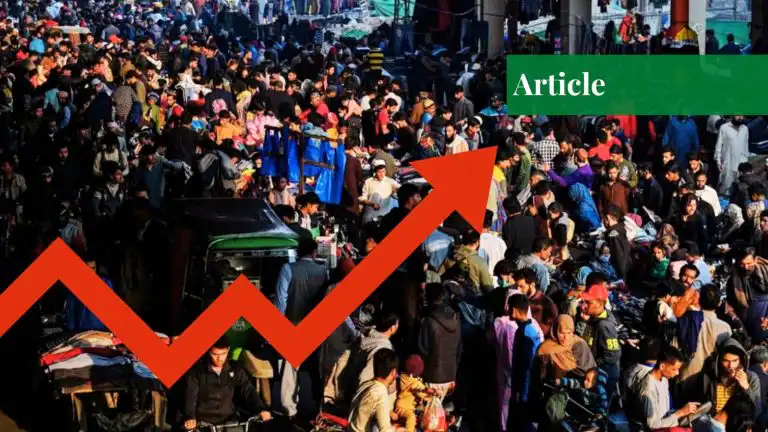
One simple fact remains: population growth has outstripped the capacity for the economy to grow, institutions to adapt, and people to benefit in an equitable manner. For reference, on the scale of magnitude, a nation of 23 million in 1950 has grown to 234 million today. When comparing scale for scale against other developing economies to understand needs, also take into account the magnitude of per capita income, human development indicators, and urban infrastructure. Taking the latter points into consideration, population growth in Pakistan from the 1950s to 2022 has transformed an opt-in “neutral” demographic kin into a structural policy challenge.

Find more statistics at Statista
Demographic Transitions and Economic Outcomes
The term “demographic dividend” may have been coined in relation to the last quarter of the 20th century in Pakistan, but it is hegemonic within the policy landscape and in academics over a much shorter period. In essence, the demographic dividend postulates that, depending on the policy environment, the broad demographic profile of a country can result in faster rates of economic growth when there is a sufficiently expanding working-age population being supported by either investment into human capital or through employment generation. There is also an awareness that substantial demographic dividends are episodic phenomena and may be of very short duration, solely dependent on policy influence rather than chance or synchronicity.
The question, therefore, remains whether sustainable improvements that enable the realization of this hypothetical theoretical reduction in reproductive age per country have been achieved in Pakistan. School enrollment and access have increased in Pakistan through more children having the opportunity to go to school. But the quality of this school enrollment has failed to result in the ability of these children to “learn.” Furthermore, large numbers of children entering the workforce are not being absorbed into the economy.
Urban Expansion and Institutional Deficits
Urbanization has increased rapidly. It is one of the best examples of the effects of demographic pressure. Countries like Pakistan have seen their cities grow as their populations have grown. However, a great deficit exists in housing, transportation, water, and sanitation, leading to declining urban productivity and to environmental stress.
Research from the Asian Development Bank indicates that Pakistan’s urban challenge is not just demographic but institutional. Cities have little fiscal autonomy and the least planning capacity of any urban centers, even though they are home to as many people as a medium-sized country. Without serious devolution and metropolitan governance reform, Pakistan’s urban population growth worsens the situation at a time when agglomeration effects should be helping.
Population Dynamics and Gender Inequality
Population outcomes in Pakistan are closely linked to gender imbalances in education, health, and labor market participation. High levels of fertility are strongly correlated with the lack of access to reproductive health care, early marriage for girls, and the very low participation of women in the labor market. These factors, linked to female reproductive health and sexuality, are not just factors delaying demographic transition; they also restrict long-run economic growth.
Fertility decline, supported by investments in girls’ education and demand-led incentives for child spacing, has consistently been shown to be more effective in reducing fertility than coercive population programs. But in Pakistan, progress on fostering such investments has been inconsistent.
The Persistent Policy Disconnect
Although it is mentioned again and again in planning papers, population counts are very weak in the decision-making of Pakistan on economic and financial matters. Population is treated as a background variable rather than a core determinant shaping fiscal priorities, service delivery, and institutional design.
This discourages strategic investment in health, education, and labor productivity, while population growth continues to intensify pressure on governance arrangements and fiscal systems.
Reframing Population as a Core Policy Variable
The question for Pakistan is not, “Is the population too big?” but instead, “Does the state have the institutional arrangements to deliver effective governance at scale?” International experience suggests that population considerations must be treated as core policy inputs rather than standalone social interventions.
Rights-based family planning, education aligned to labor market demand, urban governance reform, and enhanced women’s participation in economic life are not population-control tools; they are prerequisites for sustainable demographic transition.
Closing Thoughts
The shape of demography in Pakistan has no predetermined future. Constraints and opportunities coexist, and policy choice determines outcomes. The greatest risk lies not in population size itself but in delayed policy realignment. Population dynamics must be embedded into economic planning, governance reform, and development strategy. Failure will deepen institutional fragility; success can convert demographic scale into long-term economic and social resilience.
If you want to submit your articles and/or research papers, please visit the Submissions page.
To stay updated with the latest jobs, CSS news, internships, scholarships, and current affairs articles, join our Community Forum!
The views and opinions expressed in this article/paper are the author’s own and do not necessarily reflect the editorial position of Paradigm Shift.

Mehwish Arshad is an MPhil scholar of government and public policy at the National Defence University, Islamabad. Her academic interests center on public policy reform in Pakistan, with particular attention to governance structures, institutional capacity, and policy implementation. Her work engages critically with the political and administrative conditions that shape reform outcomes in the Pakistani context.