
Introduction
“In one of our culture circles in Chile, the group was discussing (based on codifications) the anthropological concept of culture. In the midst of the discussion, a peasant who, by banking standards, was completely ignorant said, “Now I see that without man there is no world.” When the educator responded, “Let’s say, for the sake of argument, that all the men on earth were to die, but the earth remained, together with trees, birds, and animals. Rivers, seas, the stars… wouldn’t all this be a world?” “Oh no,” the peasant replied emphatically, “There would be no one to say, ‘This is a world’” (Freire, 1970).
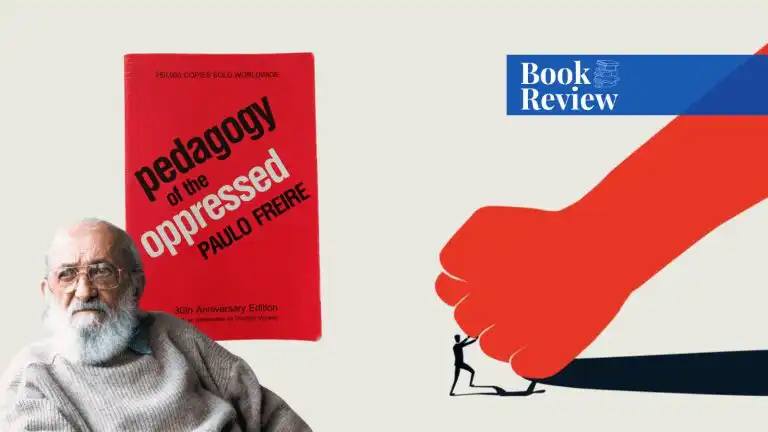
If one excerpt from the Pedagogy of the Oppressed were to encapsulate the whole idea of this book, my immediate choice would be this dialogue. And this selection highlights two understandings. How a peasant, who is conceived as illiterate by the dominant pedagogical structure and deprived of their agency to participate in the discursive spheres, can feel at home in an alternative one. Secondly, this implies the dependence of the world’s existence on the presence of humans.
This affirms that human beings and the world exist, in conjunction, as subjects and objects. Accordingly, it is men who name the world, and with the capacity of naming comes the capacity of transforming it.
But the dominant social structure has, per Paulo Freire, been imposed onto humans, the notion that the world is a static, immobile reality, and that humans have to adjust to this “space” rather than transforming the space to make it more humane. This dominant social structure is corroborated by the banking model of education, which deprives the learner of their agency to think critically and pushes them to view the world one-dimensionally, rather than as a scope that, upon adjustments, can offer a better view than the existing one. From the emphasis added on pedagogy, one must not infer that the book is a monocausal explanation of oppression, but takes into account multiple causes and links them to pedagogy.
Synopsis
Humanization has been historically, from an axiological point of view, humankind’s inescapable concern. This pursuit makes ontologically possible dehumanization. But with both of them as historical possibilities, only the former remains to be humankind’s vocation, a vocation consistently snubbed by the latter. But the more the former is negated by the latter, the stronger the affirmation for the former becomes. The harsher dehumanization becomes, the more there is a proportional increase in demand for a saner world to dwell in. It is as if we are conducting a controlled experiment; the distortion of an independent variable (dehumanization) affects the dependent one (humanization).
From the presence of dehumanization flows the thought that there would be oppressors who would distort the historical vocation and the oppressed who would fall victim to the exploitative structure. In this context, the oppressor, to avoid uprisings, erects structures that veil the underlying exploitative mechanism. These structures are implicit and packaged benignly. This includes but is not limited to “softening of power” or paternalistic treatment of the subservient. But this paternalistic treatment doesn’t necessarily mean that the oppressor, by “easing” himself, has achieved humanization. Rather, it maintains the existing exploitative structure.
Have you ever observed in your locality an individual who would criticize bureaucracy for its exploitative nature in post-colonial countries and yet strive to be a part of it? This is a recurrent phenomenon. An oppressed person criticizing a structure of exploitation and yet striving to become a part of it. Freire calls this condition duality. When in duality, one “houses” both the oppressed and oppressor inside. In other words, the oppressed is “submerged” in reality. Thus, the oppressed is conditioned in a manner that he seeks to evade the oppression and turn harshly towards his own “comrades.”
The conditioning of the oppressed affirms that there is something inherently problematic within their pedagogical ecosystem. Here, the discussion boils down to education. There could be varying interpretations of why the book has been titled with the word “pedagogy” and not “curriculum” or some other word. A relatively suitable explanation would be that pedagogy literally means “to lead a child.” In this context, the pedagogy of the oppressor, with its potential to impose definitions of social realities on a nascent mind, “prescribes” upon the oppressed his definitions of social realities. These definitions include, but are not limited to, looking at the world as a static and unchanging reality, the myth of individual efforts and education as neutral, etc. This pedagogy “leads an oppressed” to accept external definitions of reality rather than generating their own.
This sort of definition echoes in our world. Which leads us to a question about its origins. If human beings are, per John Locke, a “tabula rasa” (clean slate) that can be molded into diverse fashions in a given contextual setting, how can the world (constituted of humans) be a static, unchanging reality? The Pedagogy of the Oppressed here takes a radical posture and suspects the education system.
Freire critiques what he calls the “Banking Model of Education,” the existing pedagogical structure, on various counts. In this system, the teacher is conceived as an all-knowing authority and the student as an empty vessel to be filled with information. The teacher decides the program content, and the students adapt to it. The teacher chooses and enforces his choice; the students comply.
In the banking model, the students are viewed, unsurprisingly, as manageable beings. The more they store the deposits entrusted to them, the less they develop their critical consciousness, which would result from their critical intervention in the world as transformers of that world. Hence, the interest of the dominant (oppressor) lies in “changing the consciousness of the oppressed, not the situation that oppresses them,” and the oppressed embody the “static-reality principle,” unconsciously.
But there lies a silver lining. From humanization as vocation, the presence of oppressors and the deliberate design of pedagogy that maintain the classes stem from the possibility of transforming the social reality. Pedagogy of the Oppressed relies on an interesting comparison between animals and human beings to offer a hope of transformation and subsequently, offer an alternative model of education, the problem-posing model. Per Freire, animals are ahistorical creatures, separate from the clutches of past, present, and future. The world to them is an object that fulfills their immediate needs and owes them nothing more. Thus, the world exists in dialectical relation with them and is certainly static.
But humans, contrarily, have the agency to act upon the world, given their agency to name it, and by the affirmation of humanization by dehumanization. Moreover, humankind has, through action upon the world, created the realms of culture and history. It is the virtue of humankind to three-dimensionalize time into present, past, and future. It is through transforming action that humans produce not only material goods but also social institutions, ideas, concepts, and certainly, historical epochs.
An epoch is characterized by a complex of ideas, concepts, hopes, and challenges whose concrete representation constitutes the themes of that epoch, striving towards its plenitude. Now, in the thematic universe of an epoch, people take contradictory positions. Some seek to maintain the structures, others to change them. This implies that everyone carries their worldview, which is marginalized by the prevailing social and cultural definitions.
That humanization is a historical vocation, that the banking model of education attempts to negate the vocation, and that humans (including the oppressed) have a thematic description of an epoch; an alternative pedagogy becomes a need of the epoch that liberates the oppressed. But this alternative should originate from the oppressed since the former-devised model has frozen the strata and consolidated oppression. Consequently, Freire suggests the problem-posing model, which views students and teachers as co-creators of knowledge rather than bankers and vessels.
This pedagogy consists of acts of cognition, not the transfer of information that “prescribes social reality.” It is the learning situation in which “the cognizable object (far from being the end of the cognitive act) intermediates the cognitive actors, i.e., teacher and students, through dialogical relations.
Since the alternative pedagogy should stem from the oppressed themselves, it would involve dialogue with them, through which themes can be generated that could be used to redefine the world and liberate them. This implies that dialogue as a constitutive element of the problem-posing model would have some characteristics that could transform the social reality.
Thus, dialogue can’t exist without profound love for the world and its people. Regardless of where the oppressed are found, the act of love is a commitment to their cause, liberation. Secondly, dialogue can’t exist without humility, since its absence characterizes the banker-educator. Further, dialogue requires an intense faith in humankind’s power to transform the world and in their vocation to be human. Nor can dialogue exist without hope, which is rooted in humans’ incompletion, from which they move out in a constant search, apparently in communion.
Finally, dialogue can’t exist without critical thinking, thinking that discerns the indivisible solidarity between the world and the people and thinks of no dichotomy in them. It is the thinking that perceives reality as a process, as a transformation rather than static.
A Critical Appraisal
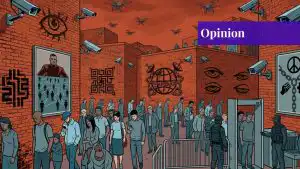
In modern times, there is a universal tendency to suspect the good faith of an individual who attempts to offer a “humane model of humanity.” Such individuals are often dubbed as idealists on the premise that they ignore the systemic and structural inertia that impedes the transformation of a certain temporality and are advised to be “realistic.” But such dumbing down of “idealists” has friction at its core. The “realists,” while advising the former to be like them, acknowledge the evil of the status quo but surrender their agency to act due to the crushing weight of this transformation task.
Thus, individuals are structurally pushed into a one-dimensional view of the world, adjusting to it rather than acting upon and changing it. This makes Freire’s thesis of pedagogy as a tool of oppression relevant; an individual is first conditioned in a manner to adjust to the status quo and then made to succumb to the inertia.
Moreover, and more importantly, the banking model of education thesis can be best applied to Pakistan. In Pakistan, the teacher is conceived as an all-knowing authority who delivers the lecture and “fills the empty vessels” with information that could be later used to pass exams. While education is intended to illuminate an individual’s cognitive capacities for a better comprehension of social realities, he is reduced to a mere receiver of the existing “knowledge.” And while education is meant to refine the social realities, it serves to further entrench the status quo. The outcome of this model is not education (the ability to identify, name, act upon, and transform the social realities) but mere educational qualifications, which could be leveraged for a government job.
But Freire’s alternative pedagogical model of problem-posing isn’t without friction. While he stresses the importance of dialogue in problem-posing education, he fails to take note of how dialogue in its essence is shaped by linguistic structures of a larger power structure and material dependence. So while Freire names the domination well, he seldom theorizes how domination reproduces itself within the aforementioned dialogical spaces. This is a crucial gap, since it has the potential of turning dialogue into a moral ideal rather than a politically conditioned practice. In this context, the dialogue with the “rejects of life” could prove to be a gamble, since the dialogue itself can reveal the hidden power structures of language or individuals who can’t be fully conceived of as “benevolent.”
Furthermore, in education, the problem-posing model is often romanticized. This romanticization embodies its own pathologies. Since the “co-creators of knowledge” alongside the teacher are the students, it would be naive to assume that a child or adult would be able to comprehend the social realities surrounding them and act critically to transform them. Themes may indeed be generated from children’s lived experience, but only through structured critical guidance, since children initially relate to the world as an extension of themselves, one that fulfills immediate needs rather than revealing social complexity. Simultaneously, these themes do not remain politically innocent. There’s a likelihood that they circulate back to educators who are themselves selected, trained, and positioned by established power structures, thereby reabsorbing emancipatory content into dominant frameworks.
Conclusion
Although Freire’s method of teaching illiterates originally seemed to belong to Latin America, there are certain parallels that can’t be overlooked. Our ever-advancing technological society has transformed us into objects and conformed us to the logic of domination, “submerging” us to an extent into a “culture of silence.” But the same technology is a paradox. By virtue of opening new avenues, especially for young people through newer forms of media, it has opened ways to an acute awareness of this logic of domination. Moreover, there is no such thing as neutral education. It either integrates the younger generations into the present system by bringing conformity, or it becomes “critical,” a practice of freedom. By means of which the younger generation deals critically with reality and discovers how to participate in its transformation.
If you want to submit your articles and/or research papers, please visit the Submissions page.
To stay updated with the latest jobs, CSS news, internships, scholarships, and current affairs articles, join our Community Forum!
The views and opinions expressed in this article/paper are the author’s own and do not necessarily reflect the editorial position of Paradigm Shift.