
In contrast to traditional political systems, such as those of the United States and the United Kingdom, where the political spectrum has been dominated by two major ideological perspectives—conservatism and liberalism—it is challenging to identify a cohesive ideological approach among the parties in Pakistan’s political system.
Analyzing Key Political Parties of Pakistan
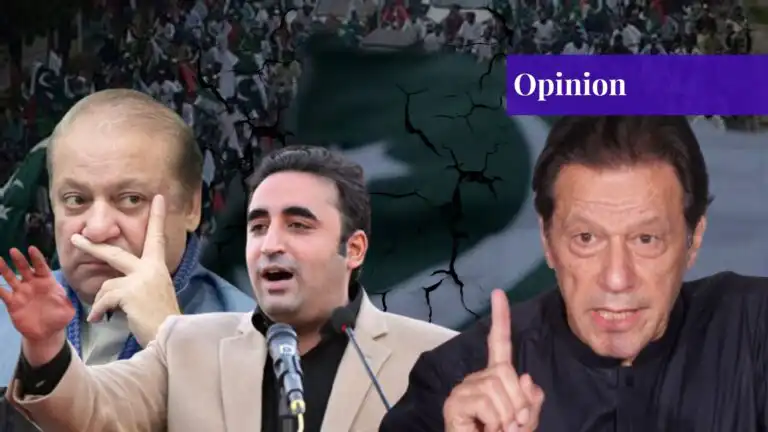
After President Pervez Musharaf’s dismissal, three political parties, the Pakistan Peoples Party (PPP), the Pakistan Muslim League-N (PML-N), and the Pakistan Tahreek-e-Insaf (PTI), won the elections.
Pakistan Peoples Party (PPP)
The Pakistan Peoples Party, founded by Zulfiqar Ali Bhutto in the 1960s, has maintained itself as a socialist-democratic party from the beginning. However, apart from Bhutto’s tenure from 1971 to 1977, there is little evidence to justify this stance.
Nationalization is one of the key components of social democracy, which Benazir Bhutto, Yousaf Raza Gillani and Raja Pervez Ashraf abandoned by their policy changes. During Benazir’s tenure, Pakistan Telecommunication Cooperation was partially privatized, marking PPP’s inclination towards a more capitalistic framework. It was followed by many efforts during the Presidency of Asif Ali Zardari when the government showed interest in the privatization of Pakistan Steel Mills and Pakistan International Airlines.
Despite this significant shift in policy approach, the Pakistan Peoples Party maintained their famous narrative of “Roti, Kapra, Makan.”
Pakistan Muslim League-N (PML-N)
Conversely, Pakistan Muslim League-N is often viewed as a centre-right party – as is the case with almost all parties of Pakistan. The most prominent leader and the party head, Nawaz Sharif, enjoyed the highest office three times, with his younger brother, Shehbaz Sharif, advancing to the same office after the ousting of Imran Khan in 2022. The party is often targeted for its hereditary structure, which is supported by feudal influence. PML-N’s policy approach combines ideas of conservatism and economic liberalism. Nevertheless, they have proven to treat the nation as a business entity, adopting a rather pragmatic approach to solving all issues irrespective of their ideological implications.
Pakistan Tehreek-e-Insaaf (PTI)
The third party on the list is Pakistan Tehreek-e-Insaaf (PTI), which was formed by Imran Khan in 1996. From its inception, PTI has adhered to populist policy, with strong electoral backing achieved by Imran Khan’s celebrity status, which rose to fame after the 1992 World Cup win.
The party’s narrative aligns itself with “Islamic nationalism,” where it’s not uncommon to use “Islamic touches” to appeal to voters. The party, which only won 35 seats in the 2013 general elections, formed a government after the 2018 general elections with 149 seats.
Pakistan Tehreek-e-Insaf, which might have had populist interests at heart, turned into a party of turncoats or political opportunists who betrayed their previous parties and joined PTI. After the imprisonment of Imran Khan and a wave of resignations after the 9th May incident, the party, now led by a mixture of lawyers, feudal lords, and some Imran loyalists, lacks a clear strategic direction.
Why Do Political Parties in Pakistan Lack Ideological Groundings?
The answer to this question lies in Pakistan’s historical construction. Since 1947, Pakistan has struggled to mark itself as a democratic country, with constant military and bureaucratic involvement in political affairs. Additionally, the state is still influenced by outdated concepts like “feudalism.”
To this day, the common man is represented by those in power and, later on, their children and so on. Even those who hail from non-feudal backgrounds hold significant power in the society, which is no less than that of a feudal. It is also one of the primary reasons for our social fragmentation and national disintegration. Moreover, this lack of ideology arises from the masses’ lack of political knowledge. How can I expect a person who doesn’t understand the basics of capitalism or communism to be concerned with the political ideology of a party?
What are the Implications?
To vote for a certain political party without understanding their political standing is like aiming for something blindly. Two types of negative implications entail this ideology lacking.
Foremost, it paves the way for the political parties to run for office without understanding the general will; therefore, the representation in the office is not of the masses but of the votes, the very ballets that are as meaningless as those narrative-constructing speeches. Secondly, it doesn’t allow the construction of political consciousness. For example, if a party is ideologically communist, its primary concern would be to indirectly make the masses familiar with the tenets of communism and those of opposing ideologies. This interaction between a political party and commoners will alleviate the society’s political consciousness, leading to a better democratic system.
If you want to submit your articles and/or research papers, please visit the Submissions page.
To stay updated with the latest jobs, CSS news, internships, scholarships, and current affairs articles, join our Community Forum!
The views and opinions expressed in this article/paper are the author’s own and do not necessarily reflect the editorial position of Paradigm Shift.

Sarmad Usman possesses a Master's degree in Philosophy from the University of Leeds.