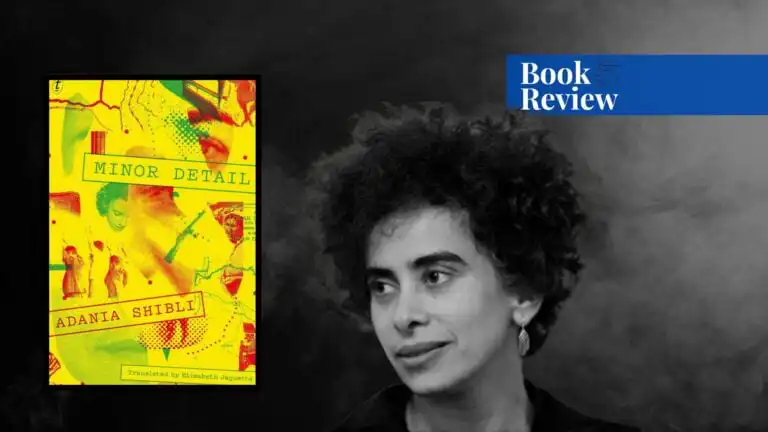
An Introduction to Minor Detail
Literature, at times, captures the weight of silence. An echo of voices that have been suppressed and fractured in histories written by oppressing powers. Thus, when literature emerges as the voice of a historically silenced subject, it becomes an act of resistance. A significant amount of such literature comes from Palestinian writers. A recent voice amongst them is Adania Shibli. Adania Shibli is a Palestinian author, novelist, playwright, and professor. Written in 2017 and translated to English in 2020 by Elisabeth Jaquette, Shibli’s “Minor Detail” is a masterclass in literary subtlety, using silence, detail, and historical absence to craft a powerful anti-colonial narrative.
“Minor Detail” is a book of details. It is not a book of grand gestures or explosive descriptions of violence. I say this because very often the so-called “post-colonial” or anti-colonial literature is very explicit in its depiction of violence, yet Shibli’s book is unique in that manner; it is far more subtle in its approach to the subject matter. Shibli’s sensibility as an author is one of deep sensitivity. I shall get to this later; perhaps it would do good to first summarize briefly what the novella is about.
The novella is divided into two parts. The first part takes place in the summer of the year 1949, a year after the Nakba. The first part focuses on a group of Israeli soldiers stationed in Negev in order to “comb the southwest part of the Negev and cleanse it of any Arabs.” The first part depicts the daily lives of these soldiers. The narrative is focused mainly on the group leader, referred to only as “he.” It depicts his struggle with an insect bite. Yet soon the focus of the story shifts when the soldiers find a Palestinian girl. They rape, murder, and bury her in the sand.
The second part of the novella takes place years later. A woman from Ramallah stumbles upon an article about the incident in a newspaper. It fascinates her because the date of the incident would “coincide, exactly a quarter of a century later, with the morning of (her) birth.” So, she forms a certain connection. Thus, she goes on to find out more about the incident. This part of the novella focuses on her journey towards this attempted discovery. This summarization did not reveal anything more than the synopsis at the back of the physical book—but, further on, there might be spoilers.
The Book of Subtlety & Details
The title is significant not only as a nod to the woman’s obsession with a “minor detail” in history but also in its aesthetic function. I said earlier that it is a book of details. It is a book of details because of Shibli’s approach to history. She, of course, writes a history of oppression, but without any explicit reference to major historical events. She focuses rather on the everyday experiences of oppression, in a manner so real as to make it almost universal. She does not forget that she is writing a Palestinian book, yet her references to specific historical narratives remain implicit. This makes the book powerful.
The lack of historical terms and references makes the narrative more human. For example, even the depiction of rape is very subtle. Shibli uses auditory cues to depict the absolute helplessness of a suffering human being, a colonized subject without any bodily autonomy. In the scene when she writes of the event of the Palestinian girl’s rape by the Israeli soldier, she writes it like this: “With his right hand covering her mouth…the bed’s squeaking drifted up over the stillness of dawn…” She only uses implicit visual cues, relying more on auditory descriptions of the events.
This highlights, perhaps, the fact that history is not merely a collection of meta-narratives but, more so, it is hidden in individual voices that are suppressed and silenced. It is only when such voices emerge that we might truly understand history. The great terror of systems of oppression such as colonialism and apartheid is felt deepest by those who experience it, not merely those who write about it from the distant window of a university campus.
As Shibli recounts in terrifying, yet still implicit, detail the horrors felt by the girl, she ends the scene in the following words contrasting the sounds of the bed to that of a dog howling: “…after the squeaking finally ceased, the loud howling outside the door continued for a long time.” The constant howling of the dog contrasted with the squeaking of the bed and finally extended over the deafening and defeating silence, too, says something. It speaks, perhaps, of the importance of those unimportant voices that emerge from our surroundings as witnesses to oppression. In Gaza, the destruction of the environment, the sounds of trees falling, of animals squealing, too, speak of Gaza’s tragedy along with her people.
Shibli does not simply demonize the Israelis; she portrays them as complex human beings, proud, yet often oblivious to their own history. I do not make this point to raise a liberal concern for de-politicizing literature. I highlight this because such a depiction of the oppressor highlights the true complexity of the situation. As binary as a colonial system is, it is nonetheless a difficult-to-travel terrain. This also makes Shibli’s novella an important one; it deals with the complex situation of the apartheid yet without taking a neutral stance, for although without great visual focus, she depicts the violence of the Israeli army vividly.
She also gives a brilliant account of the Palestinian identity. To investigate the story, the woman in the second part must travel to restricted areas, but she lacks a “blue identity card.” A friend offers the woman her own blue ID card; she takes it and proceeds further because they all “look similar…at least in the eyes of the soldiers at checkpoints.” This shows how the Israelis see the Palestinians, not as human beings, but merely as names and numbers depicted on the pages of a document. This underscores how Palestinians are reduced to manageable subjects, confined within boundaries dictated by the Israeli government.
In conclusion, Adania Shibli’s “Minor Detail” is a brilliant depiction of what it means to be a Palestinian in the midst of a life deeply regulated by the increasingly dystopian Israeli regime. The novella speaks in silences more powerful than any scream. The book ends abruptly too, as does the history of most women and men amid the chaos of such an oppressive system. Shibli’s “Minor Detail” is not only a significant work of Palestinian literature but also a profound exploration of historiography, existentialism, and the essence of being human.
If you want to submit your articles and/or research papers, please visit the Submissions page.
To stay updated with the latest jobs, CSS news, internships, scholarships, and current affairs articles, join our Community Forum!
The views and opinions expressed in this article/paper are the author’s own and do not necessarily reflect the editorial position of Paradigm Shift.

Shahalam Tariq is based in Rawalpindi, Pakistan. His writings on history, theory and literature have appeared in The Friday Times and Bazm e Dana. His poems have appeared in The Writers Sanctuary, Borderless Journal and Gentle Visitations.