

The horrendous and only use of nuclear weapons in war took place towards the end of the Second World War, triggering enormous destruction and lifelong suffering. A nuclear holocaust, or nuclear apocalypse, is a theoretical scenario where the mass detonation of nuclear weapons causes widespread annihilation, radioactive fallout, and potential extinction or collapse of a complete civilisation. It involves extreme, long-term environmental devastation, rendering large parts of Earth uninhabitable, with severe consequences for all life forms. Numerous “close calls” throughout history, such as the 1962 Cuban Missile Crisis, have highlighted the constant, lingering risk of nuclear conflict. The present Gulf Crisis is one such close call, where the war imposed on Iran may bear unequalled consequences.
The art of war has seen a major paradigm shift towards the middle and end of the twentieth century, where the advent of nuclear warfare began with the Manhattan Project’s success in 1945, culminating in the atomic bombings of Hiroshima and Nagasaki, which highlighted the devastating power of fission technology.
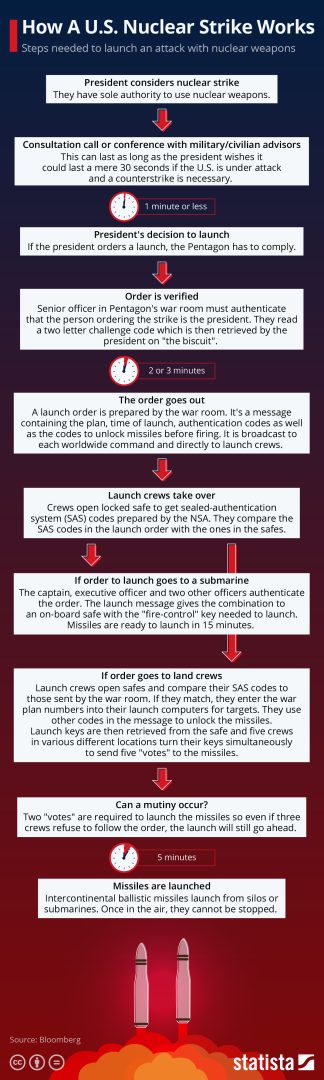
How A U.S. Nuclear Strike Works by Niall McCarthy,
Developed to counter enemy advancements, nuclear weapons fundamentally changed global security, the beginning of possibly the “nuclear age” and the concept of mass destruction, leading to Cold War strategies of deterrence. In the first twenty years of this century, there have been wars in 54 countries of the world’s 193 countries, and most of these wars are continuing today. Around 60 States and 100 armed groups were actively participating in war in 2020, according to the ICRC (International Committee of the Red Cross), with many other States supporting these wars in principle and practice as diplomatic, financial, and arms-trading allies. These early 21st-century wars have 10 striking characteristics, i.e., Militarily small wars, Religious wars with a Muslim Geography, Internationalised Civil Wars or Armed Groups and Coalitions, Urban Warfare, Long War, Chronic Political Violence, Computerised Warfare, Sub-Threshold and Hybrid War, Hyper-legal warfare, and Public Participation in War. The hallmark of the recent past conflicts of the twenty-first century between the non-nuclear and nuclear potent nations has involved, to date, the use of a mix of old conventional methods, latest weapons of mass destruction, and state-of-the-art Air Force to include Drones, SSMs, ASMs, and ICBMs. Standoff technique, ECM, Barrage Jamming, and Digital-based technologies, etc. As the world returns to the geopolitics of Great Power competition, there is a risk of major peer-to-peer clashes between huge armed forces that would be very different from the asymmetrical and militarily small wars of the first 20 years of this century. All Great Powers and regional powers today are preparing for large-scale conflicts that will see warfare across the traditional domains of land, sea, and air. These preparations should be able to implore a greater understanding of modern warfare and invoke a sense of responsibility among the masses – and especially amongst the incumbent leadership.
Preemptive Strikes
The term signifies an extreme form of proactivity, ensuring that one’s own action occurs before someone else’s, even if that person was already planning to act early. Some examples may include:
- Negotiation/Arguments: Answering an anticipated argument before the other person even makes their preparatory point.
- Management: A manager implementing a policy to prevent a team member from introducing a policy that would make the manager’s position irrelevant.
- Cybersecurity/Strategy: Developing a defence against an attack that is itself designed to trigger a defence.
- Military Use: An attack carried out with nuclear weapons is intended to destroy an enemy’s capacity to respond. Preemptive strikes are based on the assumption that the enemy is planning an imminent attack.
Restricting our context to military use, it defines an action taken even earlier than anticipated preventative moves to render it ineffective. It is a strategic escalation, acting first to forestall a competitor’s expected, first-mover advantage, or acting ahead of a planned, preemptive action. It is often used primarily in competitive scenarios with our arch-rival adversary India, but with the recent rapidly changing, excessively fluid situation of war in the Middle East, our adversary list has visibly expanded manifold. We need to indulge in high levels of strategic planning, anticipation, and preparedness.
Second Strike Capability
The Second Strike capability, often referred to as “striking from the grave”, is a nuclear-armed state’s assured ability to retaliate with a powerful nuclear counterstrike after surviving a first strike, serving as a cornerstone of deterrence, especially against a “no first use” policy. It prevents adversaries from initiating nuclear war by warranting their own destruction, often achieved through hidden, survivable assets like nuclear-powered submarines (SSBNs). A secure second strike is generally assured through a triad of delivery systems referred to as The Nuclear Triad:
- Submarine-Launched Ballistic Missiles (SLBMs): Considered the most reliable and survivable, as they remain hidden underwater.
- Land-Based ICBMs: Often placed in hardened, blast-resistant silos or moved around, such as on road-mobile vehicles, to enhance survival.
- Strategic Bombers: Can be kept on alert to avoid being destroyed on the ground
Nuclear Strike Protocols
These protocols are highly classified, state-specific procedures governing the authorisation, command, control, and execution of nuclear weapon launches. They are designed to maintain absolute political control, ensure credible deterrence, and provide for retaliatory action, often involving a “nuclear triad” of bombers, land-based missiles, and submarines. The potential of being a nuclear potent Nation expects from its leadership and people, a very high standard of preparedness and follow-up of emergency procedures, duly well accustomed and rehearsed. The preparation may include the creation of strategically located shelters and bunkers. Identification of these shelters by the residents. Making the residents familiar with the safe, central, or underground locations in advance. Creating personal kits with water, food, and basic essential items like radios. Some primary emergency procedures in the event of a nuclear strike can be summarised as follows:
Get Inside, Stay Inside, and Stay Tuned: Immediate Actions (Within First 10 Minutes)
- Get Inside: Move to the centre of a sturdy building (brick or concrete), ideally in the basement, to avoid the blast and radioactive fallout.
- If Outside: Do not look at the flash; lie flat on the ground, cover your head, and seek shelter immediately.
- Decontaminate: If exposed, remove outer clothing, shower, or wash exposed skin to remove fallout particles.
Sheltering and Safety (First 24–72 Hours)
- Stay Inside: Remain sheltered for at least 24 hours to avoid the highest radiation levels.
- Seal Shelter: Close windows, doors, and turn off HVAC systems to minimise exposure to outside air.
- Listen for Info: Use battery-powered radios for updates.
Safety Limits: Do not leave to pick up family members, as this increases danger. Conserve water and use sealed, pre-packaged food.
Genetic Mapping of the Recent Gulf Crisis
The sole beneficiary of the US-led ten-year-long Soviet-Afghanistan proxy war, the post-September 11 war on terror against Afghanistan, and the Iraqi invasion was none other than the People’s Republic of China. The historically known US-Soviet bipolar world, where these two superpowers dominated the world with roughly equal military, economic, and technological capabilities, which divided the world into opposing spheres of influence, has now turned its maximum weight to a unipolar China. The Costs of War Project at Brown University estimated that the US spent $2.26 trillion on the war in Afghanistan alone between 2001 and 2021. When combined with the Iraq war, the total costs for both wars are estimated to be at least $4 to $6 trillion over the long term, if interest is included. We must remember that these were only the tangible financial costs calculated, not the intangible losses suffered in terms of the emerging mutilated image of the United States and its claim of being the ruler of the known world. The initiation of the MAGA (Make America Great Again) movement is an effort to rebuild the lost supremacy. MAGA, a right-wing populist political movement, is a Donald Trump-centred movement, emphasising economic nationalism, strict immigration enforcement, and an “America First” foreign policy. It has reshaped the Republican Party, blending grassroots cultural grievances with desires for economic change and restoring national pride, often described as a status-based social movement.
The actions of the United States in bringing peace to the world, as acclaimed, have a single line ambition, i.e., “Rule The World” – by any means, whether it be pseudo wars or use of diplomacy as persisted by Chas Freemen. A vivid example and case in point in the ongoing war against Iran is the abrupt resignation by Joe Kent, who had been serving as the Director of the National Counterterrorism Centre of the United States. We must remember that this resignation is the highest-profile rebuke yet of the war effort from a Trump administration insider and staunch supporter of the MAGA (Make America Great Again) movement, albeit one who instantly drew criticism for alleged antisemitism. It reflects how the conflict is churning some of Trump’s most high-profile MAGA supporters, like Tucker Carlson and Megyn Kelly, even though rank-and-file Republicans largely back the president. Joe, a senior intelligence official appointed by President Donald Trump, abruptly announced he is stepping down from his post on 17 March 2026. Citing his misgivings about the administration’s war with Iran, he posted his resignation letter on X, contradicting the administration’s basis for launching the war and imploring Trump to end it. “I cannot in good conscience support the ongoing war in Iran,” Kent wrote in his letter that Iran posed no imminent threat to the United States – and that it was clear that they started this war due to pressure from Israel and its powerful American lobby.
Kent wrote that he supported the values and the foreign policies that Trump campaigned on in 2016, 2020, 2024, and enacted in his first term. Until June of 2025, he read that Trump understood that the wars in the Middle East were a trap that robbed America of the precious lives of its patriots and depleted the wealth and prosperity of its nation. Moreover, he knew that in his first administration, Trump understood better than any modern President how to decisively apply military power without getting the Americans drawn into never-ending wars. He understood that Trump demonstrated this by killing Qasem Soleimani and by defeating ISIS. Kent added that early in this administration, high-ranking Israeli officials and influential members of the American media deployed a misinformation campaign that sowed pro-war sentiments to encourage a war with Iran. This echo chamber was used to deceive Trump into believing that Iran posed an imminent threat to the United States, and that, should the US strike immediately, there would be a clear path to a swift victory. This was a lie and is the same tactic with which the Israelis drew the United States into the disastrous Iraq war that cost our nation the lives of thousands of our best men and women. We cannot make this mistake again. He added that as a veteran who deployed to combat 11 times and as a Gold Star husband who lost his beloved wife Shannon in a war manufactured by Israel, he can not support sending the next generation off to fight and die in a war that serves no benefit to the American people nor justifies the cost of American lives.
Commenting on the resignation of Joe Kent, Trump said that it’s a “good thing” Kent resigned over his objections to the war with Iran, deriding him as “very weak on security.” “When somebody is working with us and says that he didn’t think Iran was a threat, we don’t want such people,” Trump said from the Oval Office. “They’re not smart people, or they’re not savvy people.” Totally baffled by the outcome of the war, the petrified Israeli Prime Minister Benjamin Netanyahu, during a press conference on 20th March 2026, denied allegations that Israel pressured the United States to go to war with Iran. He rather iterated that they (USA and Israel) were both in this together.
The Arab Spring
Before moving any further, it would only seem prudent to carry out a quick autopsy of the Arab Spring. Naively painted, the Britannica portrays the Arab Spring as a wave of pro-democracy protests and uprisings that took place in the Middle East and North Africa beginning in 2010 and 2011, challenging some of the region’s entrenched authoritarian regimes. The wave began when protests in Tunisia and Egypt toppled their regimes in quick succession, inspiring similar attempts in other Arab countries. Not every country saw success in the protest movement, however, and demonstrators expressing their political and economic grievances were often met with violent crackdowns by their countries’ security forces.
Encouraged by protesters’ rapid successes in Tunisia and Egypt, protest movements took hold in Yemen, Bahrain, Libya, and Syria in late January, February, and March 2011. Unlike in Tunisia and Egypt, however, the outpouring of popular discontent in these countries led to bloody and often protracted struggles between opposition groups and ruling regimes. In its inception, the term “Arab Spring” was coined by Marc Lynch, an American political scientist, in an article published in the US political academic journal “Foreign Policy”. This movement comprised both violent and non-violent protests against the enduring authoritarian regimes, persistent states of emergency granting excessive powers to police and governments to suppress people, and escalating issues such as unemployment, poverty, and inflation across the Arab world. Social media emerged as a pivotal tool utilised in all countries where these protests occurred, serving to garner international attention.
The objectives of the Arab Spring protests were multifaceted, encompassing various social, political, and economic aspirations. According to a survey conducted among respondents, the primary goals of the protests included improving economic conditions, tackling corruption, promoting social justice, enhancing dignity, and increasing political freedoms. Frustration with the outcome of the Arab Spring protests powered greater levels of antagonism toward existing regimes. The protests undermined the unitary nation paradigm established during the colonial post-independence period, highlighting ethnic and religious identities that had been largely ignored. As a result, ethno-religious minorities became increasingly marginalised, exacerbating tensions. However, regimes in the Arabian Peninsula had largely managed to retain power, with some even strengthening their grip on society, except for Yemen, thanks to factors such as the introduction of extensive welfare packages, the lack of external pressure for change, and incremental political reforms.
The Arab Spring, as portrayed by the West, symbolised the pent-up frustration and aspirations of populations long oppressed by autocratic regimes. However, the reality is not the same as the British guiding principle of “Divide and Rule” and the US expansionist and hegemonic designs, which are both favoured by autocratic rule. Hence, the big question, why “The Arab Spring”; the answer is pretty simple: Islamophobia, the warm waters, and finally the “Black Gold (oil).
The divide was created by the advent of the Shia-Sunni conflict, where Iran played a pivotal role by initiating a conflict with Iraq. A diplomatic rift started on 8 March ’80 when Iran withdrew its ambassador from Iraq. In April, failed assassination attempts on Iraq’s Foreign Minister Tariq Aziz and Minister of Culture and Information Latif Nusseif Al-Jasim contributed to the worsening of the situation. Iranian agents further inflamed the situation. Between May and August, clashes along the Iraq-Iran border intensified, signalling a clear escalation in hostilities. A critical turning point came on September 17 when Iraq abrogated the 1975 Algiers Agreement by declaring full sovereignty over the Shatt al-Arab waterway. This move effectively dismantled the fragile peace established by the agreement. Finally, on September 22, 1980, Iraqi forces invaded Iran, initiating a prolonged and devastating war that would last for eight years. The war was a struggle for dominance between two rival regimes driven by fundamentally divergent worldviews. Later, Iran’s role in the U.S.-Iraq War (2003–2011) was characterised by a strategy to exploit the power vacuum created by the U.S. invasion, ensuring Iraq did not pose a future threat and bolstering Iranian influence. Tehran supported Shia militias and political factions to counter American presence and influence the new Iraqi government, making Iraq a proxy conflict zone, particularly after 2007. The conceived objectives of the Arab Spring were thus partially achieved, where some countries successfully deposed their leaders. However, the long-term success of these objectives has been uneven, with many nations experiencing subsequent civil wars, economic instability, or a return to authoritarianism.
The Ostensible Britain’s Collusion with Radical Islam
According to an edited extract from a book titled “Secret Affairs: Britain’s Collusion with Radical Islam” by Marc Curtis, the British strategy of colonial divide and rule, and reliance on Muslim forces to promote imperial interests, reached its apogee in the Middle East during and after the First World War. The carving up of the region by British and French officials has been endlessly commented on, though less so as an illustration of the long-standing British ‘use’ of Islam, which then took on a new turn. The Middle East was seen by British planners as critical for both strategic and commercial reasons. Strategically, the Islamic territories were important buffers against Russian expansion into the imperial land route from British India to British-controlled Egypt. But oil had by now also entered the picture, with the founding of the Anglo–Iranian Oil Corporation in Persia in 1908, the discovery of oil in Iraq soon after, and its increasingly important role in powering the military during the First World War. British planners viewed control over Iraqi and Persian oil to be the number one British war aim. Sir Maurice Hankey, secretary of the War Cabinet, said towards the end of the conflict that ‘the future power in the world is oil’.
British foreign policy had, since the sixteenth century, supported the Ottoman Empire of the Muslim Turks, the largest and most powerful Muslim entity in the world, which, at its height in the seventeenth century, had spanned North Africa, southeast Europe, and much of the Middle East. Britain was committed to defending ‘Ottoman integrity’ against Russian and French imperial designs, which mandated de facto support for the Turkish Caliphate and the Ottoman Sultan’s claim to be the leader of the Ummah, read the Muslim world. After Britain captured India, the Ottoman Empire was seen as a convenient buffer to keep out rivals along the military and trade route to the jewel in the crown. London often projected itself as the saviour of the Turkish sultan: in the Crimean War of 1854–6, one of the bloodiest conflicts in modern European history, Britain and France fought on behalf of the Ottomans against Russia. The ‘Eastern Question’, read the imperial struggle for control in the lands dominated by the decaying Ottoman empire, was a process in which Britain essentially tried to shore up the last great Muslim empire against its great power rivals. By the time Ottoman Turkey made the fateful choice of siding with Germany in the First World War, it was already a declining power, but still controlled much of the Middle East, including present-day Syria, Iraq, Jordan, and Palestine, which it had ruled for 400 years. After its defeat, the European powers, led by the British, fell upon its carcass and divided it up between them. During the First World War, Britain appealed to the Arabs in the Middle East to join it in overthrowing Ottoman rule of their territories, in exchange for British guarantees of postwar independence. In its 1914 proclamation ‘to the natives of Arabia, Palestine, Syria and Mesopotamia’, the British government stated that:
“One of [the government’s] fundamental traditions is to be a friend of Islam and to defend the Islamic Caliphate even if it was a Caliphate of conquest and necessity, as the Turkish Caliphate which England had defended with money and men and influence several times. No nation amongst Muslims is now capable of upholding the Islamic Caliphate except the Arab nation, and no country is more fitted for its seat than the Arab countries”.
In May 1915, Britain also proclaimed to the ‘people of Arabia’ that ‘the religion of Islam, as history proves, has always been most scrupulously respected by the English government’, and that, despite the Sultan of Turkey having become an enemy, ‘our policy of respect and friendliness towards Islam remains unchanged’. The power-hungry Arabs took the bait as desired by the British. A huge amount has been written on the ‘Arab revolt’ against Turkish rule, including the romanticized heroics of Lawrence of Arabia and Britain’s subsequent betrayal of its guarantees of ‘independence’ for the Arabs; these guarantees, to the British, meant not granting Arabs national sovereignty but allowing the presence of exclusively British advisers to administrate Arab countries which would become British ‘protectorates’. One striking aspect of the call to Arabs was Britain’s appeal to Islam in its promises to the then ruler, or sherif, of the Holy City of Makkah, Hussain bin Ali. Hussain, whose religious authority and position derived from his supposed descent from the Final Messenger Muhammad (Peace Be Upon Him), agreed to lead the Arab revolt in return for British recognition of him after the war as the ruler of a vast territory stretching from present-day Syria to Yemen, thus encompassing all of modern Saudi Arabia. The British government wrote to Hussain in November 1914, stating that:
“If the Amir [i.e., Hussain] and Arabs in general assist Great Britain in this conflict that has been forced upon us by Turkey, Great Britain will promise not to intervene in any manner whatsoever, whether in things religious or otherwise. Till now, we have defended and befriended Islam in the person of the Turks; henceforward, it shall be in that of the noble Arab. It may be that an Arab of true race will assume the Caliphate at Makkah or Madinah, and so good may come by the help of God out of all the evil that is now occurring.” This last momentous sentence was Britain promising to help restore the Islamic Caliphate to Arabia and for Sherif Hussain to be the new Caliph, the successor to the Turkish sultan. It was Madinah, in modern Saudi Arabia, which was the first capital of the Caliphate after the Beloved Prophet Muhammad (Peace Be Upon Him), passed on in the seventh century, following which it had been claimed by a variety of dynasties, latterly the Ottomans. London promised to Hussain that Britain “will guarantee the Holy Places [at Makkah and Madinah] against all external aggression and will recognize their inviolability.”
Lord Kitchener, the Secretary of State for War, noted in March 1915 that “if the Caliphate were transferred to Arabia, it would remain to a great extent under our influence.” The coastline of the Arabian Peninsula could be easily controlled by the British Navy. By championing an Arabian kingdom under British auspices, Britain was exerting its dominance over the spiritual leadership of the Muslim world. Indeed, Britain was helping Islam to reclaim its roots and return to its origins. But Muslims of the world in general and Arabs in particular had forgotten what the Lord of Heavens and Earth had told them:
The Jews will never be pleased with you, nor will the Christians, unless you follow their faith. Say: “Guidance of Allah SWT is, indeed, the guidance.” Were you to follow their desires despite the knowledge that has come to you, there shall be no friend for you against Allah, nor a helper. (Surah Al-Baqarah Ayat: 120, The Glorious Quran refers). The succeeding paragraphs are some of the many examples proving the authenticity of the Divine Revelation and should serve as an eye-opener for the Muslim world.
However, some British officials during and after the war also feared that the Caliphate could be used as a rallying point for anti-colonial movements, to undermine British rule in India and Egypt. In particular, they feared the prospect of a Muslim Holy War against Britain, something the Turkish sultan had proclaimed on entering the First World War. In his analysis of the Middle East during and after the First World War, David Fromkin notes that British leaders believed that Islam could be manipulated by buying or capturing its religious leadership. They believed, in short, that whoever controlled the person of the Caliph controlled Sunni Islam. Sherif Hussain came out in revolt against the Ottoman Empire in June 1916, recruiting a small Arab force of a few thousand men to fight in the Hijaz region, the western coastal area of Arabia comprising the cities of Jeddah, Makkah, and Madinah. The writer, Gertrude Bell, who was to become an imperial architect of Iraq, noted that with the fighting at Makkah, “the revolt of the Holy places is an immense moral and political asset”.
Nevertheless, Hussain’s revolt achieved only minor victories over the Ottoman army and failed to mobilise people in any part of the Arab world, despite being subsidised by the British to the tune of £11 million. British officers served as military advisers to Hussain’s revolt; one such was Colonel T.E. ‘Lawrence of Arabia’, an aide to Faisal, Sherif Hussain’s son, who was appointed to command the latter’s military forces. One month before the Arab revolt broke out, Britain and France secretly agreed to divide the Middle East between their zones of influence, in the Sykes-Picot Agreement, named after their respective foreign ministers. This abandonment of the commitment to Ottoman territorial integrity, overturning a mainstay of British foreign policy, was openly acknowledged by British officials. Lawrence, supposedly the great ‘liberator’ of the Arab world, wrote an intelligence memo in January 1916 stating that the Arab revolt was:
“Beneficial to us because it marches with our immediate aims, the breakup of the Islamic ‘Bloc’, defeat and disruption of the Ottoman Empire, and because Sherif Hussain, who would set up to succeed the Turks, was a British crony. The Arabs are even less stable than the Turks. If properly handled, they would remain in a state of political mosaic, a tissue of small jealous principalities incapable of cohesion”.
After the war, Lawrence wrote a report for the British Cabinet entitled ‘Reconstruction of Arabia’, arguing that it was an urgent matter for the British and their allies to enrol a Muslim leader to counter any jihad attempts against them in the name of the Caliph:
“When war broke out, an urgent need to divide Islam was added, and we became reconciled to seek allies rather than subjects. We hoped by the creation of a ring of client states, themselves insisting on our patronage, to turn the present and future flank of any foreign power with designs on the three rivers [Iraq]. The greatest obstacle, from a war standpoint, to any Arab Movement was its greatest virtue in peacetime, the lack of solidarity between various Arab movements. Sherif Hussain was ultimately chosen because of the rift he would create in Islam”.
The benefit of division in the Middle East, a key point in all these documents was also recognized by the foreign department of the British government of India: ‘What we want’, it stated, ‘is not a United Arabia, but a weak and disunited Arabia, split up into little principalities so far as possible under our suzerainty, but incapable of coordinated action against us, forming a buffer against the Powers in the West.’
Birth of the British-Saudi Alliance
Following the Arab revolt in 1916 and Britain’s defeat of the Turkish armies throughout the region, Hussain bin Ali, the ruler of the Holy city of Makkah, proclaimed himself King of all the Arab countries, including the Hijaz in Arabia, but the British government was prepared to recognize only his control of the latter. Confrontation over the future of Arabia ensued between Hussain and another British protégé, Abdul Aziz Ibn Saud, an emir and rising power in central Arabia whose forces had captured the Najd region with its capital at Riyadh. British officials had been split on who to champion as the leader of the revolt against the Turks. The British government of India had feared British sponsorship of an Arab Caliph who would lead the entire Muslim world, and the effects this might have on Muslims in India, and had therefore favoured Ibn Saud, whose pretensions were limited to Arabia. In contrast to Hussain’s orthodox Sunnism, the future founder of Saudi Arabia sat at the head of an ultra-conservative Sunni revivalist movement, now known as Wahhabism, which professed a strict adherence to the tenets of Islam and which had developed in the eighteenth century based on the teachings of the theologian, Mohammed ibn Abdul Wahhab, born in 1703. Ibn Saud’s military forces were the Ikhwani, or Brotherhood, a militia of Bedouin tribesmen instructed by religious teachers who were committed to the purification of Islam and the advancement of government based on strict Islamic law.
Britain had already provided arms and money to Ibn Saud during the First World War, signing a treaty with him in 1915 and recognising him as the ruler of the Najd province under British protection. By the end of the war, he was receiving a British subsidy of £5,000 a month, considerably less than the £12,000 a month being doled out to Hussain, whom the British government at first continued to favour. Nevertheless, some British officials were pinning their strategic hopes on Ibn Saud during the war. In 1919, London supported Hussain in the Hijaz region and used its air force against confrontation with Ibn Saud. After accepting a temporary ceasefire in 1920, Ibn Saud’s 150,000-strong Ikhwani advanced relentlessly, and by the mid-1920s had gained control of Arabia, including the Hijaz and the Holy Places, defeating Hussain for supremacy in the region. Ibn Saud established Saudi Arabia in an orgy of murder. In his exposé of the corruption of the Saudi ruling family, Said Aburish (the controversial Palestinian journalist) describes Ibn Saud as ‘a lecher and a bloodthirsty autocrat, whose savagery wreaked havoc across Arabia’, terrorising and mercilessly slaughtering his enemies. The conquest of Arabia cost the lives of around 400,000 people, since Saud’s forces did not take prisoners; over a million people fled to neighbouring countries. Numerous rebellions against the House of Saud subsequently took place, each put down in ‘mass killings of mostly innocent victims, including women and children’.
By the mid-1920s, most of Arabia had been subdued, 40,000 people had been publicly executed, and some 350,000 had had limbs amputated; the territory was divided into districts under the control of Saud’s relatives, a situation which largely prevails even today. The British recognised Ibn Saud’s control of Arabia, and by 1922, his subsidy was raised to £100,000 a year by Colonial Secretary Winston Churchill. At the same time, Churchill described Ibn Saud’s Wahhabis as akin to the present-day Taliban, telling the House of Commons in July 1921 that they were ‘austere, intolerant, well-armed and bloodthirsty’, and that ‘they hold it as an article of duty, as well as of faith, to kill all who do not share their opinions and to make slaves of their wives and children. Women have been put to death in Wahhabi villages for simply appearing in the streets. It is a penal offence to wear a silk garment. Men have been killed for smoking a cigarette.’ However, Churchill also later wrote that ‘my admiration for him [Ibn Saud] was deep, because of his unfailing loyalty to us’, and the British government set about consolidating its grip on this loyalty.
In 1917, London dispatched Harry St John Philby, father of Kim, the later Soviet spy, to Saudi Arabia, where he remained until Ibn Saud died in 1953. Philby’s role was ‘to consult with the Foreign Office over ways to consolidate the rule and extend the influence’ of Ibn Saud. A 1927 treaty ceded control of the country’s foreign affairs to Britain. When elements of the Ikhwani, opposed to the British presence in the country, rebelled against the regime in 1929, Ibn Saud called for British support. The RAF and troops from the British-controlled army in neighbouring Iraq were dispatched, and the rebellion was put down the following year. Ibn Saud highly appreciated Britain’s support for him, especially during the rebellion, and this paved the way for the development of relations between the Saudi Kingdom and the West that became the core of Saudi foreign policy. Following the consolidation of the Saudi–British alliance, Ibn Saud relegated the Ikhwani’s role to that of educating and monitoring public morality. But the power of Wahhabism had already transformed Bedouins into mujahideen. Holy warriors for whom devotion to the Ummah transcended tribal affiliations. In subsequent decades, the Ikhwani Jihadi conquest of the Arabian Peninsula by the sword and the Quran would be constantly invoked in Saudi Arabian teachings. Officially proclaimed in 1932, and to a large extent a British creation, Saudi Arabia would go on to act as the world’s main propagator of fundamentalist Islam, providing the ideological and financial Centre of global Jihadism. Indeed, Saudi Wahhabism has been described as the ‘founding ideology’ of modern Jihad. The new state of Saudi Arabia, its regional authority underpinned by a religious fundamentalism, gave Britain a foothold in the heart of the Islamic world, in Makkah and Madinah. More broadly, Britain had succeeded in achieving its goal of a divided Middle East and a ‘ring of client states’ out of the ashes of the Ottoman empire. The Gulf states ringing Saudi Arabia, in Aden, Bahrain, and Oman, were all feudal regimes underpinned by British military protection. Meanwhile, Britain continued to exploit its other potential clients: Faisal, who, with the Allies, had captured Damascus in 1918, was made King of Iraq in 1921, and Abdullah, Sherif Hussain’s other son, was dubbed King of Transjordan, which became ‘independent’ under British ‘protection’ in 1923.
Finally, there was Palestine, which had also been captured by British forces towards the end of the war. Here, however, Britain was committed to creating what Foreign Secretary Arthur Balfour outlined in 1917 as a ‘National Home’ for the Jews. In April 1920, at a conference in the Italian resort of San Remo, the newly formed League of Nations formally handed Britain a mandate to govern Palestine. Balfour had also said that what Britain needed in the Middle East in the early years of the twentieth century was ‘supreme economic and political control to be exercised in friendly and unostentatious cooperation with the Arabs, but this option was to be exercised as a last resort.’ The regimes that Britain had created were puppets, essentially law-and-order governments allied mainly with the traditional ruling classes of Islam. In turn, these favoured Sultans, Emirs, or monarchs saw British rule as providers of protection against the dangers of instability or emancipatory nationalist movements that had begun to stir, notably in Iraq. Needless to mention that the American influence and money began to be felt directly, backing perhaps Saud over Hussein in the midst of World War 1.
A schism, competing interests, or a two-fishing-line two-faced approach between or from old and emerging new seats of western empire and financial power. The US was nudging out Britain in the Middle East, as in much of the world, during World War II. As a symbol, Washington took over the annual subsidy to Saudi Arabia at the Cairo Conference in 1943. London still believed it had a great deal of heft in the region, which was disproven in the Sinai War of 1956, when the US bloodied its and France’s nose. Oil drilling in Saudi Arabia had begun just before the war and expanded quickly after the war, benefiting the US companies massively. From that point onward, Saudi Arabia needed no annual allowance. The US was its main sponsor, economically, militarily, and diplomatically. In the early 1970s, things got complicated due to the US-Israel alliance, and the growth of independent Saudi wealth was put to harm’s way in a big way; however, the basic alliance still exists.
US-Israel Attacks on Iran- An Extension of The Arab Spring’s Covert Objectives
As deliberated at length in the preceding paragraphs by elucidating on known historical facts and evidence, the covert objectives of the Arab Spring were ‘Islamophobia, Warm Waters, and Oil’. The said objectives necessitated the creation of a weak and disunited Arabia, split up into little principalities so far as possible under the suzerainty of the West. Thus, harnessing the majority of the Muslim Ummah to follow their way of living instead of the Divinely Promulgated Islam. The measures taken were a promise for financial security and foolproof territorial integrity against any future movements generated by ‘radical Islam’.
In 1953, the CIA and MI6-backed 1953 Iranian coup d’état overthrew Iran’s prime minister, Mohammad Mossadegh, who had nationalised the Anglo-Persian Oil Company. The coup reinstated Mohammad Reza Pahlavi as an absolute monarch and significantly increased the level of influence of the United States over Iran. Meanwhile, Iran witnessed yet another turmoil in 1979, where the Islamic Revolution culminated in the overthrow of the Pahlavi dynasty. The revolution led to the replacement of the Imperial State of Iran by the Islamic Republic of Iran, as the monarchical government of Shah Mohammad Reza Pahlavi was superseded by Ruhollah Mostafavi Musavi Khomeini. The Iranian revolution, followed by the Iran-Iraq war. added more reasons for the already defunct Arabs to bow further in utter humility in front of the West (read: Americans). The Arabs slowly and gradually submitted to the demands of the United States, providing them with all the assistance they needed. The US maintains a significant military presence in the Gulf region to secure maritime routes, support operations, and counter regional threats, with roughly eight long-term bases and multiple sites housing thousands of personnel. The Key US Military Installations in the Gulf Region include the following:
- Qatar: Al Udeid Air Base is the forward headquarters for U.S. Central Command (CENTCOM), hosting around 8,000 to 10,000 troops and critical air operations.
- Bahrain: Hosts the headquarters of the US Fifth Fleet, critical for regional naval operations and maritime security near the Strait of Hormuz.
- Kuwait: Serves as a primary logistics hub for US ground forces, with key sites including Camp Arifjan (US Army Central HQ) and Camp Buehring.
- UAE (United Arab Emirates): Al Dhafra Air Base functions as a critical air hub for reconnaissance, refuelling, and fighter jet missions, along with the use of Jebel Ali Port for naval vessels.
- Saudi Arabia: Prince Sultan Air Base hosts U.S. forces focused on air and missile defence, supporting Patriot missile batteries and THAAD systems.
- Iraq: Despite recent drawdowns, bases such as Ain Al Asad Air Base and Erbil Air Base have been used for training and operations.
- Jordan: The Muwaffaq Salti Air Base supports regional surveillance and air operations.
Is Iran Truly an Axis of Evil for the US and Israel or Hand in Glove with Them?
This is a question that haunts the minds of every sensible person. Let us look into some ground realities to this query. After condemning the September 11 attacks and expressing sympathy with bereaved Americans, Iran briefly cooperated with the United States in late 2001, providing limited military support against the Taliban in Afghanistan, including operations in Herat. However, in early 2002, President George W. Bush labelled Iran part of an “axis of evil” along with Iraq and North Korea, sharply worsening relations. Later, as already discussed, Iran’s role in the US-Iraq War (2003–2011) was characterised by a strategy to exploit the power vacuum created by the US invasion, ensuring Iraq did not pose a future threat and bolstering Iranian influence. On June 22, 2025, the United States Air Force and Navy attacked three nuclear facilities in Iran as part of the Twelve-Day War, under the code name Operation Midnight Hammer. The Fordow Uranium Enrichment Plant, the Natanz Nuclear Facility, and the Isfahan Nuclear Technology Centre were targeted with fourteen GBU-57A/B MOP “bunker buster” bombs carried by B-2 Spirit stealth bombers, and Tomahawk missiles fired from a submarine. According to U.S. President Donald Trump, US F-35 and F-22 fighters also entered Iran’s airspace to draw its surface-to-air missiles, but no launches were detected. The war ended with a ceasefire on 24 June 2025, just two days after the nuclear sites were attacked. Reports indicate that on March 21, 2026, a strike was conducted on Iran’s Natanz nuclear enrichment complex, following earlier attacks on missile facilities, military sites, and leadership. The Arms Control Association notes that known operating centrifuge production facilities in Iran were destroyed in June 2025, and subsequent 2026 strikes aimed at destroying remaining infrastructure, including a potential third enrichment facility in Isfahan. Satellite images taken by Vantor on 1 and 2 March were made public, which showed that Iran’s Natanz Nuclear Facility in Isfahan, Iran, had sustained damage. Subsequently, the International Atomic Energy Agency (IAEA) confirmed that satellite imagery showed that entrance buildings at Natanz were damaged, but no radiological consequence was expected, and no additional impact had been detected at the fuel enrichment plant itself. It should be noted that there were no radiological consequences reported by IAEA or any other agency resulting from the 2025 or 2026 attacks on Iranian nuclear installations. There could be three reasonable explanations for the referred situations: The first and foremost is that Iran anticipated the strikes and had successfully shifted its facilities, secondly, that Iran was informed about the strikes being a protege in advance and it shifted its facility, and lastly, that Iran was still endeavouring to achieve the potential but did not get the time to do so. The referred US-Israel attacks made sure that the Iranians would be left standing haplessly, devoid of any infrastructure to begin their nuclear enrichment program.
There was a very strong nexus between the United States and Iran, predominantly during the Cold War era. For several decades, particularly between 1953 and 1979, the two nations were close allies. Key points in this historical relationship include:
- 1953 Coup (Operation Ajax): The CIA and British intelligence orchestrated a coup to overthrow Prime Minister Mohammad Mosaddegh, reinstating Shah Mohammad Reza Pahlavi to power to protect Western interests.
- The Shah’s Era: The US supported the Shah’s authoritarian rule, viewing him as a stable, anti-communist ally in the Middle East, while Iran provided the US with access to oil and helped it manage regional security.
- Nuclear Cooperation: In the 1960s and 1970s, the US helped launch Iran’s nuclear program, providing a research reactor and fuel as part of the “Atoms for Peace” initiative.
- 1979 Revolution: The close relationship ended abruptly when the Iranian Revolution replaced the Shah with a theocratic government, creating a deep, lasting animosity.
- Iran-Contra Affair: Despite the animosity, the US secretly sold weapons to Iran in the mid-1980s to fund the Contras in Nicaragua.
Since the 1979 Islamic Revolution, the relationship has shifted to one of severe conflict and deep distrust.
There was a significant “nexus” or close partnership between Israel and Iran before the 1979 Islamic Revolution. During the reign of Shah Mohammad Reza Pahlavi (1941–1979), the two nations were strategic allies, maintaining deep economic, military, and intelligence ties. Key Aspects of the Pre-1979 Alliance:
- Diplomatic Recognition: Iran was the second Muslim-majority country to recognise Israel as a sovereign state, doing so shortly after its establishment in 1948.
- Periphery Doctrine: Israel, looking to break its isolation in the Arab-dominated region, viewed non-Arab Iran as a natural ally under David Ben-Gurion’s “periphery doctrine”.
- Energy and Trade: Iran was a major oil provider for Israel, supplying up to 60% of its needs, and sent oil to Europe via the joint Israeli-Iranian Eilat-Ashkelon pipeline.
- Military/Intelligence Cooperation: The two nations cooperated on security, with Mossad helping to train the Iranian secret police, SAVAK. They also engaged in joint projects, such as “Project Flower” in 1977, which was a joint effort to develop a new missile.
- Active Exchange: Direct flights connected Tel Aviv and Tehran, and Israeli firms were active in Iranian construction and agriculture.
Following the 1979 Revolution, this relationship completely reversed, with the new regime in Tehran adopting a policy of hostility toward Israel, viewing it as a “Zionist regime”.
Post-1979 Cooperation (The Iran-Contra Period). Despite severing formal ties after the 1979 Islamic Revolution, the two nations maintained a covert, pragmatic relationship during the 1980s. Israel supplied weapons to Iran between 1985 and 1986 during the Iran-Iraq War to counter Saddam Hussein, a shared enemy, and as part of the Iran-Contra affair, which allowed US-made weapons to reach Iran. The presence of the remnants of these US-Israel alliances cannot be ruled out.
A critical scrutiny of what Joe Kent, Director of Counter Terrorism wrote in his resignation letter, that Iran posed no imminent threat to United States, infers a twofold connotation; one that Iran is an ally (hand in glove with us) and the other that the Iranian nuclear facilities which we are claiming to have destroyed are still secured and working and that Joe Kent cannot become a part of the lies which they are telling to the American people and rest of the world.
Comments
- Peace is a state of harmony characterised by the lack of violence, conflict behaviours, and the freedom from fear of violence. Universally tacit as the absence of hostility, a state of peace suggests the existence of healthy, interpersonal or international relationships, prosperity in matters of social or economic welfare, the establishment of equality, and a working political order that serves the true interests of all. Presently, it is unimaginable to survive in the comity of Nations without acceptable arrangements of mutual coexistence, without compromising the sovereignty of the country, envisaging the fundamental religious and constitutional obligation of surrendering the National will to the Supreme Sovereignty of Allah SWT.
- The entire Arab read Muslim world has been going through cataclysmic events since the beginning of 2011. The first political conflagration broke out in Tunisia, ending with the ouster of a long-governing dictator of that most secularised North African country. Then came Egypt’s turn, after having suffered under three successive military regimes since 1952, the masses rose and acted on the slogan, Kifaya, i.e., enough of Hosni Mubarak. No sooner had Mubarak left Cairo for an unknown destination than the winds of amends moved westward. This time, the bonfire was at Libyan Arab, ‘Jamahiriya’, the unusual Arabic nomenclature for “republic” invented by the semi-rational Colonel Qaddafi. (The normal Arabic word for republic is “jumhuriyya,” with its equivalent in Turkish, “cumhuriyet”).
- It is but common knowledge that September 11th had generated an intense debate and a search for answers not only in the US but also around the world. The resultant “Global War on Terrorism” unleashed against Afghanistan shaped new curiosity about Afghanistan and its already troubled neighbour, Pakistan. Once the mainstay of the United States in the Cold War Era, and the bastion for breeding, feeding, and harbouring the Mujahideen movement, Pakistan’s support was consequential in breaking up the formerly bipolar world, and it was solely responsible for the orchestrated New World Order. The longstanding Afghan war had far-reaching effects on Pakistan. The US left Afghanistan in a mess, presumably leaving a bunch of friendly Taliban in place for face-saving, but it didn’t work at all; not for Pakistan at least, the refugee predicament and resurgence of Taliban after the said withdrawal in 2021 gave India the leverage of harnessing state-led terrorism in Pakistan.
- As a prologue to the ‘Great Game’, the US has so far technically succeeded in forming an imperialist armed ring against the Central Asian Oil Republics — stretching from Yugoslavia to Afghanistan, the target, naturally, the oil resources of the former Soviet Union. The formation of such competing military-political-economic blocks is an inherent feature of monopoly capitalism. The capture of sources, raw material, and commodity markets has been the basis of two world wars. Every imperialist power must expand or face the threat of being swallowed by another more rapacious imperialist power. Lenin referred to this propensity as the ‘Law of Combined and Uneven Development of Capitalism’. This intensely competitive struggle for resources leads to militarisation and war.
In other words, war is an integral feature of the imperialist system. The most aggressive and ravenous is none other than the USA, utilising its enormous propaganda machine to disguise and camouflage each particular step as a different campaign. The “war against terror”, the war against “greater Serbia”, Chechnya, Daghestan, and so on, are all part of a solitary objective to consolidate their Global Hegemony. Carter’s National Security Adviser, Brzezinski, admitted that the US intervened in Afghanistan before the Soviet Union. He said: “The US began aiding the Islamic Fundamentalist Mujahedin six months before the Russians made their move, even though we believed that this aid was going to induce a soviet military intervention, the secret operation was an excellent idea. It had the effect of drawing the Russians into the Afghan trap. The day that the Soviets officially crossed the border, I wrote to President Carter: We now have the opportunity of giving to the USSR its Vietnam War.” (Rogue State, by William Blum, refers).
- The Iraqi invasion, yet another misadventure of the US, was based on wrong-cum-alleged/made-up information about weapons of mass destruction. It was amply discussed with clear recommendations by the IAEA that Iraq has no such capability, which was proven later as a ground reality. A Hollywood blockbuster movie titled “Green Zone” starring Matt Damon tells you all. The initial war against Iraq was a sequel to Saddam’s attack on Kuwait (with the consent of the then American Ambassador to Iraq) and its occupation. Then the US attacked Iraq along with coalition forces and freed Kuwait. Saddam’s contention was his claim that Kuwait was to be an integral province of Iraq. The US invasion of Iraq and Iraq’s attack on Kuwait were based on falsehoods: they both stand to be immoral. On the gravity of immorality, the facts point towards the US invasion of Iraq. The number of civilian casualties in the invasion of Iraq was so high that it made one scream out loud. A large number of these casualties are attributed to Iran, which moved in to fill the vacuum created in Iraq. The fallout is even worse because it continues to kill more every day, not to mention the regional instability and continual terrorism.
- At times, one is forced to imagine: Who is the actual architect of American policy after all?
Chas W. Freeman, Jr., author of ‘America’s Misadventures in the Middle East’, hit the headlines in the early weeks of the Obama administration when Director of National Intelligence Adm. Dennis C. Blair named him Chair of the National Intelligence Council, citing his diverse background in defence, diplomacy, and intelligence. News of Freeman’s impending appointment met a firestorm of criticism from numerous strongly pro-Israeli commentators, who lambasted him for the view he had often expressed that the U.S. needed to maintain an even-handed stance between Israel and the Arab countries. In early March 2009, Freeman withdrew his name from consideration for the position and issued a statement, laying the blame for the campaign against him on a network of pro-Israel activists.
- The massive military presence of the US in the Gulf region wasn’t just to secure maritime routes, support operations, and counter regional threats, but was with a hidden motive of exploiting the centuries-old ideological grudge of religious beliefs between Iran and the rest of the Muslim world and presenting a bait to the Iranians in case of a US-Israel offensive on Iran. Sadly, the Iranians took the bait and responded exactly as per their enemies’ desires.
- Pakistan Armed Forces have contributed tremendously towards the Global War on Terror, and played their part surely in every eventuality, to safeguard national interests and the integrity of the country. The LEAs, the intelligence community, and the media have also done their bits, and so have the incumbent and past democracies.
- Islam and Pakistan are both symbolic of peace, but if there is a war looming over our heads, we need to be prepared for it. “And prepare against them whatever you are able of power and of steeds of war by which you may terrify the enemy of Allah SWT and your enemy and others besides them whom you do not know [but] whom Allah SWT knows. And whatever you spend in the cause of Allah SWT will be fully repaid to you, and you will not be wronged. Surah Anfal Ayat 60, The Glorious Quran.
The age-old orthodox use of Drones has returned with a big bang. In 1940, during World War II, Reginald Denny started the Radio Plane Company, and more models emerged during this time. They used both to train anti-aircraft gunners and to fly attack missions. Nazi Germany produced and used various UAV aircraft during the war, like the Argus As 292 and the V-1 flying bomb with a jet engine. Italy developed a specialised drone version of the Savoia-Marchetti SM.79 flown by remote control, although the Armistice with Italy was enacted before any operational deployment. UAVs (Unmanned Aerial Vehicles) may be classified like any other aircraft, according to design configuration, such as weight or engine type, maximum flight altitude, degree of operational autonomy, operational role, etc. According to the United States Department of Defence, UAVs are classified into five categories from small, medium, large, larger to largest, with a payload carrying capacity of 9.1 Kgs to 600 Kgs with an operating altitude of 370 Meters (1200 Feet) to 5500 Meters (18000 Feet), ranging from less than 5 KMs to greater than 650 KMs. Endurance of .50 to .75 hrs to greater than 36 to 48 hrs, and the wingspan ranges from less than 50 cms to more than 10 meters. The latest drones are equipped with pre-fed GPS locations and reach their targets without being detected. The cost price of detecting and putting them down with modern Air Defence Systems is much more than the drone prices. The signature start of the much-spoken impending war would be the usual border skirmishes, airspace violations, trailed by a mix of conventional war and Allah SWT forbid, followed by a preemptive tactical nuclear strike.
Recommendations
There is no more time left for bogus claims and writing memoirs of victory, defeat, and denial. It is time now to put forth solutions to the problems, like what we should actually do. Some plausible recommendations are listed below:
- Solidarity of the fragmented Ummah is the need of the hour. A summit meeting of the OIC should be called immediately to address the grievances of Iran and convince the latter to stop attacking brethren Muslim countries, especially the custodians of Haramain Sharifain, and simultaneously move towards a reconciliation with the United States and Israel on respectable terms.
- New Corporate Social Responsibility (CSR) parameters should be drawn, earmarking dedicated areas of responsibilities for all corporates, business giants, and willing philanthropists both at home and abroad to erect structures, make necessary shelters and provisions for the respective communities to cater to a nuclear strike eventuality. The respective donors may also be made responsible for holding mock exercises in their respective areas.
- An all-out media campaign should be launched to equip the general masses with the drills and procedures to be followed in case of a nuclear strike. This media campaign should be given peak time coverage with no expenses incurred to the government exchequer.
- Radio Pakistan should be given a dedicated responsibility for erecting operational bunkers and marking dedicated frequencies for the eventuality, and carrying out mock exercises from these bunkers.
- The predicament of drones can be easily resolved by reverting back to human intelligence efforts and the old VA and VP protection method by incorporating the observation posts manned by human resources and an early warning system of any intrusion, followed by engaging them with the old vintage air defence weapons.
- Clearly defined foreign policy objectives, with special reference to having cordial relations with neighbours based on principles of mutual co-existence and equality. Legislation based on and within the boundaries and fundamentals of Islam, conveying an outright message to the entire world on the figurine position of the Islamic Republic of Pakistan.
- Defining liberalism to impede undue and misleading obscenities on the pretext of enlightened moderation. A Code of Conduct with a clearly defined media policy. Responses sought only from a dedicated government spokesperson.
- Dedicated video coverage of the parliament sessions for public awareness. Dedicated government website and postal address for feedback.
Concluding Thoughts
It is valued that desperate times call for desperate measures, but they should not be hysterical to the extent of losing everything. “and they (disbelievers) planned, and Allah SWT planned (against them): and Allah SWT is best of Planners”, Aal-e-Imran Ayat 54, The Glorious Quran.
Although the relationship between Pakistan and the US at the moment seems more than functional and stable, the recent killing of innocent protestors outside the Karachi Consulate is a sign enough of the American mindset, because once it comes to safeguarding their own people, they can go to any extent.
As we tried to improve our relations with them, we received yet another bashing by their Director of National Intelligence, Tulsi Gabbard, alleging a potential threat from Pakistan’s missile capability. Historical particulars propose that America’s interest in Pakistan or elsewhere is best looked after in the hands of an autocrat. You may refer in this regard to the post or pre-Cold War era.
You may give the example of a nuclear-armed Islamist Pakistan and for its psychological conversion into a moderately enlightened country because of this autocratic influence; thus, the unprecedented goodies being tendered down to our leadership.
Has “The End of Times” commenced? The Man Who Saw Tomorrow is a 1981 American documentary-style film about the predictions of French astrologer and physician Michel de Nostredame (Nostradamus). Presented and narrated by Orson Welles, A “King of Terror”, wearing a blue turban, described as “the terror of mankind”, would rise to power from Greater Arabia during the late 1990s, wage war around the world, and spread the influence of Islamic fundamentalism, along with the decreasing influence of Christianity. Nostradamus claims that the “King of Terror” would ally with the Reds – meaning communists (read: Russia). According to Nostradamus, the “King of Terror” and Russia would wage World War III against the West (United States, United Kingdom, and France), starting with a nuclear strike on New York City. The author Michel Notredame was a Jew turned Catholic Christian, hence his predictions could well be a part of psychological warfare, to cast hatred amongst the people of scripture against Muslims.
Our all-time number one adversary, India, or any freshly emerging enemies, are fully cognizant of the fact that we have a devastating second strike capability. Nevertheless, as a nation, we should be fully prepared for any eventuality. Preempting a preemptive nuclear strike doesn’t imply that we should be able to preempt a nuclear strike; it also proposes that we should be able to strike out of the grave once we are hit by a nuclear weapon. That, my brethren, is only possible if we start taking our preparations seriously – as ordained by The Lord of Heavens and Earth.
If you want to submit your articles and/or research papers, please visit the Submissions page.
To stay updated with the latest jobs, CSS news, internships, scholarships, and current affairs articles, join our Community Forum!
The views and opinions expressed in this article/paper are the author’s own and do not necessarily reflect the editorial position of Paradigm Shift.