
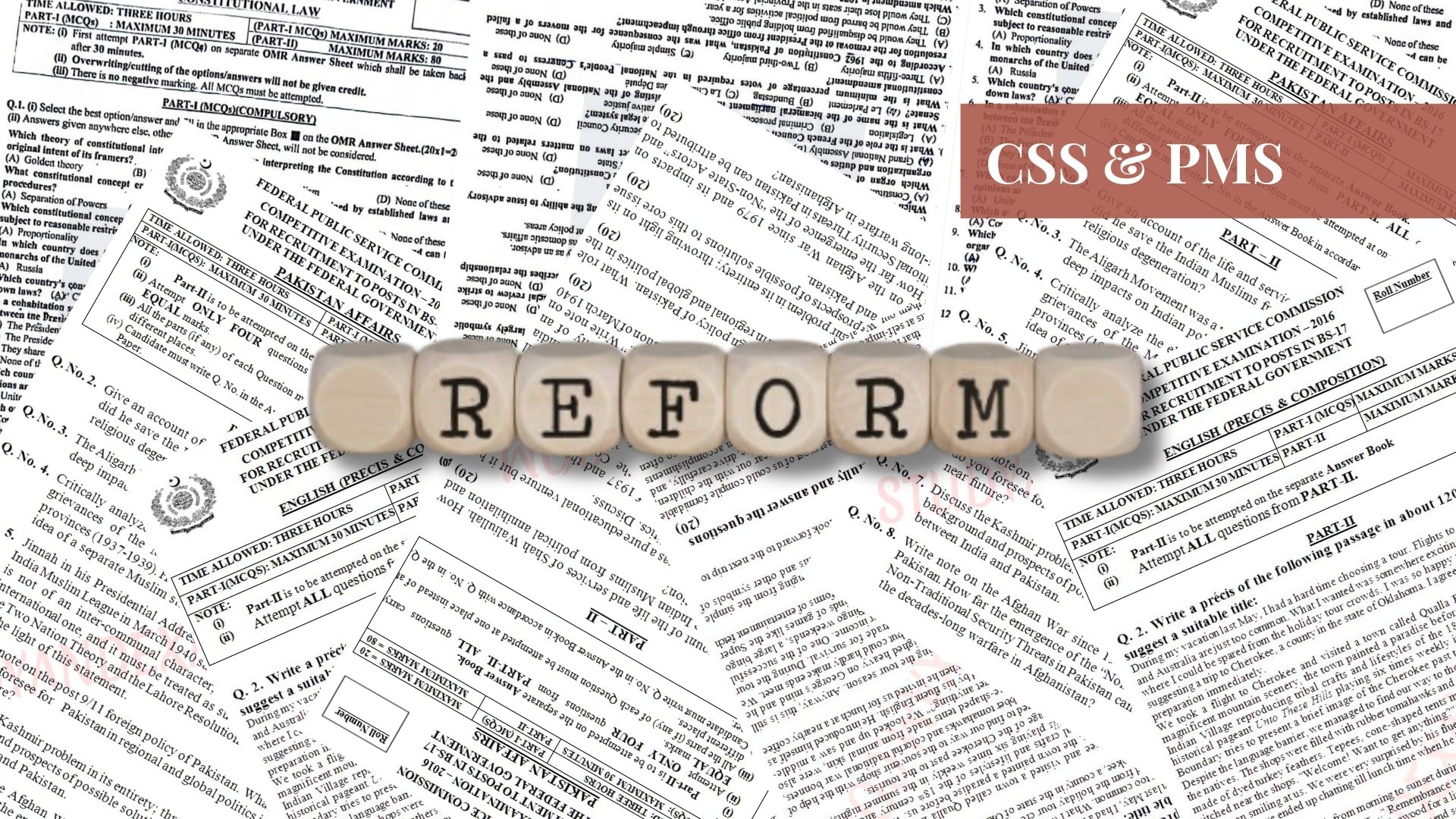

The title of the most reputable and distinguished examination in Pakistan is the Central Superior Services (CSS) exam, which is conducted and supervised by Pakistan’s Federal Public Service Commission (FPSC). The examination is held annually, usually around February each year. Taking its roots in British bureaucratic practices, the CSS examination provides a platform for Pakistan’s intellectual and competitive youth to serve their state in various domains, including the most significant aspect of decision-making and policy-making. The aspirants are enrolled and recruited after a tough path of scrutiny and evaluation followed by a screening test, written test, medical exam, psychological exam, and final (viva) interview. The successful aspirants are then allocated to 12 service groups, i.e. Foreign Service, Police, Pakistan Customs, and other executive bodies. Reforming the CSS exams has recently become a hot topic in the state’s political sphere.
During a senate session on 11 March 2025, Federal Minister of Law and Justice Azam Nazeer Tarar explained the ongoing developments, reform talks, and major reformative steps to be taken in syllabi and the conduct of CSS exams. According to Azam Tarar, the educational disparities, either rural or urban, federal or local, are a major hindrance to the slow progress of the civil services sector of Pakistan. The students aspiring for the CSS exams come from different educational experiences. Thus, to tackle this issue, the government is striving to introduce a cluster-based system that completely revolves around one fundamental idea, “right man for the right job.” As per reports, these reforms will allow the candidates to serve in a specific service group that best suits their aptitude and past educational experiences. The primary motive of these amendments is to promote and bolster specialization in policy-making sectors.
CSS Exam Reforms in Pakistan: A Historical Overview
There is an idea and sense of panic emerging in Pakistan’s youth about these examination reforms. It is to be noted that states and their systems are evolving in nature. They evolve with time to progress towards eminence. The ongoing reforms in the Civil Services of Pakistan are not a brand-new step; rather, this sector has always been prone to amendments to eradicate flaws and provide our country with competent and skilled civil servants.
1. Bhutto Era (1973)
The 1973 reforms focused on categorizing civil servants. President Zulfiqar Ali Bhutto replaced classes I, II, III, and IV with a more enhanced pay grade system, ranging from 1 to 22. He tried eradicating the political and elite culture entrenched in Pakistan’s civil services and introduced a Common Training Programme (CTP) for all civil service groups.
2. Musharraf Era (2004-2008)
The second major reforms in CSS were instituted by President Musharraf under his ‘devolution power strategy” of 2000. By empowering the local governments. The President tried to hand over the majority of control to provincial bodies to conduct CSS exams per their educational standards. The government further introduced Performance Evaluation Reports (PERs) to gauge the skills and performance of civil servants, thus improving efficiency and accountability in the bureaucratic structure of Pakistan.
3. CSS Reforms Initiative (2015-2016)
In April 2015, the government introduced major reforms to the CSS exam system, including the updated CSS syllabi. Similarly, two important structural elements were added. A screening test was incorporated into the exam structure, which would be taken before the written test. Secondly, psychological assessment was also added to the evaluation process of the exam to select well-skilled and equipped candidates for civil services.
Challenges faced by the Aspirants
The first and foremost challenge faced by the aspirants is the passing rate of the exam. Approximately 2-2.9% of candidates from all over Pakistan are allocated via CSS. The utility of CSS exams is average compared to other private-sector jobs. The major challenge in this regard is the allocation of aspirants in very remote areas. The administrative and police services are following a rotational policy under which the aspirant has to serve outside his province for at least 5 years.
CSS is undoubtedly a very stable job platform but experienced people believe that in terms of money or pay, CSS is not the right career. For a person who wants to boost their financial condition in the first five years after his/her graduation, a career in CSS will not help. No doubt, allowances and bonuses are there, but earning an attractive ransom with honesty is impossible. CSS aspirants are paid according to their grades. A civil servant cannot improve his/her income for five years. As the salaries of BPS-17 candidates are below one lakh, this is nothing for a person who has studied and invested a lot to pass the CSS exam.
The most important investment in CSS is the time of an aspirant. Usually, the CSS exam requires three attempts, and if a person is going for either 2 or 3 attempts, they will be investing a lot of time, which is the cost that aspirants have to pay. In addition, a fresh graduate who wants to be a part of the private sector/will eventually enter the market in the first month. However, in the case of CSS, the candidate will enter the market after one or 2 years and even 5 years if he/she is going for all three attempts. Last but not least is the gender disparity in the CSS exam. Between 2003 and 2024, the ratio of male allocations was high compared to that of women.
Criticism of the CSS Exam System
Despite being Pakistan’s leading prestigious examination, CSS has faced various criticisms regarding evaluation, conduct, and assessment. Predominately, the exam is centred around the theoretical evaluation of a candidate’s skills. Long essays, extraordinary English, and various subjects to be covered. Then comes the lingual hindrance. From screening to written and from written to interview and then to CTP, English is the language that has dominated the CSS structural arrangement or is being imposed on all candidates from different educational backgrounds. Low passing rates and a sense of pressure building have caused serious mental difficulties, including anxiety and stress. Despite all these challenges faced by students, in the end, many aspirants remained unallocated due to the shortage of seats or some other inappropriate and corrupt causes.
Recommendations to Improve the CSS Exam
Experts and educational analysts have given various humble recommendations to eradicate all the challenges and issues halting CSS progression. A first suggestion, which is very significant, is to review and change the MPT (MCQ-based Preliminary Test) conducting time. Aspirants must be given valuable time to prepare for the MPT test. Second, the English essay word limit must be reduced to 1000/1200. Experts believe there can be two essays in an English exam, each of 1000 words. This will result in a more qualitative production of arguments by aspirants in a very concise and to-the-point manner.
Third, exclude the synonyms, antonyms, pairs of words, and idioms section. If not excluded, then at least eradicate highly difficult words from the exam. Fourth, adding compulsory subjects combining economics, public administration, governance, and public policy will enhance the basic understanding of these subjects, which is necessary for decision-making and policy-making. Fifth, the psychological assessment must be restructured. This, in part, will filter out those candidates who are facing any mental illness or will prove to be disastrous for themselves and their state.
Sixth, educational experts believe that at least in the interview exam, Urdu must be included so that candidates can explain their perspectives on the questions asked. Last, practicality must be emphasized over theoretical considerations. Either in the written or interview section, the ratio of practical questions must be more than that of theoretical ones. Based on practical knowledge, the CSS exam will allow the candidates to acquire better decision-making and problem-solving skills to cope with immediate crisis situations and introduce such policies, improving the state’s internal and external vulnerabilities in the long term.
Conclusion
The ongoing developments in the CSS exam structure and evaluation have caused serious candidate resentment. Moreover, delays in results and allocation issues are also the reasons behind this. The civil services sector needs reforms not limited to just syllabi or evaluations. The government has to ensure the ways through which unallocated candidates can pursue other governmental jobs. The reforms must address the public resentment and the indigenous issues in the bureaucratic sector. CSS will remain the most distinguished examination, providing our country with skilled and equipped bureaucrats.
If you want to submit your articles and/or research papers, please visit the Submissions page.
To stay updated with the latest jobs, CSS news, internships, scholarships, and current affairs articles, join our Community Forum!
The views and opinions expressed in this article/paper are the author’s own and do not necessarily reflect the editorial position of Paradigm Shift.

He is pursuing a BS in International Relations programme from International Islamic University, Islamabad and has a keen interest in research works, policy analysis, defence and strategic studies and conflict resolution.