The horrors of the Israel-Palestinian conflict are etched into our collective memories. Grotesque images of corpses strewn on rubble, hospitals collapsing to the ground, and tiny children facing starvation and even death pop up all over social media.
These emotional anchors allow any empathetic soul to ponder how they could mitigate such suffering. So, the Muslim community decided to engage in “Boycotts, Divestments, and Sanctions,” a collective effort of economic warfare against the perpetrators. Beyond its moral buttress, it served as a way to remediate the domestic industry. If the American brand was ousted by the boycott, a domestic brand would not only help the economy but also keep more profits at home.
With a burgeoning Israeli offensive ballooning the death toll to over 51,000 Palestinian casualties, silence became impossible. Pakistanis took to the streets of Karachi. The rallies had protesters of every kind, from lawyers to traders and teachers. They were primarily organised by the Jamaat-i-Islami (JI) and the Jamiat Ulema-i-Islam-Fazl (JUI-F) on Main Sharea Faisal and Sharah-i-Quaideen, respectively.
Beyond popular support, the Council of Islamic Ideology (CII) took a strong stance. The Chairman, Dr Raghib Naeemi, branded Israel as “a terrorist and a criminal state.” He called for a complete boycott of all and every Israeli product and company. He lamented the increased violence despite the enforcement of a ceasefire and the general brutality of the Israeli regime. With such a strong stance, he still reiterated the need to protect property and lives.
The key part of the plan was that it was a form of non-violent resistance, which was true until very recently.
On the 14th of April, a simple worker at KFC was toiling away as the sun’s light began to fade. His outlet was visited by two individuals, who promptly used a gun to inflict wounds on him, 45-year-old Asif Nawaz.
Police Take Action
Sheikhupura Regional Police Officer (RPO) Athar Ismail said the two men appeared outside the outlet of the fast-food chain, and one of them opened fire from outside the outlet. At 11:05 PM, a call went out to report the incident, and though he was rushed to the hospital, he succumbed to his injuries. The police have registered an FIR under Section 302 of the Pakistan Penal Code and Section 7 of the Anti-Terrorism Act. Given this power, they have tracked and taken 40 individuals into custody. Unfortunately, the main suspect remains at large.
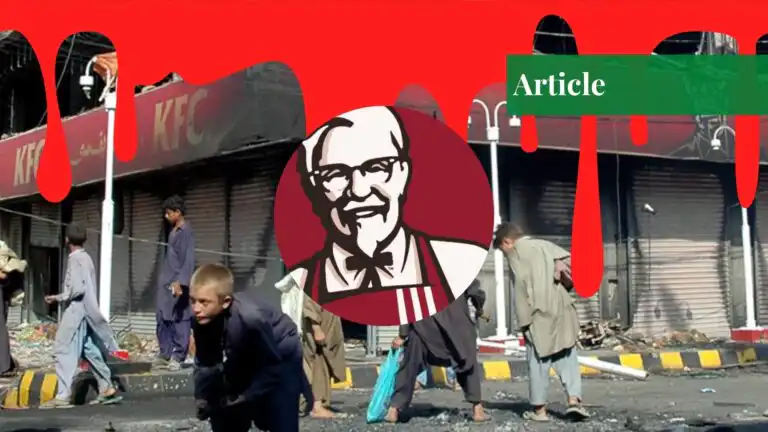
This was the violent climax to a string of attacks on multiple fast-food chains; previously, outlets of KFC and Domino’s Pizza were attacked in the cities of Karachi and Lahore. It was reported that 10-12 individuals armed with sticks entered the branch and started using abusive language toward staff members and customers. The attacks range from impassioned language to spreading awareness to pelting rocks at the establishment.
Addressing a conference about Palestine, renowned Islamic scholar Mufti Usmani lambasted Israel’s actions in the Gaza Strip and supported a boycott of products to express solidarity with Palestine. Yet, he also reiterated the need for using peaceful methods, highlighting this need after the string of attacks nationwide.
Though coverage of the conflict had been instrumental, the incitement of violence seems to have been correlated to a recent protest call by Tehreek-i-Labbaik Pakistan (TLP). TLP is a far-right Islamist political party that has been involved in previous violent protests in the country, and before the shooting, 11 members of the party were arrested for ransacking an outlet in DHA Lahore. Though suspicious, official remarks still assert their non-involvement. They claim the murder happened after the protest was over and that violent acts were never intended. They assert members involved in such violence are to be considered lone wolf attacks instead of being associated with TLP.
KFC remains the primary punching bag for most of the violence. Even though it’s a franchise that produces a considerable amount of wealth for Pakistan, it’s seen as a glaring symbol of the United States of America, the primary backer of the Israeli state.
Though the intentions had respectable moral foundations, it is imperative to realise that the destruction of property and violence against fellow citizens won’t alleviate the situation in Gaza. Asif Nawaz was simply a worker hoping to make money for his family. He didn’t deserve to die for something that wasn’t even remotely his fault. This violence not only hurts the nation but also makes it difficult for foreign investors to be green-lit, as they may worry about the protection of their outlets.
Regardless of recent events, the boycott remains an excellent cause, so the intended ethos of non-violence and economic pressure should be the main drive while simultaneously rejecting the violent posturing by extremists.
If you want to submit your articles and/or research papers, please visit the Submissions page.
To stay updated with the latest jobs, CSS news, internships, scholarships, and current affairs articles, join our Community Forum!
The views and opinions expressed in this article/paper are the author’s own and do not necessarily reflect the editorial position of Paradigm Shift.

The author is studying Economics at the National University of Science and Technology (NUST) with a keen interest in financial affairs, international relations, and geo-politics.