
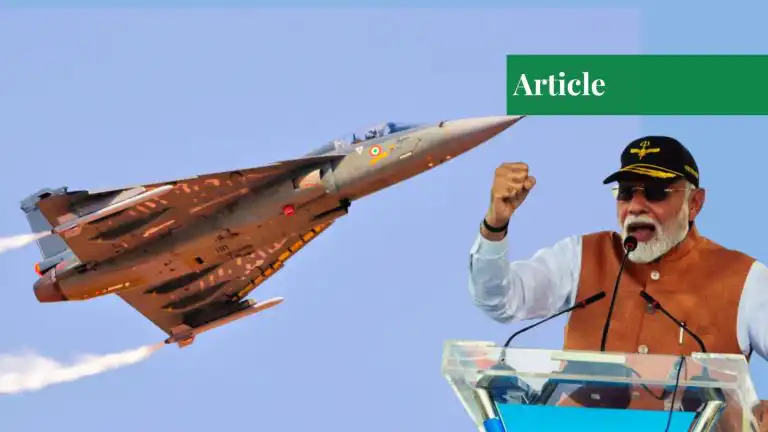

Recently, the Indian Air Force (IAF) grounded its fleet of 30 Tejas light combat jets, following a recent crash on 7 February. Aviation accidents are not something new in military history, and an investigation should be allowed to reach a conclusion. The significance is not in assigning the cause to this crash because the answer lies elsewhere. India claims Tejas as an indigenously manufactured aircraft, and the decision to ground the entire fleet raises a deeper question about institutional accountability, defense governance, and the political economy of strategic autonomy.
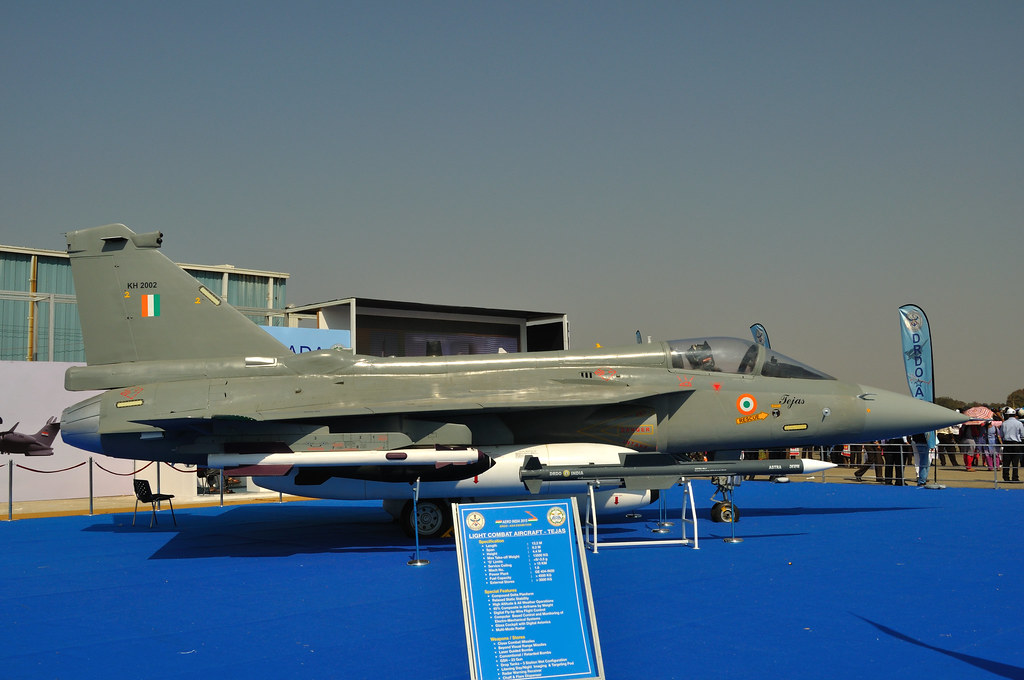
India’s Aeronautical Development Agency (ADA) developed the Tejas program, and it is manufactured by Hindustan Aeronautics Limited (HAL). The program started in 1980 to replace its aging MiG-21 jets. In February 2021, India’s defense ministry signed a ₹480 billion contract for 83 Tejas MK-1A aircraft, which was followed by an additional ₹623 billion for 97 more aircraft in September 2025, just two months before Tejas crashed for the second time at the Dubai air show since its launch. This shows India’s strong ambition to acquire self-reliance over foreign suppliers in its aerospace technology, but repeated incidents question India’s strategic credibility.
Hybrid Dependency and Institutional Setbacks
“Hybrid dependency” is one of the underexplored dimensions in this debate. Tejas is attributed as an indigenously produced aircraft, but its production relies on imported parts such as engines supplied by GE Aerospace. This provides a structural dilemma; while being labeled as indigenously produced, full supply chain sovereignty is still unachieved.
In this way, governance complications arise. For instance, when external suppliers such as GE Aerospace delayed the delivery of F-404 engines, it halted MK-1A jet production. When such delays are encountered, domestic producers take the political pressure, and when the domestic need is not fulfilled, the international suppliers are being scrutinized. So accountability becomes complex, making oversight mechanisms difficult, and raises concerns about the defense contracts.
Scholars argue that it is hard to say that defense autonomy has been achieved through developing partial production capability because governance oversight, institutional and regulatory frameworks, diverse suppliers, and long-term investment planning are also required. When these setbacks and delays are faced by a domestically produced aircraft, then the reason behind these setbacks seems less to be technical faults and more to be institutional designs.
Credibility is a Strategic Asset
Reputational governance is another overlooked factor when it comes to achieving strategic precedence. In the modern weapons market, credibility is a strategic asset. States that believe they can export military equipment must also work on their transparency and regulatory maturity instead of just being ambitious to achieve technological competence.
Public accidents alter the international perception. Defense analyst Douglas A. Birkey has discussed the broader implications of military aviation incidents. He says that incidents like the Tejas aircraft crashing can damage confidence, even when recovery can be achieved in the long run. Perception management is an essential part for the nations that want to expand their defense exports.
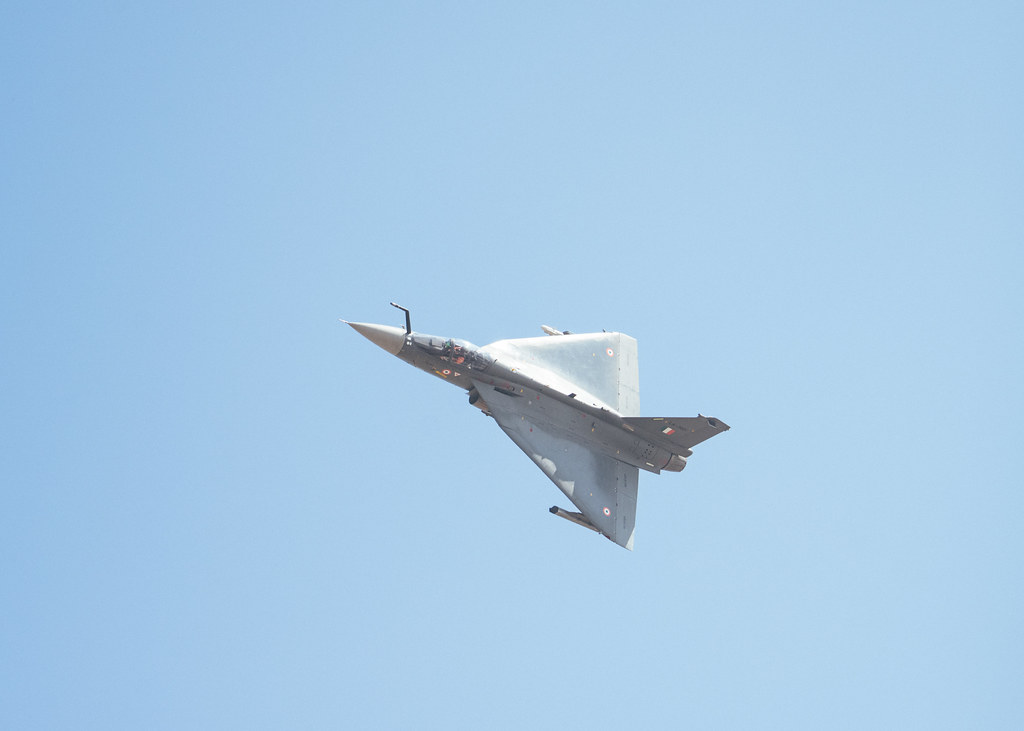
Aircraft failures, particularly in a competitive regional environment, are significant. In November 2024, another Tejas aircraft crashed at the Dubai air show, with its pilot dying. The show is one of the largest of its kind in the world, where states not only exhibit their hardware, but they also signal institutional stability, reliability, and a credible long-term partnership. This means that the defense governance is not limited to the internal audits; it also shows external commercial and diplomatic standing.
Domestic Governance and Credibility of Arms Control
Moving forward, the governance dimension also connects defense management at home to the global arms control credibility. India presents itself as a responsible nuclear power and as a reformer of international governance. Yet at home, it lacks institutional transparency. Arms control is not limited to defining numerical values anymore or signing just treaties; it also includes the production legitimacy, safety protocols, ensuring external suppliers, and regulatory standards. States that claim to be advocating for responsible military conduct must show such accountability themselves first.
It is important to note that major aerospace powers such as the USA, Russia, and France have also experienced these prototype failures and operational setbacks during developmental phases. The presence of setbacks is not something new; what really matters is the presence of credible investigation and a corrective system when such events are recurring.
Tejas’ grounding is a test for governance. The central question is not the technical challenges to these programs because indigenous fighter programs do face such problems; the question is about transparency, credibility, and the concept that institutional responses to such incidents strengthen oversight.
Implications for the Global South
The most fascinating dimension of this event is its implications for the global south. Countries that are trying to become self-sufficient in their defense industries often have to face the global supply chains that are dominated by Western and Russian manufacturers. It is hard to enter this ecosystem because technological sovereignty requires decades of learning through failures and strengthening governing bodies domestically.
This is a risky path, but risks must be accompanied by innovative governance measures. Those who come in as emerging producers must design oversight systems to get along with their technological ambitions. For instance, major aerospace powers depict that long-term success depends upon developing institutional resilience and avoiding setbacks. It is right to say that strategic autonomy is acquired through regulatory aspects as much as engineering capabilities.
Tejas’ grounding is a lesson for South Asia that repeated incidents are not just technical faults anymore; it shows institutional errors. It shows that defense sovereignty is not achieved through symbolism alone; good homework is needed, which requires sustained and strong institutions, building capacity, and maintaining domestic as well as international credibility.
Conclusion
In an era where markets are heavily politicized and the international community watches every step closely, it is important to understand that governance capital is as necessary as technological performance. Strategic autonomy in a nuclear environment is a long-term project, and where such crashes are recurring, it is hard to say that the institutions that regulate production domestically are strong enough to deal with such pressure.
If you want to submit your articles and/or research papers, please visit the Submissions page.
To stay updated with the latest jobs, CSS news, internships, scholarships, and current affairs articles, join our Community Forum!
The views and opinions expressed in this article/paper are the author’s own and do not necessarily reflect the editorial position of Paradigm Shift.

Muhammad Faiz ur Rehman is currently serving as a research intern at the Center for International Strategic Studies AJK (CISS AJK). A graduate in government and public policy from the National Defence University, Islamabad, he has worked across multiple NGOs and think tanks in research and analytical roles.