
Introduction
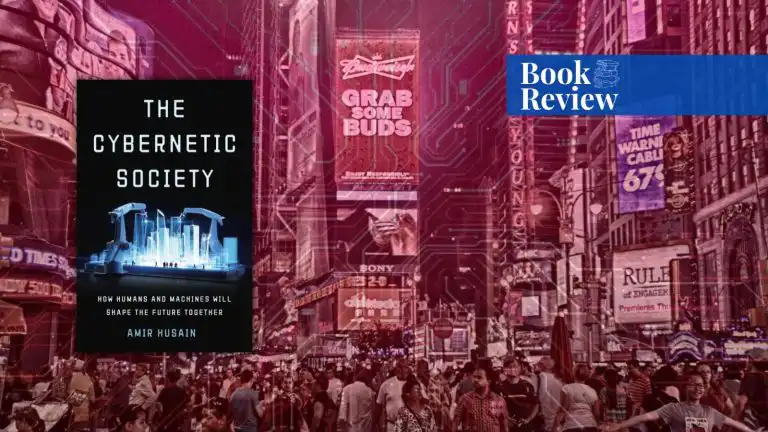
The Cybernetic Society: How Humans and Machines Will Shape the Future Together, by Amir Husain, examines the convergence of artificial intelligence (AI), autonomous systems, sensors, networks, and human decision-making to create a cybernetic society in the contemporary world. The book was published in August 2025 by Basic Books, and it uses cybernetics as its central organising framework.
Amir Husain is a technologist, entrepreneur, programmer, and investor who has worked extensively in the field of AI and autonomous systems for a long time. In 2013, he founded an AI company that reached a valuation of 1.4 billion USD. He also worked on Unmanned Aerial Vehicles (UAVs) with senior military, government, and corporate industry leaders. Husain also served on the board of the University of Texas, US.
Main Argument
According to the author, cybernetics is the science of the control and communication of complex systems. The core of Husain’s argument is that man and machine are converging to build interdisciplinary cybernetic systems that are changing society. He believes that this change is already happening and will alter the way cognition is understood, organisations function, cities are built, wars are fought, and politics is decided. The real problem is how humans are able to lead this technological shift to increasing empowerment and freedom, rather than focusing on power and control.
Book Summary
The book starts with a central idea: the connection between code, consciousness, and control, which Husain uses as the basis of the new cybernetic society. He claims that software has already transcended the computer and is becoming part of physical systems, organisations, and daily life. What is seen, remembered, and decided, and what is believed, is determined by a smartphone, algorithms, and AI. The model of transformation developed by cybernetics is relevant to the understanding of this transformation because it involves communication, feedback, adaptation, and control. Husain’s main argument is that humans and machines are becoming a seamless part of the same systems and that they are producing effects through a process of ongoing interaction. To explain this, the author divides his book into 5 broad themes.
The book examines the origins of cybernetics and the contributions of Norbert Wiener and Arturo Rosenblueth. Husain discusses Wiener’s attempts to portray biological and mechanical systems through feedback and the intellectual context of cybernetics with regard to earlier thought on control and governance. Wiener’s work on anti-aircraft systems during World War II is presented by Husain as an important link between robotics, AI, information theory, and cybernetics. According to Husain, AI and cybernetics are closely related because they both focus on information processing, decision-making, and intelligent behaviours. Finally, he depicts modern society as a growing cybernetic organism in which sensors gather information, machines and humans respond to it, and those responses provide new information.
The author explores the concept of cybernetic cities and businesses, with Saudi Arabia’s NEOM serving as the primary case study. In the author’s vision of the future, cities are intelligently monitored and responded to around the clock, with AI, sensors, autonomous vehicles, drones, and digital networks looking after them. Unlike traditional cities, which are more or less permanent and planned by humans, cybernetic cities would be adaptive systems. Smart contracts and decentralised autonomous organisations could facilitate resource management and administrative tasks. Neom is thus offered not just as a development of the city but as an experiment in combining the human and the machine in decision-making. Husain also proposes that such cities can be economies of knowledge and power.
The author then moves on to the use of cybernetics in businesses and economic organisations. He refers to the research of Geoffrey West, who studied how city and corporation growth patterns are alike and why companies eventually reach limits due to the slower velocity of information flow within expanding hierarchies. He used the example of Nvidia, which focuses on simplicity and fast communications. According to the author, the key to a successful company is having effective feedback loops and adapting to environmental shifts. AI and robotics can support this process by enabling an organisation to gather information, analyse it, and then make changes to its processes before humans can.
The book further examines the concept of human augmentation. Husain discusses personal AI, neural interfaces and, in particular, brain-computer interfaces (BCIs) in the context of education, employment, health and entertainment. His fictional case study of Ava demonstrates the possibility of a BCI to offer continuous adaptation to the user in an immersive learning environment. More importantly, Husain argues that AI should not be viewed as a tool that’s external to the organisation. Humans and machines will begin to co-evolve so that technology will become an integral part of how humans think, learn and act. This raises questions about identity and agency: if machines become deeply integrated with human cognition, what does it mean to remain human?
The implications of cybernetics for warfare are explored through the idea of “hyperwar.” Husain argues that AI and autonomous weapons could make military decision-making much faster, reducing the time humans have to make decisions. He believes this could lead to a race between countries to develop more advanced autonomous systems. Some early signs of this are evident in the conflict in Ukraine through the use of drones, swarms, and machine learning. According to the author, future wars will be fought with low-cost precision systems that allow machines to target accurately and rapidly. Husain, however, is aware that technology will not prevent war because conflict is the product of human behaviour. Rather, the future war will be a more intimate and complicated relationship between man and machine.
Beyond technological and military applications, Husain introduces Peter Turchin’s concept of cliodynamics to examine how technological developments may affect political stability. He believes that AI and automation could create vast wealth but also make society more unequal by giving those with high skills greater opportunities. Existing political tensions may deepen if technological progress leaves many people in society behind while empowering a small elite. Technology then is not necessarily positive; it must be distributed and governed in a way that makes it so. To assist societies in managing these risks, Husain suggests using adaptive governance, social resilience, public education, and early-warning mechanisms.
While concluding the book, Husain asserts that society is “already opted in” to the cybernetic environment. Husain argues that individuals are no longer able to completely avoid forms of data collection, surveillance and networked technologies. He thus introduces “technologies of freedom” like decentralisation, the open-source approach, personal data ownership, community networks and participatory governance. The book focuses on “Cybernetic Synthesis,” which states that humans, machines, organisations, cities, and states are becoming increasingly interconnected. But Husain is guardedly optimistic, acknowledging that technology is not inherently oppressive or liberating; it’s what humans do with it that matters.
Analysis
One of the salient features of this book is that it bridges many disciplines within the single framework of cybernetics. Husain illustrates the impact of AI on organisational design, urban planning, warfare, human cognition, political stability, and individual freedom. The use of real-life examples like Neom, autonomous UAVs, AI-based business models, and BCIs makes the discussion accessible and applicable in the real world. Husain’s personal technological experience also provides the book with a sense of realism.
Its applications are, however, limited due to its wide scope. Some topics are treated more superficially than others, as Husain moves quickly across cybernetics, smart cities, human augmentation, warfare, cliodynamics, blockchain, privacy, and climate change. He sometimes jumps from what technology can do to what technology is likely to be able to do without making a concerted effort to explain the technical, institutional, and political constraints. His thoughts about autonomous warfare and AI-powered cities are very interesting. Still, some of his suggestions are more of a guess, and problems like bias in algorithms, inequalities, cybersecurity, and accountability can be improved upon.
A tension between control and freedom is also uncovered in the book. Husain acknowledges the dual merits of technologies in both improving efficiency and fortifying surveillance and manipulation. Still, questions of data ownership and technological leverage are not entirely answered by solutions like “decentralisation” or “digital literacy.” This makes this book more important as a model of what the future might look like, rather than a blueprint of what it should be. Its central contribution is demonstrating how humans are embedded in technological systems that influence how societies are organised.
Conclusion
Overall, The Cybernetic Society is an ambitious and thought-provoking book that offers a useful framework for understanding the growing integration of humans and machines. Husain effectively shows that technological change is also a question of power, agency, and control, although some of his predictions are speculative and insufficiently scrutinised. Ultimately, he argues that the cybernetic future is inevitable, but its outcome depends on whether humans actively shape technology or become controlled by the systems they create.
If you want to submit your articles and/or research papers, please visit the Submissions page.
To stay updated with the latest jobs, CSS news, internships, scholarships, and current affairs articles, join our Community Forum!
Find our FREE quizzes and MCQs here!
The views and opinions expressed in this article/paper are the author’s own and do not necessarily reflect the editorial position of Paradigm Shift.