

Background: From the 1848 Revolution to the Coup of 1851
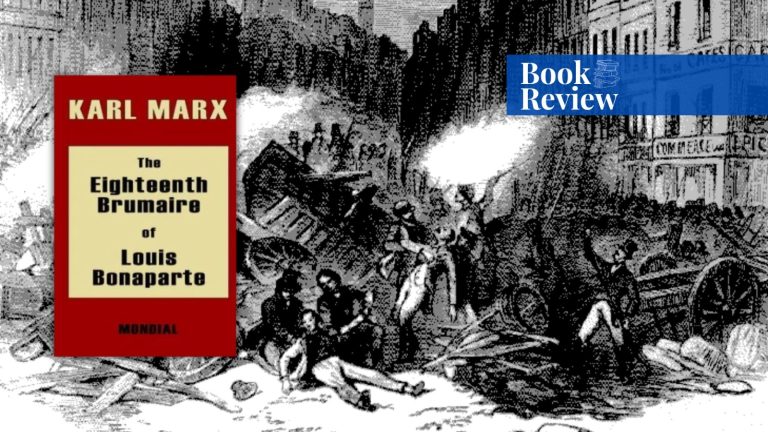
Karl Marx wrote The Eighteenth Brumaire of Louis Bonaparte in the winter of 1851-1852. It was subsequently published in Die Revolution (a German magazine in New York). By this stage Marx was politically isolated following the failure of the revolutions of 1848. The questions that were burning in his mind were those of the most stark compression of the circumstances. How did a revolution that had promised a republic and a better life end up with the nephew of the great Napoleon in power?
In February 1848, the revolution in Paris overthrew King Louis Philippe and established the Second Republic. The government promised work for the poor. That unity didn’t last long. In June, the workers rose up when the government closed the National Workshops, and General Cavaignac put them down, resulting in the deaths of thousands. By December of that year, Louis Napoleon Bonaparte (Napoleon III) had won the presidency by a very large majority. This was a victory achieved through the power of his name and the votes of the peasantry.
Over the next three years, he systematically dismantled and eliminated the power of the Assembly. It was not the last straw. On the 2nd of December 1851, he closed it down and arrested his opponents. That was the culmination of it all, in the form of making himself Emperor Napoleon III.
Marx’s Central Argument: History, Class Struggle, and Inherited Conditions
Marx rejects two facile answers. Hugo puts the blame on one evil man (the Bonaparte). Proudhon sees the coup as simply the natural outcome of history. Marx here is making the point that it was the class struggle that created the situation in which an ordinary, even ridiculous, man could be the hero. “Men make their own history, but not merely as they please; they do not make it under conditions of their own choosing, but under conditions inherited from the past.” Marx is saying that no individual can go beyond the conditions of history.
He sees the period 1848-1851 as a string of defeats. The February Revolution was an alliance of classes with conflicting interests, held together only by the vagueness of their objectives. When the Republic had to decide what it was going to stand for, that alliance broke up. The workers were crushed first, and the Republic became a middle-class affair.
The Bourgeoisie: A Divided Class That Surrendered Its Own Political Power
Marx is most amusing in his treatment of the bourgeoisie. He doesn’t present it as a single, monolithic ruling class. The legitimists were the big landowners and wanted the old Bourbon family back. The Orleanists were the bankers, the industrialists, and the traders. As they couldn’t agree on a king, they had to go with a republic. In their attempt to protect their property and maintain order, they destroyed the parliament, which was the very instrument of their political power. In the face of strikes, angry newspapers, and all sorts of protests, they decided it was safer to give up the political power and keep the money. The coup wasn’t imposed on them from the outside. In a sense, they invited it.
The Working Class: Defeat, Desperation, and the Need for Independent Organization
The working class comes in as a class that has been beaten before it was ready. The workers of 1848 still thought in terms of small experiments in the existing system, and the June uprising was more a case of desperation than a genuine attempt to seize power. They then joined the democratic middle class and were left by it. The lesson was a bitter one: the working class needed to have its own organization. Marx goes on to say that working-class revolutions learn from their defeats, criticizing themselves and starting again with the most ruthless honesty.
The Peasantry: The Social Base of Bonapartism
The peasants are the most interesting section of the book in so far as they tell us who Bonaparte really was. The little French farmers are a vast class in themselves, all living in much the same circumstances and with very little contact with one another. They are like potatoes in a sack. They have no national organization and so can’t speak for themselves. They identify with Bonaparte because his name brings back the time of his uncle, when their grandfathers had the land. Marx goes on to say that the peasants were in fact getting poorer and poorer, crushed under the weight of debt and taxation. Their loyalty was therefore based on a foundation that was already crumbling.
Other Actors and the State: Shopkeepers, the Lumpenproletariat, and the Bureaucratic Machine
Marx also has a host of other groups on the stage. The little shopkeepers and their representatives see every defeat as a mere fluke and every crisis as an opportunity to give a speech. The lumpenproletariat (the refuse of all the classes) was in the form of a gang who were all cheering for Bonaparte. Most significant of all is the state itself. The state’s vast machinery of army and officials had been created under the old monarchy, and every regime since had treated it as a prize to be won rather than a machine to be destroyed.
Bonaparte inherited it and could claim to be above all classes while ruling for no one in particular. The state thus appears to be above the classes, and the bourgeoisie were prepared to surrender their political power in order to retain their social power.
Critical Assessment: Strengths and Limits of Marx’s Account
The book has its drawbacks. It was written in a state of anger and doesn’t always distinguish between fact and invective. Bonaparte is frequently reduced to a joke, and it’s in these moments that you lose sight of his political acumen and the real degree of popularity he enjoyed. The historians are quite critical of Marx’s depiction of the peasants, finding it rather bleak and one-dimensional. That said, the book is really best read as a statement of method rather than as a fully formed doctrine.
Modern Relevance (I): Trading Political Freedom for Order
What givesThe Eighteenth Brumaire of Louis Bonaparte such a modern feel is the recurrence of its core pattern. The first of these is the phenomenon of people abandoning politics when they are tired or feel unsafe. Marx identified the middle-class voter giving up their political freedom in exchange for their money and their peace. Today, in so many countries, we see the same thing happening. People facing economic insecurity, fear of crime, or fear of chaos will often say they want order and a strong leader who will sort it all out. A leader who can promise to cut through the bureaucracy of parliament and the courts can command real support. Marx’s warning is that this is a very bad deal, as the freedom you give up is very difficult to get back.
Modern Relevance (II): The “Sack of Potatoes” and Populist Politics
The second is the “sack of potatoes.” Bonaparte reached out to the millions of divided people who had no organization of their own. That’s exactly what modern-day populist leaders do. They use television and social media to connect directly with the electorate, cutting out the middlemen of parties, unions, and local groups. Just like Bonaparte, such leaders will often claim to be speaking for the common man, with each group of people seeing their own particular aspirations in that leader. They will also be very fond of dressing up in the old clothes, with all the rhetoric about restoring the lost glories. That’s the farce of history according to Marx: going back to the old costumes to avoid having to face the new reality.
Modern Relevance (III): Hollowing Out Democracy from Within
The third one is how democracy can be undermined from within. Bonaparte didn’t abolish voting. He used elections and referenda to give his regime a veneer of democracy, while the real power was in the executive. That’s exactly what’s happening in so many democracies today. The courts are being squeezed, the press is being targeted, the rules of elections are being changed, and the powers of the state (which now includes the power of digital surveillance) are being greatly expanded. The constitution can become just a piece of paper if that’s the state of affairs.
All of this can be done in a legal manner and with the approval of the public. Marx demonstrated that a republic could be hollowed out without a single tank ever being seen in the streets by the very groups who thought they were acting in their own interests.
Limits of the Comparison
There are limits to the comparison, of course. We don’t live in 19th-century France, and history doesn’t repeat itself exactly. The peasantry is a very small group in most of the world today, and there are all sorts of new divisions (regional, educational, migratory, online, etc.). Yet Marx’s approach is still valid. It gets you to look past the personality of the leader and ask which groups are fearful, which are fractured, which have given up on politics, and which are in a position to benefit from a strong leader.
Conclusion: Why the Book Still Matters
The Eighteenth Brumaire of Louis Bonaparte is, in the end, both a masterpiece of historical writing and a work that is absolutely fundamental to the way you think about politics. It is a demonstration that you can’t understand politics by looking at the individuals involved or at the economy alone. It is a demonstration of how fear, of division, and of exhaustion can be used to drive a population to hand power to a man who promises to protect them. That is why it is still read, still debated, and still relevant to events that are in no way connected with the Paris of 1851.
If you want to submit your articles and/or research papers, please visit the Submissions page.
To stay updated with the latest jobs, CSS news, internships, scholarships, and current affairs articles, join our Community Forum!
Find our FREE quizzes and MCQs here!
The views and opinions expressed in this article/paper are the author’s own and do not necessarily reflect the editorial position of Paradigm Shift.

Bilal Khan Niazi is an undergraduate law student at Bahria University, Islamabad. His interests include political philosophy, history, law, and social justice. He is particularly interested in exploring the ideas that shape societies, political institutions, and the relationship between power and justice.