
A graveyard of empires, or a graveyard of its own civilization? If it is a graveyard of empires, where are those empires buried? For a generation, Afghanistan has been portrayed as a land where imperialist powers enter and meet their demise. Some attribute this to its inhospitable geography, while others credit the undefeated character of its tribal arrangements. There is no doubt that the country has endured invasions by Alexander the Great, Genghis Khan, the British, the Soviets, the Americans, and many other great armies. However, history suggests that Afghanistan has rarely destroyed invading powers on its own; rather, imperial exits followed from strategic limitations, changing global dynamics, and shifting domestic politics.
The phrase “graveyard of empires” always raises several questions. Were these empires annihilated forever in this graveyard? Did they meet their demise on Afghan soil? Did they return without having their political and military objectives achieved? And did Afghanistan emerge as a powerful state after these empires perished in the Hindu Kush?
After the withdrawal of the US from Afghanistan, scholars, journalists, geopolitical analysts, and many other segments of academia started debating the graveyard of empires. This popular thesis describes that region’s rough landscape and its populace’s warrior-like attitude as repelling the world’s most powerful militaries. In reality, this is not the case; Afghanistan is inherently undefeatable.
Historical evidence tells a different story. There were many empires that ruled many parts of Afghanistan, or some parts of it, for centuries. The prominent ones include: the Achaemenid Persian Empire ruled parts of current Afghanistan for roughly two centuries; the Kushan empires managed to control significant parts of the region; the Ghaznavid Empire ruled parts of the region for almost 200 years; the Mongols have invaded Afghanistan several times. The period of their rule varied across the region.
To begin with, it is a common misconception that Alexander suffered a defeat in the Hindu Kush region. Alexander conquered Bactria, a region in present-day Afghanistan. There was organized resistance by the local rulers, but Alexander crushed their military campaign. In 327 BC, he left Bactria and embarked on his Indian expedition through the Kabul valley. When he died in 323 BC, his successors ruled major parts of Afghanistan for generations.
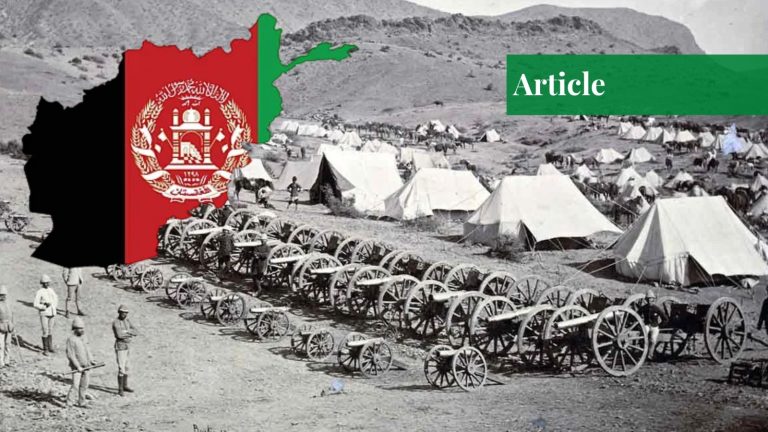
Similarly, the tactical catastrophe of British East India Company during first Anglo Afghan war (1839-1842) has been attributed to Afghanistan unvanquished nature. However, the reality is that the British Empire didn’t collapse; rather, it achieved its important strategic goals during the Second Anglo-Afghan War (1878-1880), making Afghanistan a vassal state. The territorial annexation of Afghanistan was never Britain’s main priority. Instead, the British wanted a controlled buffer state in their neighbors to contain Russian expansion and protect their empire in India. Then, through the Treaty of Gandamak (1879), the British gained control over Afghanistan’s foreign policy. Calling Afghanistan the graveyard of the British Empire is a historical misconception.
Without a doubt, the Soviet military intervention in Afghanistan was a strategic blunder. Yet, it was only one of several factors that contributed to the crisis faced by the Soviet Union. The Mujahideen did not single-handedly defeat the Soviet Union. Instead, economic and political pressures at home, along with Mikhail Gorbachev’s decisions, led to the withdrawal of Soviet forces in 1989. Before the withdrawal, Soviet forces controlled major Afghan cities, airbases, and other strategic locations; the Soviet backed military regime of Dr. Muhammad Najibullah survived for three years after their departure. It should be noted that the Mujahideen also received military support from the US, Pakistan, and Saudi Arabia. Therefore, the Soviet Union’s collapse resulted from internal economic failures, political decay, and Cold War proxy warfare, rather than from military defeat in Afghanistan alone.
The fall of Kabul to the Taliban in August 2021 added another chapter to the myth of Afghanistan as a graveyard of empires. In reality, the withdrawal of US forces resulted from changing strategic priorities and the failure to establish a sustainable Afghan political order. In 2001, US-led forces toppled the Taliban government within a few months and maintained their military presence in Afghanistan for 20 years. Therefore, the US withdrawal cannot be framed as a military defeat inflicted by popular resistance.
History shows that foreign powers did not meet their end in this graveyard. They entered and exited when their strategic priorities shifted. Alexander, after crushing local resistance, marched towards the Indian subcontinent. The British aimed to establish Afghanistan as a buffer state. The Soviet Union dissolved primarily due to its internal collapse. The US exited when remaining in Afghanistan no longer made strategic sense. Today, the US is enjoying its status as a global power while Britain and Russia remain important global actors. In the end, it is the people of Afghanistan who continue to suffer. Great powers entered the region, buried the glory of Afghan civilization, then simply exited.
If you want to submit your articles and/or research papers, please visit the Submissions page.
To stay updated with the latest jobs, CSS news, internships, scholarships, and current affairs articles, join our Community Forum!
Find our FREE quizzes and MCQs here!
The views and opinions expressed in this article/paper are the author’s own and do not necessarily reflect the editorial position of Paradigm Shift.
Zia ud din holds a BS in Political Science and hails from Zhob, Balochistan. His areas of interest include governance, public administration, democratic institutions and public policy.