Abstract
The digital class consciousness in Pakistan is undergoing a remarkable shift due to new levels of informational access, memetic culture, and global political conversations. Using a narrative ethnographical approach through postcolonial theory, media studies, and cultural studies, this analysis investigates how everyday digital productive acts, and memes more specifically, function as informal ideological apparatuses. Drawing from over twenty hours of participant observation online from Twitter, Facebook groups, and WhatsApp networks, and a sample of over 300 memes and viral images relating to class, the paper argues that these cultural texts are not only channels of class anxiety, but they are also performative mediated acts that reshape collective imagination and interpellate subjects into emerging class identities.
The analysis is approached through three interconnected registers. First, the analysis contextualizes memes within the conduit of digital production; platform affordances, algorithmic curation, and attention’s political economy before assessing how memes capitalized on pre-established patterns of visibility and/or marginalization. Second, it considers the affective dimensions of online communities and traces how humor, irony, and parody emerged as forms of articulating aspirations, resentments, and alliances across social class. Thirdly, it engages with the twin promises of digital liberation and the algorithmic containment of difference or dissent, while illustrating that platform capitalism is an audacious site of both amplification and disciplining of class narratives.
By rethinking engagements with class today, as narrative, mood, and aesthetics, curated, contested, and performed moment-to-moment on Telcom-Pakistani timelines, this research furthers our understanding of the dialectics of digital culture and social stratification. In doing so, it contributes to postcolonial digital scholarship through framing everyday memes as contested ideological sites of struggle for meaning, with both grassroots and top-down potential for enabling change and resistance to surveillance. Ultimately, it calls for a better understanding of how platformed publics mediate with and change class configurations in the Global South.
Introduction: Class and the Digital Imagination
The historical class fabric of Pakistan, based as it is on the structures of feudal landholding, military capitalism, and patronage systems, has been produced for decades through a hegemonic combination of state-sponsored school curricula, state-controlled media, and elite institutions that shape the national imaginary. In doing so, these institutions consolidated and structured concepts of class, social categories, and hierarchies through representations of meritocracy, religiosity, and, to a lesser degree, national salvation. Over the past decade, however, concatenations of developments in technology have begun to shake and ultimately displace that monopoly. With the ubiquity of smartphones, affordable mobile data, and the prevalence of social media over traditional forms of media, we are witnessing a digital turn in how class is articulated, represented, and critiqued. Historically relegated to drawing rooms, campuses, or political rallies, the conversation about class is increasingly taking place in fluid and asynchronous digital spaces, like Twitter timelines, Instagram reels, TikTok parodies, and YouTube explainers. The classroom no longer monopolizes the language of critique, now, digital spaces have displaced the hegemony of privileged spaces by democratizing access to discourses about inflation, job precarity, and structural violence. The historically excluded or baited are now able to articulate, perform, and negotiate their social positions in the modern world.
This paper asks:
- How does this enhance techno-cultural recalibration of class consciousness in Pakistan?
- What new imaginaries, languages, and aesthetics of class are produced when critique travels via 30-second TikTok rants or memes gone viral, as opposed to academic essays or journalistic exposés?
The study situates digital culture in three overlapping analytical frameworks: postcoloniality, cultural production, and platform capitalism, and utilizes some of Raymond William’s conceptualization of culture as “a whole way of life” (Williams, 1983) and Antonio Gramsci’s theory of cultural hegemony to consider how dominant class narratives are consolidated, resisted, or remixed in the digital public sphere.
Walter Benjamin’s (Benjamin, 2018) theoretical insights on mechanical reproduction are strategic when thinking about the political implications of how amplification and circulation are viral, while Jean Baudrillard’s hyperreality enables an investigation of how forms of class identity are mediated through elements of ironic distance and parody. Gayatri Spivak’s (Spivak, 1988) interrogation regarding the speech of the subaltern asks, can the meme-posting subaltern speak – and if yes, who hears them and under what conditions?
The study employs a narrative-ethnographic method as a way to address the affective, performative, and aesthetic aspects of online class discourse. The author conducted interviews with 20 Pakistani digital content creators, ranging from viral TikTok performers to educators on YouTube to meme page administrators. These conversations were enhanced by participant observation in virtual communities, including meme-sharing WhatsApp groups, Twitter subcultures, and Facebook communities.
A corpus of 500 differently categorized digital artifacts, memes, short-form videos, text posts, infographics, and trending hashtags was gathered and thematically coded. The analysis wishes to focus less on reductive metrics of activity, such as engagement and follower counts, and instead is committed to mushy text, thick description, and interpretive richness, to begin to show how humor, irony, nostalgia, and absurdity come together in classed experiences, frustrations, and aspirations.
The paper centralizes the expressiveness of everyday media users and makers. It presents digital media not as a neutral medium, but rather as a contested site of ideological struggle. The paper hopes to illustrate how ordinary Pakistanis are producing class discourse as much as they are consuming it, often through ways of making sense of the world that do not produce conventional political grammar. In the end, the paper would like to re-conceptualize class consciousness in Pakistan as an emotional, affective, and aesthetically mediated, rather than purely discursive, process, which is shaped as much by memes and moods as it is by material conditions.
Marx, Gramsci, and the Cultural Reproduction of Class
In order to make sense of the development of new class imaginaries in Pakistan’s digital ecology, it is necessary to start with the theoretical framing of Karl Marx and Antonio Gramsci, two of the seminal theorists whose work continues to energize current discussions of ideology, culture, and power. Marx gives us the structural explanation of class as a function of material relations and production, while Gramsci follows Marx into a cultural and political analysis that emphasizes the maintenance of power, not just through coercion, in the base sense of violence as a relation of conflict, but also through consent (that is not to say, though, that Marx did not also recognize the role of hegemony). Gramsci gestured towards the notion of ‘cultural hegemony’ as embedded in and supported through everyday routine habits and the cultural institutions that ensure dominance, thus permitting variation and difference as long as social safety budgets are not depleted.
At the heart of Marx’s argument is the notion of class struggle: our history is defined by the struggle between owners of the means of production (the bourgeoisie) and laborers whose sole means of survival relies on the sale of their labor (the proletariat). Marx argues that the ruling ideas of any given epoch are those of the ruling class. We might refer to this today as the “ideological superstructure,” which encompasses the various media, education, religion, and law. These institutions create, as it were, the “natural” conditions of production, justifying and legitimizing unequal relations of production, and allowing the exploitation of capitalism to appear not just “inevitable,” but “desirable.” As Marx famously wrote in The German Ideology (Marx, 1845), “The ideas of the ruling class are in every epoch the ruling ideas”.
Yet, classical Marxism’s insistence on economic determinism has frequently failed to explain why often would-be rebels do not, in fact, revolt as well as why they sometimes become internalized and even endorse the ideas of subordination that are nevertheless oppressive. This is where Antonio Gramsci begins his intervention. Gramsci argued that, in addition to force, a ruling class dominates by a concept, hegemony, cultural and moral leadership, or the leading by securing the consent of the governed. Hegemony functions in the realm of the everyday: through language, education, everyday culture, religious practices, and media narratives that produce a sense of what is “ordinary” or “common sense.”
Gramsci’s commitment to civil society, the web of organizations and institutions that produce meaning, invites analysis not only of how power is forced but also of how power is felt, told, and negotiated. In his Prison Notebooks, Gramsci argues that civil society is the site where “a war of position” is fought: slow, discursive struggles over meaning that might undermine hegemonic ideologies and plant the seeds of alternative sensibilities. This is particularly relevant in the context of the internet, where digital culture emerges as a contemporary civil society, fragmented, participatory, and thoroughly mediated by corporate bureaucracies.
In Pakistan today, class divisions are materially lived and ideologically reproduced through cultural narratives (who speaks; whose suffering is made visible; whose lifestyle is valuable; and whose existence is made invisible). This ideological work has been done most visibly by state institutions and elite media. But the age of platform capitalism has enabled social media to be both a site of hegemonic reproduction and a possible site of counter-hegemonic struggle. While memes and digital speech can be considered collectively as forms of vernacular speech, they are simultaneously modes of expression that straddle the boundaries between pedagogy and parody, and mourning and mockery.
Wherever we might stand in our analysis of class consciousness today, we must consider whether memes and digital speech are increasingly accessing a complicated terrain of digital culture that can be both a liberatory form of cultural production and a site of seclusion, a conceptual weapon as well as a conceptual trap. Gramsci’s dialectics of hegemony rings true here: domination is not total, and resistance is never pure. We cannot just try to decode memes or videos for their ideological content; we must probe the contexts/circumstances in which they circulate, the collective affective labor they summon, and the public(s) they hope to address.
Section I: Postcoloniality and the Crisis of Representation
In postcolonial Pakistan, class representation has often been mediated by the weight of nationalist narratives, elite control over worthy discourses, and institutional silence. Mainstream media and the state educational system, including publicly funded institutions, have traditionally served as ideological apparatuses wherein intentions to uphold structural inequality are concealed beneath sanitized myths of national cohesion or individual upward mobility.
In school textbooks, for instance, an examination of feudalism or dispossession is never performed; rather, estimations of landownership and wealth are made in romanticized language, characterizing these large swathes of land as “sacred” and identifying them as Pakistan’s “rural” or “cultural” heritage (Singh, 2024). These are not accidental or incidental elisions, but strategic moves to sustain the legitimacy of postcolonial power structures that are themselves intimately related to colonial forms of stratification and disparity in class.
Televised political discourse does not relent on class representation either. Political talk shows are most often broadcasted by English-speaking anchors, and corporate-sponsored analysts and expert pundits, whose etic of policing reproduced the illusion of democracy, consistently analyze crises of the economy in abstract, unidentifiable terms: inflation (statistical data); unemployment (policy); and, class struggle (failures in governance). Technocratic framings will encourage Stuart Hall (Hall, 1973) to abstract messages of “encoding,” wherein anchored messages are geared to reinforce hegemonic ideologies and marginalize or dismiss counter-narratives based on lived experience. This produces a controlled public sphere that, on the surface, appears pluralistic but is tightly patrolled by elite interests and representational conventions.
Conversely, the digital space represents a rupture of sorts in this epistemic order, at least in the form of these media voices; a space of contest and flux where the state and its institutional allies are not the only ones claiming representational authority. The voice of flying members from the working and lower-middle classes can now speak to political issues through platforms like social media, virtual spaces of non-gatekeeping. The voice of individuals through YouTube channels, Instagram pages like ClassMatterz, and a seemingly endless stream of smaller meme pages and explainers operate on small amounts of thresholds with reach, idea of a lower continuum within a comedically perceived ideology.
Content ranging from satire of IMF-induced austerity measures to the deriding of a small landlord is all created in a working-class vernacular, with regional idioms, accents, and images that mainstream institutional media might deem “unprofessional.” Yet, therein lies their potential; these digital productions were able to resonate with audiences through forms of media that they were not seeing or hearing themselves as represented within elite media.
They do not just inform, they perform. Through satirical images, textual critique, and narrative events of their lives, these performances establish moments of pedagogy, or in Paulo Freire’s (Freire, 1970) terms, critical consciousness, defining what he termed “conscientização.” Viewers of the comment sections often write their own stories of wage theft, day-to-day precarity, or shared grievances with landlords and employers. These conversations create what can be understood as a vernacular archive of class critique: a decentralized, crowd-sourced, memory-and-resistance archive that contests official state narratives. Representation is now a participatory act, rather than a passive representation.
In this way, it is easy to view these dialogues as a transformative moment, but we also need to contend with the deeper epistemological shift: the diminishing authority of top-down, one-way flows of knowledge. Digital publics no longer comprise passively consuming information, but are now producers, editors, interpreters, and critics. While knowledge continues to circulate, it does so through horizontal relationships between peers, community members, and people we don’t know, often outside of institutional television. This horizontalism calls into question older ideas of expertise and authorship, as people search out meme pages or TikTok explainers when making sense of class structures, tax reforms, or the cost-of-living crisis, an epistemology that feels more effective and materially rooted than watching a panel of experts on television.
This emerging counter-public is hardly devoid of inconsistencies. Gayatri Spivak’s question “Can the subaltern speak?” lingers over these new media in nuanced ways. On the one hand, memes, parody videos, and digital storytelling provide the subaltern with new modes of articulation that dodge conventional institutions of intelligibility. Yet, the representation of these articulations comes with ever-present risks of algorithmic flattening. Content is sorted by virality, not depth; digital space rewards speed, sensationalism, and aesthetic coherence at the expense of structural critique. A meme that critiques the elite’s capture of state resources might go viral, but devoid of context, it is merely seized upon as yet another consumable piece of content to be consumed in the midst of the infinite scroll.
Further, the infrastructural aspects of this digital space, platform capitalism, surveillance algorithms, and data extraction introduce new kinds of threats to subaltern visibility. A page like ClassMatterz might develop a radical following only to be shadow-banned for violating “community guidelines,” which are vague and inconsistently invoked. Representation is thus a contested site: visibility itself is rendered fragile, and speech acts exist in a context where they can be erased, distorted, or commodified at any time.
Section II: Memes as Subaltern Speech Acts
Whether still images embellished with wording, shorts, remix culture, or screen-recorded parody, memes represent condensed units of meaning, thick with affect, irony, and critique coded in culture. They are the visual vernacular for digital publics, often ephemeral in form, but lasting in sociocultural impact. Memes at times resemble textual manifestos and editorial essays but are accessible as humor, searing in their economy, and explicitly present in the shared cultural consciousness of their connoisseurs. They are not expressive of only internet culture; they are rhetorical, being packed with ideological meaning.
To consider memes in a critical methodological stance is to consider memes as cultural negotiations; while memes are sometimes trivial demonstrations of youth boredom, they also can be used as serious, powerful expressions used for social negotiation, particularly in ways created by those positioned outside of power. Memes can serve as a critical performance similar to Judith Butler’s (Butler, 1990) theorizing of performativity, while class does not exist without being performed, it is useful to consider that memes can be performative, and follow other iterations and inscriptions in repetition as gender in Butler’s assessment. Memes perform and cite already existing class narratives such as precarity, exclusion, aspiration, or resistance, while also destabilizing these narratives in parody and exaggeration.
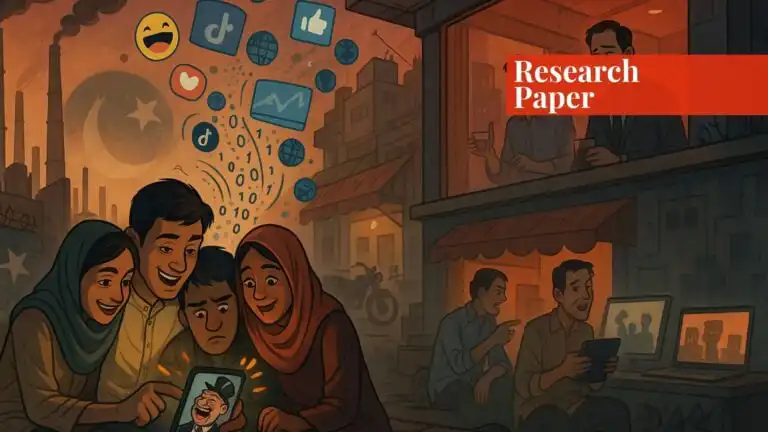
Think about the ever-circulating meme format that superimposes highly aestheticized images of opulent “Sunday brunches” with ironic captions, such as “state-sanctioned austerity measures.” Or the viral TikTok video compilations that complement influencer tourism content with footage of families displaced by inundation in Sindh. The juxtaposition of these content types functions as a semiotic protest, being affectively dissonant in their revelation of class inequalities. These instances of digital culture inform Jean Baudrillard’s (Baudrillard, 1994) contentions on simulation, blurring the boundaries between the real and that represented. When flood victims’ pain is aestheticized in memes, there is a risk of consumption as spectacle, while simultaneously, this memetic visibility keeps injustice in circulation, and dampens the ability to nullify or ignore it.
To simply characterize some of these memes as “subaltern speech acts” is to consider their incorporation of voices from groups that are linguistically or politically silenced. The subaltern may not be able to “speak” through typical academic or political descriptors, but they can gesture, meme, and parody. This is not “just” entertainment; it is communication. It is always political and often a critique of dominant meaning-making.
Take a harmless TikTok in which a gig worker lip-syncs to a romantic Bollywood song, only to disclose in subtitles that they have not been paid by their employer in three months. Or consider a stitched video where domestic workers put their cramped kitchen alongside the marble countertops of a day in the life” influencer. These are not just acts of mimicry; they are counter-mimetic acts that instrumentalize leisure platforms as sites of witnessing and testimony. In this case, personal is political, but spoken in emoji, irony, and low-resolution rage. While they may not adhere to the standards of intellectual critique, they communicate in a way that is visceral and sometimes viral.
Furthermore, memetic speech acts bypass existing gatekeepers of discourse. Unlike journalism or scholarship, memes require no editor, no institutional endorsement, and no privileged linguistic capital. This arises out of a difficult freedom from already dominant cultural forms, which Gramsci calls organic intellectuals. The organic intellectual is someone who comes from within their class to speak of that class’s experience. Memes enable these new intellectuals, not scholars or public policy experts, but delivery riders, students, market vendors, and call center workers, to critique the structural limitations of their exploitation, as this type of production is participatory and accessible.
Nevertheless, it is the ambiguity of memes that contributes to their radical possibilities. A single meme can be read as critique and celebration, satire and submission. It is a feature, not a bug, of the meme that it expresses ambivalence, reflecting the contradictions of subaltern existence under digital capitalism. The oppressed do not speak with a united voice; they speak with rupture, or through jokes, or in gestures that are only kind of meaningful. The oppressed might ridicule elites in one moment and then, in the next, engage in aspirational mimicry, which by the way is not failure in class consciousness, but rather is a mirror to the formation of it: dialectical, partial, always in process.
Memes in this sense are actually more than representations of class struggle, they are also tools of class struggle. They facilitate collective rehearsals of rage, communal thinking through despair, and dissemination of dissident positions passed off as entertainment. What at first appears to be a joke can carry the accumulated weight of unbelievable grievance, situating the comic amongst a profusion of code-switching, sarcasm, and visual puns. Thus, memes become encrypted repositories of classed experience, performed not on the streets or within unions but rather on scrolls, swipes, and shares.
Section III: Global Discourse and Local Affect
The role of the digital sphere has erased the boundaries between local and global, and we find the online communities of Pakistan always in conversation with a global world, whether this is in terms of Black Lives Matter, #MeToo, climate justice, the criticism of late-stage capitalism and its associated precarity, and so forth. Ideas are not simply unimodal or one-way; the discourses and movements that happen on a global scale are also always inflected by the context of Pakistan as “glocalized” remixes that draw meaning from here and are centered on the sociopolitical.
Remixing here is not simply the act of using or taking the global movements and discourses, but also that they are translated and remixed from the context of Pakistan’s social realities. These translations can be understood as acts of resistance and meaning-making as young Pakistanis process their lived realities within what are often increasingly untenable emotional and ideological positions.
A telling example of this remixed discourse can be found in the meme format “chador debug,” which amusingly recasts the discourse of global technocracy, alongside the discourse of flood management, in Pakistan. The discourse was able to hybridize globalized technocratic discourse, specifically terms related to debugging software, with local everyday discourses related to an age-old problem of flood management in Pakistan. The term “chador” (a conventional garment worn by women in Pakistan) is a locally grounded cultural reference, but when it is juxtaposed with the language of “debug” and other techno-cultural terms, it generates a hybridization of global discourses with local realities.
Such hybridizations are not mere mimicries; they create a language and form of expression that captures both the technological hurdles of contemporary governance as well as other integral struggles of the Pakistani people. The comedic nature in which memes such as this represent provides a way to make sense of the stark nature of the reality of disaster management work while illuminating the absurdities related to both technocratic solutions related to global governance and failures of governance on a local level.
Yet, aside from the technical and political criticism that are integral to how these digital formats develop, there exists a deeper layer of meaning that plays a more significant role in this digital engagement. Memes, hashtags, and reels, shared on sites like Instagram and Twitter, are not just political critiques or cultural observations. They are affective artifacts, forms through which young Pakistanis feel and emote. They invoke a shared and collective process of making sense of how to articulate their experiences of mental health, intergenerational trauma, and precarious work lives, and the very act of sharing memes can, in some instances, represent a public understanding of the personal and the collective. Young people, overwhelmed by instability in the economy, limited job prospects, and social expectations, utilize these modes of digital engagement to feel connected and express individual and collective experiences.
Rutu Modan’s (Modan, 2021) term “transnational affect” sheds light on this process. Modan argues that emotions, such as anger, frustration, and solidarity, are not bound to particular national contexts but instead flow through nations, taking shape and power based on local contexts. Therefore, previously bound by specific national struggles, presently the emotions brought about during global struggles circulate worldwide, but take shape and haunt differently based on context.
In Pakistan, the vocabulary of the global protests calling for climate justice or protests against systemic violence entwines with the local struggles of poverty, corruption, and authoritarianism, so that these prior sites of protest do not remain still and static. They are constantly being re-shaped and adapted into local political and social landscapes.
Critics may say these examples embody shallow mimicry of Western constructs without engaging the intellectual and conceptual foundations that animate the constructs. However, this critique undervalues the creative and intellectual work to translate discourse on a global level into something of local relevance. The act of “glocalization” and the very act of applying ideas that are foreign with local relevance is powerful intellectual agency.
Pakistanis insert local references in various ways (e.g., in the case of memes, it could be with Punjabi proverbs, Urdu poetry, or Sindhi folk music), defiance of Western hegemony, and assert act assert intellectual and cultural autonomy. This isn’t imitation. It is cultural negotiation and integrating the rich and varied intellectual tradition related to Pakistan’s multiple languages and traditions. A meme might combine a global call with reference to a local Faiz Ahmed Faiz poem. This multilayered approach makes connections with both meta-global and local. It is important to emphasize the connections and connections here, rather than opposition, that also demonstrate the sites of cultural production.
Conclusion: The Memescape as Ideological Battlefield
Class consciousness in Pakistan today is no longer formed in the forge of factory floors or union halls. Instead, it is being formed in feeds, timelines, and notification pings. Digital culture, manifested on platforms through memes, short-form videos, and hashtag activism, works as a new ideological apparatus that shifts how subjects see their social location and how they imagine changes to the status quo.
While the earlier forms of class struggles articulated in the struggle against the exploitation of labour and organization of labour in actions were framed by the material antagonisms between classes, the contemporary terrain for class consciousness is digital, disjointed, and inescapably cross-linked to global patterns of flow. In this contemporary battle for the recognition of identity, belonging, and justice, we find ourselves fighting in the ephemeral circulations of screens and social networks where power makes itself both invisible and palpable to the senses.
This paper has claimed that memes, while no more than frivolities of pop culture, are subaltern speech acts that carry both humor and trauma. These digital objects critique systemic injustice in pressing culturally appropriate ways that people engage with and satire. However, memes are confined to the logic of the very systems they seek to challenge. Unlike traditional epistemology, the ins proto-political use of memes as speech acts is directly encumbered by the capitalist encodings of the economies of the digital commons. Their active loci at the point of production, more often than not unpaid, the visibility of creators of viral content is algorithmically determined as forms of precariat labour.
The content of memes does not dictate public engagement, and so the algorithms of profit make them available either for sporadic self-expression, sensationalism, or populism. The tension that propels the disruptive premise of subversive memes and their commodified and captured existence through capitalist appropriation and commercialization ultimately subverts their radical/epistemological potential.
Although memes can be used to express solidarity and can potentially help amplify global movements, like movements like #BlackLivesMatter or #MeToo, they can also be weaponized to perpetuate hegemony. The idea of glocalization, adapting global ideas to local contexts, is both liberatory and dangerous. In the context of Pakistan, global movements that do not acknowledge the local context, one which is based on a deeply entrenched reality of patriarchal and feudal systems, can trigger a clash of local and global paradigms.
The digital forums within which memes circulate represent sites of cultural negotiation, where the global must reckon with local traditions, values, and histories. This collision of the global and local paradigm creates a now-stable space within which liberation and enslavement co-exist, but are often contradictory, and the coexistence remains complex.
By engaging these tensions, scholars can better understand the politics of digital culture in postcolonial spaces. For the young Pakistani, the meme might act in ways deeper than mere entertainment or social commentary. It can act as the manifesto they never signed, however, it bears witness, through the ancestral language of pixelated irony, to the deepest fractures of their world, fractures that are perhaps material but remain profoundly emotional, cultural, and ideological.
These young people, submerged in a web of global capitalism and localized power structures, are not just deploying memes as tools of resistance; they are sifting through them to flesh out how they fit in a world where few answers seem to exist. And for Pakistani youth, the meme may be the manifesto they never signed, but one that speaks, in pixelated irony, to the deepest fractures of their world.
References
- Baudrillard, J. &. (1994). Simulacra and simulation. University of Michigan Press.
- Benjamin, W. (2018). The work of art in the age of mechanical reproduction.
- Butler, J. &. (1990). Feminism and the Subversion of Identity. Gender Trouble.
- Freire, P. (1970). Pedagogy of the Oppressed. Herder and Herder, New York.
- Hall, S. (1973). Encoding and Decoding. Classics In Media Theory.
- Marx, K. &. (1845). The German Ideology. Marx and Engels, Collected Works.
- Modan, R. (2021). Exit Wounds. Drawn & Quarterly.
- Singh, P. (2024). Delusional States: Feeling Rule and Development in Pakistan’s Northern Frontier: Nosheen Ali. Cambridge University Press, New York.
- Williams, R. (1983). Culture and society. Columbia University Press.
- Spivak, G. C. (1988). Can the subaltern speak? Imperialism.
If you want to submit your articles and/or research papers, please visit the Submissions page.
To stay updated with the latest jobs, CSS news, internships, scholarships, and current affairs articles, join our Community Forum!
The views and opinions expressed in this article/paper are the author’s own and do not necessarily reflect the editorial position of Paradigm Shift.

Momina Areej is currently pursuing an MPhil in Clinical Pharmacy Practice. With a passion for writing, she covers diverse topics including world issues, literature reviews, and poetry, bringing insightful perspectives to each subject. Her writing blends critical analysis with creative expression, reflecting her broad interests and academic background.