
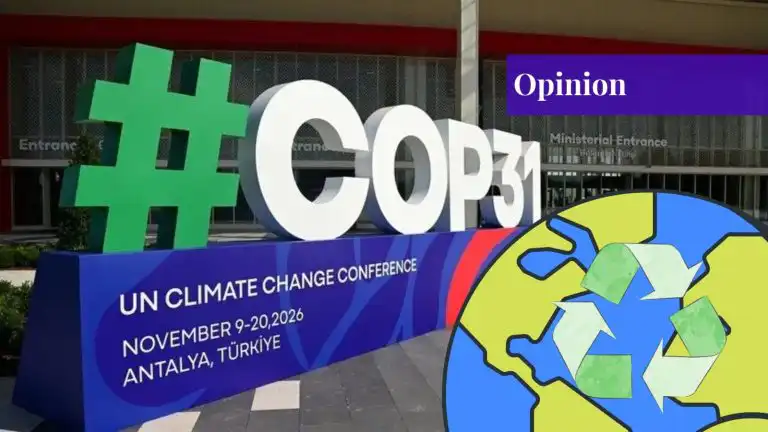
When delegates from nearly 200 countries gather in Antalya today, they will meet in a world very different from the one that produced the Paris Agreement. Wars in the Gulf and in Ukraine are absorbing political attention and public money. Just 77 heads of state or government are scheduled to address the summit, a third fewer than at the COP28 peak. COP31, which runs until 20 November, is therefore less a technical negotiation than a test of whether multilateral cooperation can survive great-power rivalry.
Climate Is a Security Question
The Strait of Hormuz crisis shows that climate and security are one conversation. Import-dependent economies have been battered by an oil and gas shock, while Climate Home News reports that rapid clean-power growth and electrification have shielded China from the oil shock more than any other country, according to experts. The energy transition is no longer only about emissions. It is about who can keep the lights on when a chokepoint closes.
Yet ambition is slipping. National climate plans now promise about half the emission cuts the UN expected: 2035 emissions would be just 6 per cent below 2019 levels, against 12 per cent projected last year, after the US exit from the Paris Agreement and weak new pledges.
The Money Problem
Finance is where trust is eroding fastest. At COP30, governments agreed to “at least triple” adaptation finance for developing countries by 2035, but the last-minute deal left out the baseline year, a headline amount, who should pay, and how money would be delivered. The arithmetic is sobering. The new UN Adaptation Gap Report shows that even if tripled by 2035, adaptation finance would reach only $85–120 billion a year against estimated needs of $305 billion.
The least developed countries want the goal set at $120 billion a year by 2030. They also note that an earlier target of roughly $40 billion for 2025 is likely to have been missed. Meanwhile, donor budgets are shrinking: the UK told the Green Climate Fund it would deliver only half of the £1.62 billion it pledged as it spends more on national security, and some European governments have cut aid. In Bonn in June, rich countries led by the EU, the UK, and Japan blocked an attempt to anchor the triple goal in the adaptation talks, and the session ended in gridlock.
Measuring Resilience
Money is only half the problem; the other half is knowing what it buys. Negotiators could not agree on the Global Goal on Adaptation, leaving open how to advance the 59 adaptation indicators adopted at COP30. Without agreed indicators, donors can claim progress that communities do not feel, and recipients cannot show where aid has reduced risk. COP31 is also expected to address the implementation of the Belém–Addis Vision on Adaptation, resilience indicators, and access to the Fund for Responding to Loss and Damage. Türkiye, which bridges developed and developing economies, is well placed to build consensus as a host, but it will need the political capital of larger powers that are currently distracted.
Rivalry Enters the Agenda
The divisions are now spilling into procedure. African negotiators have asked the UN for three additional agenda items on tripling adaptation finance, the Green Climate Fund’s financing arrangements, and trade and climate change, setting up a possible fight before substantive talks even begin. Trade is especially contentious. Developing countries object to unilateral measures such as the EU’s carbon border tax, and China has signaled that it wants COP31 to confront “protectionism” and the free flow of green technology after US and EU curbs on its cleantech exports. Climate diplomacy is being pulled into the same contest over supply chains and industrial power that shapes every other arena.
Pakistan’s Case Is Concrete
For Pakistan, none of this is abstract. The 2022 floods caused $14.9 billion in damages and $15.2 billion in economic losses, with reconstruction needs of at least $16.3 billion, according to a joint assessment by the World Bank, the Asian Development Bank, the EU, and the UN. The World Bank said more than 33 million people were affected. Two years later, the planning minister reported that pledges of $10.9 billion had been received against recovery needs of $16.2 billion. That is the adaptation gap in miniature: a country that contributes little to global emissions absorbs the shock, then waits for the money.
What Pakistan Should Demand
Islamabad is not an LDC, but its interests overlap with theirs, and its voice carries weight in the G77. It should press for four outcomes.
First, a measurable tripling goal with an agreed baseline, a clear annual figure, and a grant-based emphasis so that vulnerable countries do not borrow their way through disasters they did not cause. Second, operational loss and damage finance: developing-country voices argue that a capitalized, grant-based fund that begins disbursing in 2026 is the minimum credible outcome, and delegates should insist on real access for climate-hit countries.
Third, recognition that energy security is climate policy. Pakistan’s dependence on imported gas and oil has been exposed by Hormuz, so finance for renewables, grid upgrades, and electrification should be treated as both mitigation and national resilience. Fourth, solidarity in the agenda fight: backing the African Group’s procedural requests costs little and strengthens the negotiating bloc.
The Test Ahead
There is a practical benchmark for Antalya. If the summit ends with a defined baseline for tripling adaptation finance, a working loss and damage fund and credible resilience indicators, it will have shown that the process still produces results under pressure. If it ends with procedural deadlock, developing countries will draw their own conclusions about the value of the system.
COP31 will not end geopolitical rivalry, and it should not pretend to. But it can show that cooperation on shared risks remains possible even when governments disagree on almost everything else. The measure of success will not be another communiqué about ambition. It will be whether the countries already living with floods, heat, and fuel shocks can see money, rules, and accountability that match the scale of their exposure.
If you want to submit your articles and/or research papers, please visit the Submissions page.
To stay updated with the latest jobs, CSS news, internships, scholarships, and current affairs articles, join our Community Forum!
Find our FREE quizzes and MCQs here!
The views and opinions expressed in this article/paper are the author’s own and do not necessarily reflect the editorial position of Paradigm Shift.

Azhar Ud Din is a student of international relations at Government College University, Lahore.