
Introduction
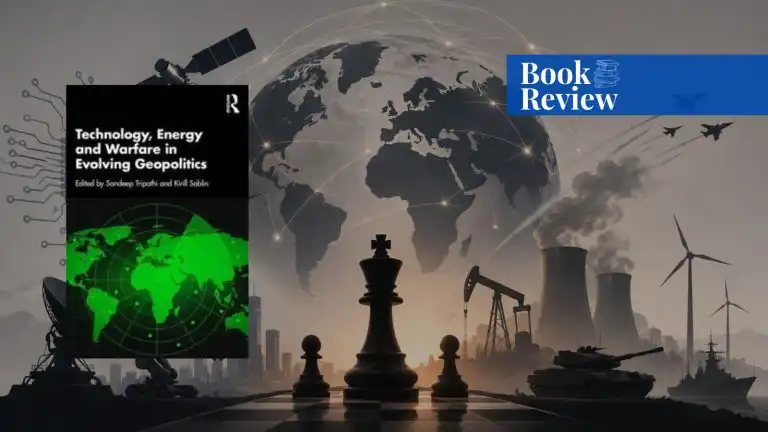
The global strategic landscape is changing rapidly. In the book “Technology, Energy, and Warfare in Evolving Geopolitics,” published by Routledge, editors Sandeep Tripathi and Kirill Sablin explore how technological shifts, energy resources, and modern conflict are reshaping the international order. The book is a collection of several chapters written by different authors. Together, these contributors provide a comprehensive and versatile overview of the evolving global power dynamics.
The book further argues that technological advancements, changing energy dynamics, and transforming methods of warfare cannot be studied in isolation. The authors used several case studies to explain how the distribution of technology, energy, and warfare has affected relationships between states, governments, international organizations, and other actors. The book is divided into three themes: technology and geopolitics, energy and geopolitics, and warfare and geopolitics.
Editors’ Background and Academic Contributions
The book is edited by two authors: Sandeep Tripathi and Kirill Sablin. Sandeep Tripathi is the founding director of the Forum for Global Studies, New Delhi, and a visiting professor at the Institute of History and International Relations at Southern Federal University, with an academic portfolio in international relations, and has extensively worked on global affairs. Kirill Sablin’s research focuses on economic development, technological sovereignty, and emerging economies, with a profound focus on political economy and energy studies. The combined expertise of these authors offers a detail-oriented analysis of technology, energy, and warfare and their effect on evolving geopolitics.
Technology and Geopolitics: Emerging Technologies and Strategic Competition
The first section of Technology, Energy, and Warfare in Evolving Geopolitics examines the impact of technology on production and economic growth. It highlights the role of technology in impacting security and global governance. Artificial intelligence (AI), the Internet of Things, biotechnology, and digitalization are described as technologies blurring the lines between the physical, digital, and biological domains. The authors link these technologies with human security. However, they argue that economic, health, environmental, and political security are increasingly influenced by technological advancements.
The discussion then moves towards the pros and cons of technology. The authors argue that the Fourth Industrial Revolution has increased productivity, communication, and access to information, but it simultaneously creates unemployment, inequality, cyber threats, and political instability. Therefore, the book calls for a global governance framework to regulate emerging technologies and counter these digital threats. The authors argue that technology has created independent platforms that require governments, private companies, and civil society to respond collectively.
The section on cyber espionage discusses another dimension of technological competition. By highlighting the possibility of covert involvement of states in other states’ affairs, the biggest problem with cyber espionage is that its covert nature allows operations to be conducted remotely and may remain undetected. The section includes case studies of the Edward Snowden revelations and alleged US surveillance of German officials. The section ends by emphasizing the ability of states to conduct and deny such operations, raising the risk of escalation.
Further analysis on the theme examines how the initial Israeli efforts to develop technology for innovation transformed into an instrument of international influence. The section discusses tech-driven defense systems, cybersecurity, and civilian innovation. It also highlights Israel’s growing cooperation in the Gulf region in fields such as water management, clean energy, defense, and technology. The Abraham Accords, I2U2, and other regional efforts are therefore seen not only as diplomatic treaties but also as platforms for technological capabilities to create geopolitical influence.
Technology, Energy, and Warfare in Evolving Geopolitics then discusses the importance of the Strait of Taiwan. The author argues that despite its small size, it has gained immense importance because of its production of semiconductors. Semiconductors are required for renewable energy systems, AI, communications, and military technologies. While China is highly reliant on Taiwan for semiconductors, Beijing still perceives Taiwan as a key security concern. The authors thus conclude that national security can outweigh economic benefits from interdependence.
The final contribution to the theme of technology and geopolitics highlights the role of technology in shaping India’s position in regional and international spheres. The idea behind it is that technological success can give states geopolitical benefits, as seen in the past with military technology, industrialization, and nuclear weapons. In the Indian context, technological development is articulated as a way of bolstering economic development, defense capacities, and strategic independence. Thus, the section reinforces the broader argument of the book that technology is no longer simply an economic asset but a significant component of national security.
Energy and Geopolitics: Energy Transition and Great Power Competition
The second theme shifts the focus to energy and demonstrates that the transition towards cleaner energy does not depict the end of energy geopolitics. The discussion on Southeast Asia portrays the region as an emerging theater of great power competition, given its rising energy consumption, natural resources, critical minerals, maritime trade, and potential for renewable energy. China offers extensive green-energy technology and financing, while the US focuses on technology cooperation, investment, and policy support. The green transition is thus a new space for influencing supply chains for acquiring critical minerals and renewable resources.
The energy section then transitions to South Asia, focusing on Nepal as a green hydrogen hub and India’s energy diplomacy. Within South Asia, hydropower potential can support hydrogen production, cleaner industrial processes, and regional energy exports. By contrast, the energy diplomacy of India is analyzed in the light of its rapidly growing energy demand and its simultaneous drive towards an energy transition. Energy diplomacy has become an integral component of India’s foreign policy, as ensuring energy supplies is connected to economic growth, national security, strategic partnerships, and regional influence, making South Asia a growing space of intersection between energy needs and geopolitical competition.
The final part of the energy section examines the Horn of Africa (HoA) and the Russia-Ukraine war to demonstrate the continuing strategic importance of energy security. The close geographic proximity of the HoA to the Red Sea makes it important for maritime trade, transportation of critical earth minerals, and great power competition. The book suggests that changing energy networks is costly and time-consuming; therefore, energy acts as an economic resource, a source of political leverage, and a strategic vulnerability.
Warfare and Geopolitics: Technology and the Changing Nature of War
The third part, “Warfare and Geopolitics,” explores the impact of new technologies on the nature of war. AI is offered as a paradigm shift in decision-making, surveillance, cyber operations, autonomous systems, and cognitive warfare/disinformation. It has a dual-use nature, and thus, while using AI, civilian technologies can be used in autonomous warfare, cyberattacks, and information manipulation. The authors believe that future military success will increasingly depend on the effective use of technology, rather than the size of the force.
The book then explores new-generation warfare, arms export, emerging technologies, and hybrid warfare. The current conflicts are a mix of conventional force, cyber warfare, AI, and autonomous systems. Arms exports are also considered tools of geopolitical influence, and Türkiye, South Korea, and Israel are becoming significant exporters. Such transfers can strengthen strategic partnerships while also contributing to proxy conflicts and instability.
The last chapters of Technology, Energy, and Warfare in Evolving Geopolitics are dedicated to India and the rise of its hybrid warfare capabilities. New technologies improve sensor capabilities, automation, speed, accuracy, and range, and hybrid warfare is becoming more common, creating a grey zone between war and peace and between state and non-state actors. The suggested solution is enhanced ISR, cyber defense, information warfare, and civil-military integration. The section is generally about how technology is changing the nature of weapons and the broader strategic context of war.
Critical Assessment: Strengths and Limitations
The major strength of Technology, Energy, and Warfare in Evolving Geopolitics is its ability to connect technology, energy, and military power across diverse geopolitical contexts. The Taiwan semiconductor case illustrates the strategic vulnerabilities created by technological dependence, while the Russia-Ukraine war demonstrates how energy can function as a source of geopolitical leverage, and the AI and hybrid-warfare chapters show how technology is reshaping contemporary conflict. However, the wide scope of the sixteen chapters means that the connections between the three themes are not equally developed. The strong focus on India also gives parts of the warfare section a more regional character. Nevertheless, these limitations are understandable in an edited volume.
Conclusion
The crux of Technology, Energy, and Warfare in Evolving Geopolitics is that geopolitical power is increasingly shaped by the interaction of technological capabilities, energy resources, and military capacity. Its case studies demonstrate that interdependence can generate cooperation while simultaneously creating strategic vulnerabilities that states may exploit. However, the book remains more descriptive than analytical in some areas and gives limited attention to the conditions under which interdependence produces cooperation, competition, or coercion. A stronger theoretical framework connecting these dynamics would have made the book’s central argument more coherent and strengthened its contribution to the study of evolving geopolitics.
Overall, Technology, Energy, and Warfare in Evolving Geopolitics is a timely contribution to the study of strategy and international relations. Despite the need for stronger theoretical integration, it provides a useful foundation for understanding how technology, energy, and warfare are reshaping geopolitical competition in the twenty-first century. The book will be particularly useful for students, researchers, policymakers, and scholars of international relations, strategic studies, and geopolitics.
If you want to submit your articles and/or research papers, please visit the Submissions page.
To stay updated with the latest jobs, CSS news, internships, scholarships, and current affairs articles, join our Community Forum!
Find our FREE quizzes and MCQs here!
The views and opinions expressed in this article/paper are the author’s own and do not necessarily reflect the editorial position of Paradigm Shift.

Raja Zark Ullah Khan is a research assistant at the Centre of Aerospace and Security Studies (CASS), Lahore. He can be reached at info@casslhr.com.