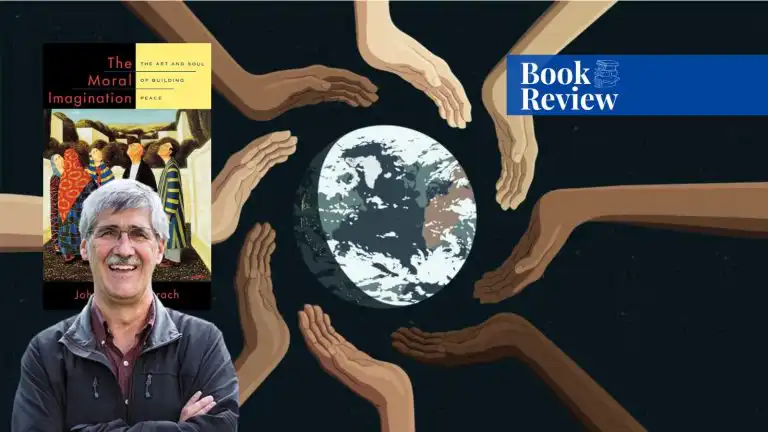

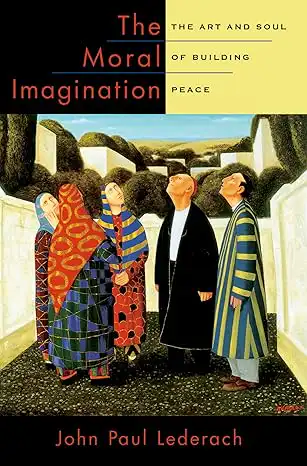
In his book, The Moral Imagination: The Art and Soul of Building Peace, John Paul Lederach discusses how moral imagination is a transforming element in the peacebuilding process. This book is more of a guide for peace work practitioners and not just an academic discourse. It is a guide that thinks of creativity, paradox, and how change can be achieved in an environment that is entrenched in conflict. Lederach, as a decades-long scholar and practitioner of peacebuilding, is an experienced individual who can share his expertise on the subject. This book can be seen as a follow-up to his earlier books on peacebuilding, which further detailed his insight into the inner workings of moral imagination in the field of peace.
Synopsis
The central point of the book is that we can get over violence by building moral imagination, an imaginative power that helps individuals to envision and create something that is unseen by the boundaries of violence and war. According to Lederach, this process can be referred to as a process of creativity, as the process involves the exploration of a world of possibilities. Moral imagination is the most important part of Lederach’s argument because it is used to overcome the dualistic perspectives that, in most cases, are dominant in conflict situations. It is the ability to bring the ostensibly opposing forces together and find alternative and new solutions that break the cycle of violence (Lederach, 2005, p. 5).
According to Lederach, peacebuilding is far beyond ending violence or even mere conflict resolution. It is a means of art that necessitates creating fresh social realities on a foundation of new ground. As such, peacebuilding is not a process but an active relationship process that entails immense creativity, imagination, and emotional intelligence. Lederach brings the notion of peacebuilding as a vision whereby the parties in the conflict management process are encouraged to transcend the traditional paradigms that usually define success, such as signing a peace treaty or imposing a ceasefire. Instead, he implies that the true definition of peacebuilding is in the capability to transform the relationships and provide people with the opportunity to create a new and just social order.
Components of the Moral Imagination
This transformation lies in the moral imagination, which, according to Lederach, has four important components. The first one is the capacity to place oneself in a network of relationships and to extend this capacity to one’s enemies, promoting empathy and understanding. Second, the ability to maintain paradoxical curiosity, the ability to think simultaneously in many, even incompatible, ways, without becoming dualistic.
Third, unshaken confidence in the strength of creativity, in the fact that new solutions can be found even in the most locked-in situations. Last but not least is the readiness to enter the unknown, which requires one to be vulnerable and risk-taking in pursuit of enduring peace (Lederach, 2005, p. 62). When combined, these principles make a peacebuilding process that, inasmuch as it is about the attainment of concrete political agreements, is also about emotional and relational development.
Lederach’s Take on Peacebuilding
The Moral Imagination has one of its strengths in its definition of peacebuilding as a process that is based on personal and communal change. Lederach questions the belief that peace is possible only with the help of agreements or political force. He condemns the realpolitik, which is the politics of pragmatic power relations, claiming that it does not appreciate the relational and human aspects of sustainable peace (Lederach, 2005, p. 61). The critique is especially applicable in the present geopolitical context, where peace agreements are seen as a way of achieving short-term stability, rather than long-term change.
Speaking of the issues of peacebuilding, Lederach acknowledges the complexity of the violent environments and mentions that true peace implies that a person has to consider the tiny, almost imperceptible aspects that help establish permanent change. He encourages the substitution of episodic peace operations by sustained and relational operations where the aim of peace is not the result but the process of building trust, understanding, and cooperation. The commitment towards the peace-building process that is long and infused with the creativity and relationship-building that Lederach reflects on offers a new and well-rounded human approach to the solution of the conflict.
Lederach concurs with this by stating that the moral imagination must have profound knowledge of the violent landscape where peacebuilding functions. Through this and by using multiple stories and examples of certain countries like Ghana, Colombia, or Tajikistan, Lederach shows how people and societies have adopted the moral imagination to overcome violent patterns (Lederach, 2005, p. 35). The use of personal anecdotes and thoughts, which permeate through the text, adds a richness and emotional depth to the theoretical dialogue and makes the book not only an academic tool but also a personal analysis of peacebuilding.
Final Thoughts
Despite the fact that the book is highly conceptual and practical, it might not be easily understood by readers who were not exposed to the intricacies of the theory of peacebuilding. Some of the language employed is heavy, and the philosophical thoughts that Lederach puts forward to explain the nature of the moral imagination might take more than one reading to take in. Nevertheless, there is no use denying the fact that the book is very influential to those who dedicate their time to comprehending the inner mechanics of the conflict and the opportunities human creativity has to break the barrier.
Structurally, The Moral Imagination is superbly structured with a clear progression of theoretical exploration on one hand and the real implementation on the other. The text is understandable, and the use of real-world examples with theoretical knowledge makes the book easier to read and understand. The metaphors used by Lederach, including the picture of a moving sidewalk with a trampoline, assist in demonstrating the complicated concepts regarding peacebuilding as a time-varying and modifying process (Lederach, 2005, p. 118-119).
Conclusively, The Moral Imagination is an important tool for anyone interested in the art and practice of peacebuilding. The Moral Imagination is a call to go beyond violence by Lederach, and it provides a deep philosophical approach to the conflict. This book is provoking and even touching as well, since he has managed to combine theory, practice, and personal experience. It is a necessity for scholars, actors, and all individuals who are inclined to the process of seeking peace, and it offers a constructive and hopeful means of escape from the labyrinths of human confrontation.
If you want to submit your articles and/or research papers, please visit the Submissions page.
To stay updated with the latest jobs, CSS news, internships, scholarships, and current affairs articles, join our Community Forum!
The views and opinions expressed in this article/paper are the author’s own and do not necessarily reflect the editorial position of Paradigm Shift.

Muhammad Sohaib holds a bachelor’s degree in international relations from the National Defence University, Islamabad, and a master’s in human rights and international conflict from London Metropolitan University, UK.