


Sajjad Ali Memon is currently pursuing his bachelor's degree in peace and conflict studies at the National Defence University, Islamabad. He is also a daily contributor to several prestigious newspapers in Pakistan, including Dawn, The News International, The Express Tribune, and The Nation. His area of interest involves Middle Eastern geopolitics, security, and the foreign policy of the US and Russia.
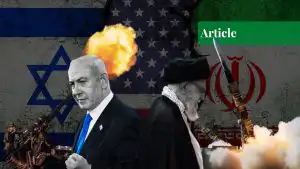
The Iran-Israel conflict, which erupted following surprise attacks by Israel on Iran’s missile launcher bases and nuclear facilities in Iran’s Natanz, Isfahan, and Tehran, significantly altered the dynamics of the Middle East. What began as a direct war between two long-standing regional rivals, Iran and Israel, quickly escalated into a global crisis. The Zionist regime has continued to strike both civilian and non-civilian sites across Iran, pushing Tehran to respond with a barrage of high-precision missiles, including the “Sejjil” and “Fattah-1,” aimed at targeting strategic locations within the occupied territories. The United States’ entry was hardly unexpected, given its historical patterns of military invasions frequently justified under the banner of neutralizing weapons of mass destruction or countering perceived terrorism threats from the Muslim world.
A brief reflection on recent history reveals a similar pattern in US foreign policy. The United States invaded Iraq under the pretext that the country possessed chemical weapons, a claim later discredited, leading to the deaths of nearly one million Iraqis and the displacement of an estimated 4 to 5 million people. Similarly, the US-led war against Afghanistan launched to dismantle Al-Qaeda and Taliban, struck forces that had initially received American support in the war against the Soviets on the Afghan front. In the ongoing Iran-Israel conflict, the United States has, once again, aligned itself with the genocidal Zionist regime, echoing the same narrative: that Iran must be prevented from acquiring nuclear weapons. This repeated justification has served as a foundation of sustained military invasions and geopolitical interventions disguised under the canopy of global security.
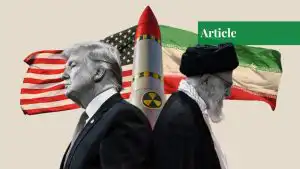
On the night of 21st June, the US bombed Iran’s Uranium enrichment facilities at Fordow, Natanz, and Isfahan and warned Iran that any retaliation would face far more deadly consequences. The United States launched “Operation Midnight Hammer,” deploying B-2 stealth bombers loaded with 30,000-lb GBU-57 bunker-busters to strike key nuclear facilities of Iran. Trump declared a “very successful” strike, stating Iran’s Uranium enrichment facility had been “completely obliterated.” Real peace is not possible with the use of force or threat to use force; it is possible with dialogue and mediation, but realpolitik, unfortunately, functions only by dominance and power interest.
Dating back to history, the signing of the Abraham Accords on 13th August 2020, though celebrated as a diplomatic milestone, also marked an ironic moment for the greater Middle East diplomacy hinged on exclusion, not inclusion. It was brokered by the United States of America between Israel and select Arab countries. The accords aimed at normalizing so-called diplomatic relations and promoting peace and stability across the region. Strategically and politically calculated agreement for diplomatic, military, and trade interests. However, the glaring exclusion of Palestine and Iran, two central actors in the region, revealed a significant contradiction. How can genuine peace be achieved when those around whom the whole Middle Eastern conflict revolves are sidelined?
By bypassing Palestine, the accords not only ignored the core issue of the “Palestine-Israel” conflict and key actors, Iran and Palestine, but also further undermined the Palestinian cause. This exclusion isolated Palestinian resistance, implicitly indicating that normalization between Israel and Arab countries is no longer based on the issue of the Palestine-Israel conflict, now perceived as abandoned even by fellow Arab nations. In the same vein, Iran, already at odds with the US since the Iran-Iraq war, interpreted the accords as an aggressive, containing, and isolating strategy by the United States, further legitimizing its opposition to US influence. Excluding conflicting parties does not build peace. Rather, it fuels resistance and deepens regional instability and polarization.
Trump often portrays himself as the self-proclaimed architect of global peace, frequently taking to his “X” account to claim credit for shaping international diplomacy and peace. However, this raises critical questions: Is the “peace” Trump wants to have credit for one built on invasions, strategic favoritism, and selective and transactional diplomacy rather than justice, dialogue, and inclusivity? Is the credit he seeks for the US invasions of Iraq and Afghanistan, which destroyed entire regions for decades? Or for the unwavering backing of Israel’s Netanyahu, who is officially declared a criminal by the International Criminal Court for his crimes against humanity in Palestine?
Trump’s diplomatic, military, and financial support for Israel further undermines his peace narrative and his global ambitions to become a global peace prize winner. His policies have often prioritized division and conflict over inclusive dialogue or championing justice-based resolutions. Genuine peace is impossible through selective alliances and transactional diplomacy. It requires principled engagement, inclusivity, and commitment to human rights, elements that have been highly missing in much of Trump’s foreign policy approach for a more stable Middle East and beyond.
Trump strategically leverages negotiations and alliances to create an image of a global peacemaker while persistently turning a blind eye to the humanitarian crisis afflicting the very regions he claims to stabilize. In his pursuit of aggressive policies, he, of course, seems less concerned with the complexities of regional sufferings and invested in the form of peace that is based on military interventions, often not needed, and coercive tactics, often justified by narratives such as counter-terrorism or the alleged presence of weapons of mass destruction. This military-interventionist approach not only destabilizes the regions but also creates fragile and volatile peace, one underpinned by aggression and resentment. Such a model of peace is inherently crippled and unstable and may ultimately sow the seeds of potential, lethal, and destructive conflicts.
If you want to submit your articles and/or research papers, please visit the Submissions page.
To stay updated with the latest jobs, CSS news, internships, scholarships, and current affairs articles, join our Community Forum!
The views and opinions expressed in this article/paper are the author’s own and do not necessarily reflect the editorial position of Paradigm Shift.