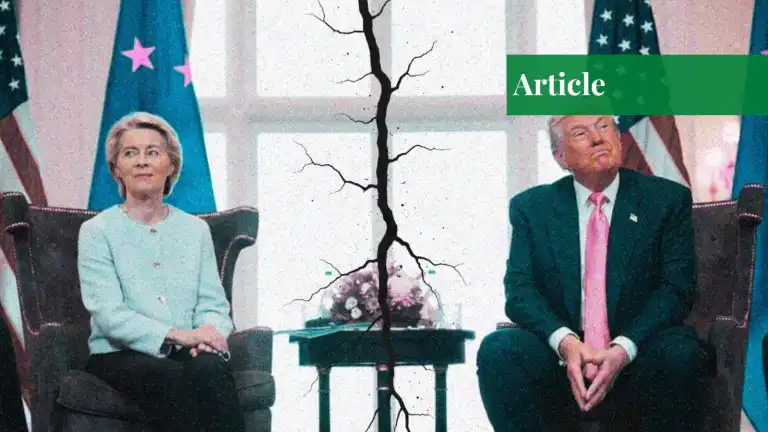

The relationship between the United States and the European Union is a relationship that is frequently pointed out as a pillar of contemporary geopolitics. It is established on common democratic principles, economic interdependence, and a mutual security system through NATO, which forms the world order after World War II. However, it became tense in the Trump-years (2017,2021). The break was not total, but the change of the atmosphere was undeniable, with more distrust, doubt, and outright reversal of the traditional US foreign policy toward Europe.
The America First doctrine was one of the clearest indicators of the relations between the US and the EU under the leadership of President Donald Trump. Trump examined foreign affairs with a vacuum-seeking optimism, with its priorities on the homeland before multilateral collaborations. That was poking holes into the rule-based system of the EU and its collective decision-making. The European leaders were, to say the least, worried about Trump’s doubts about long-standing alliances and institutions that have been the staple of transatlantic cooperation since time immemorial.
One of the points of fire was trade disputes. Trump attacked the EU several times as unfair in trade practices, particularly citing the trade deficit of the US with Europe. His government imposed tariffs on European aluminum and steel on the grounds of national security. The EU responded by slapping tariffs on American products such as motorcycles, bourbon, and agricultural products. Those tariffs pushed the relationship out of partnership back to rivalry, and both parties were relying on economic pressure, instead of negotiation, to spoil business and the consumer on the two continents.
Another common battlefield was the defense of NATO. Trump publicly challenged the usefulness of NATO, terming it as outdated and accusing his European allies of free-riding on US military defense. Though it is accurate that several European nations did not exactly meet the NATO benchmark defense expenditure, the scathing rhetoric of Trump shook the leaders of the EU. To the EU, NATO is not merely a military bloc, but more of a unifying effort for security. The threats to reduce the US commitment were repeated, leading to long-term security concerns, which sparked new EU debates about strategic autonomy and independent defense capabilities.
The anomie also revealed the ideological contradiction in this period, which climate change only revealed. When Trump withdrew the US from the Paris Agreement, he caused an uproar among the European leaders who perceive climate action as a moral and political project. The EU aligned itself as a climate leader in the world, and Trump struck down environmental rules, opposing it at extreme poles. This wedge undermined the world climate collaboration and strengthened the notion that the US was withdrawing its leadership position on global matters.
The diplomatic style also contributed to the fire. The rude speech that Trump was giving, his continual social-media attacks, and his open insults at European leaders were regarded as offensive and disruptive. The customary diplomatic etiquette virtually faded away and was confusing the US allies. Meeting points that had been taken as a representation of togetherness became a platform of strife. Such a change in tone had a denting effect on individual relationships between leaders and complicated cooperation even in cases where similar interests were still present.
All this notwithstanding, we cannot say that the US-EU relations were entirely gone. Collaboration continued to progress in such fronts as counterterrorism, sharing of intelligence, and addressing global menaces such as China and Iran. Economic relationships remained strong, as both sides are the largest trading and investment partners of each other. These backdoor directions revealed how the transatlantic relationship was strong even during political tension.
Reflectively, the Trump administration became a wake-up call to the EU. It exposed the excessive reliance of Europe, especially on the US, in terms of security and leadership, and accelerated discussions on strategic independence. At the same time, it compelled the EU to reconsider the idea that the US would always be a stable, reliable partner.
Finally, the US-EU relations under Trump were characterized by tension, insecurity, and a significant change of direction towards traditional cooperation. A common history and common interests helped the partnership to stand intact, but the era revealed significant differences in values, priorities, and leadership styles. The history of this period still has an impact on the transatlantic relations, and it helps us to remember that even old friends must be continuously worked on, respected, and share a common vision to be strong.
If you want to submit your articles and/or research papers, please visit the Submissions page.
To stay updated with the latest jobs, CSS news, internships, scholarships, and current affairs articles, join our Community Forum!
The views and opinions expressed in this article/paper are the author’s own and do not necessarily reflect the editorial position of Paradigm Shift.

Muhammad Tahir is currently enrolled in BS IR 7th Semester at International Islamic university Islamabad.