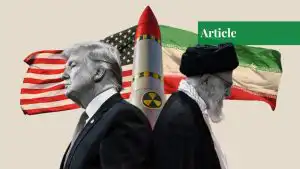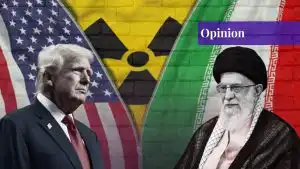
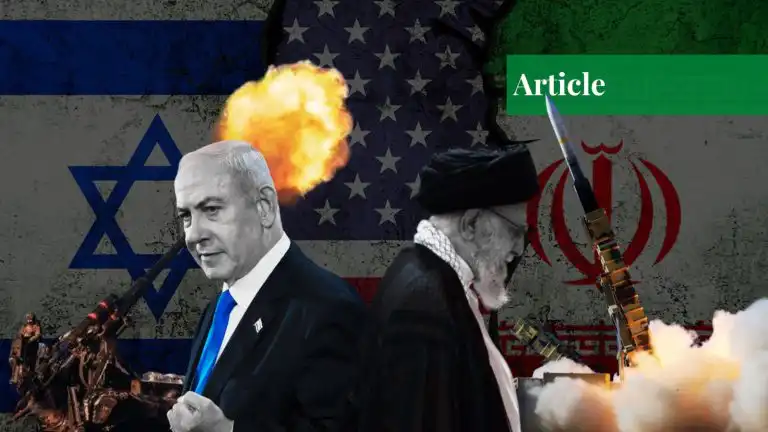

On February 28, 2026, the US forces, at the behest of Israel’s Zionist Prime Minister Benjamin Netanyahu, conducted air strikes in Iran, under the name Operation Epic Fury. Just like the previous year, when Israel attacked Iran despite ongoing negotiations, Washington once again deceived Tehran with the illusion of peace talks and launched strikes against Iran. After a break of almost 8 months, the US and Iran engaged in peace talks once again on February 6, 2026, over the latter’s nuclear program. The talks were mediated by Oman. Soon after the first session of these talks in Muscat, Oman, the Israeli Prime Minister Benjamin Netanyahu visited the United States to meet the US President Donald Trump in a rush.
According to some analysts, Netanyahu visited Washington to urge the US government to add Iran’s missile program to the agenda of the peace talks. However, the recent events suggest that the actual ambition of this visit was to increase Israeli pressure on the US government for a regime change operation against the Islamic regime in Iran. This is substantiated by the fact that even after positive progress in the second round of talks in Muscat on February 26, as stated by the Omani representative. The United States and Israel conducted a joint operation in Iran, targeting the Iranian Supreme Leader Ayatollah Ali Khamenei and other top leadership of the country, igniting a direct war with Iran and triggering a dangerous escalation across the Middle East.
The Iran War and Expanding Battlefronts
In response, Tehran targeted US military bases and interests throughout the Middle East, along with attacking Israel. Iran conducted retaliatory strikes across the Middle East, including the United Arab Emirates, Bahrain, the Kingdom of Saudi Arabia, Kuwait, Qatar, Oman, Jordan, Iraq, and Israel. Iranian attack significantly hurt US interests in the Middle East. Despite a sudden attack by Israel and the United States on Iran, the latter’s retaliatory strikes have shocked military experts around the world. Since February 28, Iran has continued to strike Tel Aviv, Jerusalem, Haifa, and key US military assets in the region despite repeated US and Israeli strikes on Iran’s missile storage sites and military assets.
Iran also claims to strike the USS Abraham Lincoln, the largest US aircraft carrier, deployed in the region to attack the country, with 4 cruise missiles. The persistent Iranian missile attacks on different regional countries, especially US military bases in the Gulf Country Club (GCC), despite the death of its top leadership, signal that the country was well prepared for the scenario and its leadership was aware of the possible US deception. The current regional developments and Iran’s rejection of further negotiations with the United States, after Trump’s claim that the country’s new leadership seeks dialogue, suggest that Tehran is not ready to surrender to the US and Israel. Pro-government protests in Iran reflect that Trump’s framing of the US-Israeli attacks on the country as a moment of liberation for Iranians has proved counterproductive for Washington and Tel Aviv.
US-Israeli Strike on Iran and the Regime Change Debate
Contrary to US and Israeli expectations, a massive number of Iranians rallied in different cities showing their support for the government, protesting against the US attack, and mourning the death of their Supreme Leader, Ayatollah Ali Khamenei. President Trump and Netanyahu have long been pushing the Iranians against their government. The actual ambition of the two leaders was to conduct a regime change operation in Iran, as the CIA had already done in Iraq, Libya, Venezuela, and many other countries. History suggests that all the countries where the US conducted successful regime change operations plunged into perennial chaos and instability.
Amid severe economic collapse and declining living standards, a surge in nationalistic sentiment among Iranians indicates a historical awareness shaping their outlook. They have realized that leaders belonging to the Epstein elite class, involved in pedophilia and satanic rituals, do not care for human rights. The US-Israeli attack on a primary school in Iran has further enhanced this feeling, killing school girls. Reports suggest the death toll of this attack on school has reached 100. The Israel Defense Forces are already known for their atrocities against women and children, and war crimes. The release of the Epstein files inculcated a feeling among Iranians that their country is not merely fighting against two rival nations but also against pedophiles and sex traffickers.
In addition to increasing internal cohesion and unity in Iran, this war has ended the global perception that Israel is an impenetrable regional power. Moreover, it has further exposed the reality that the US and Israel would never defend the Arab countries against any aggression but will only save their own interests. Another major implication of this war is that it has significantly undermined perceptions of the UAE as a secure and stable destination for investors and business leaders, increasing prospects for Trump’s plans to make Gaza a global business hub, a success for the Zionists.
Economic Shockwaves in the Middle East and the Strait of Hormuz
Beyond the battlefield, the conflict’s economic repercussions are reverberating globally. The closure of the Strait of Hormuz — a critical artery for global energy shipments — threatens sharp increases in oil and gas prices. Qatar has already halted LNG production due to Iranian missile strikes. Most of the European nations depend largely on Qatar for their energy needs. Therefore, this Qatari decision immediately led to a 50 percent surge in gas prices in Europe. The Gulf region is largely dependent on imported food products. A prolonged closure of the Strait of Hormuz would result in a significant increase in food prices in the GCC.
The US-Israeli Strikes Against Iran: A Broader Geopolitical Realignment
The conflict also appears to be widening geographically. Britain, France, and Germany have also announced their intention to join the US-Israel alliance against the Islamic regime. On the other hand, Hezbollah has also officially joined the war. It fired missiles at Haifa port from Lebanon. The war’s escalation into new geographic fronts — exemplified by an Iranian-linked strike on Cyprus — signals a dangerous broadening of the conflict beyond its original theaters. If any of the European countries joined the US-Israeli attacks on Iran, the war could spiral out of control and directly drag Eastern superpowers into the conflict.
The US-Israeli attack on Iran will also trigger a global arms race, especially among the middle powers. The GCC, South Asian, and East Asian powers are set to bolster their military capabilities, as the war has reinforced the enduring reality of international relations: states must rely on themselves to survive in an anarchic world. France has already announced that it will increase its nuclear arsenal, which would trigger a global strategic chain, triggering a global nuclear arms race. In a recent statement, the US President Donald Trump told that Iran wants negotiations. However, despite global calls for peace, Trump said that the conflict with Iran could last four to five weeks, suggesting that the war in the Middle East would further escalate. These developments suggest that in the coming months and years, humanity will face an existential crisis.
If you want to submit your articles and/or research papers, please visit the Submissions page.
To stay updated with the latest jobs, CSS news, internships, scholarships, and current affairs articles, join our Community Forum!
The views and opinions expressed in this article/paper are the author’s own and do not necessarily reflect the editorial position of Paradigm Shift.

Muhammad Hamza Tanveer is a political analyst specialising in South Asian and Middle Eastern affairs. His work focuses on religious nationalism, regional security, and minority rights. He has been featured in Stratheia, Pakistan Today, Pakistan Observer, and the Asian Mirror. He is also working as a research analyst and political commentator for Paradigm Shift and contributes to the monthly magazine of Nearpeer.