


He is pursuing a BS in International Relations programme from International Islamic University, Islamabad and has a keen interest in research works, policy analysis, defence and strategic studies and conflict resolution.
Can you imagine the international community, which had been through a series of violent conflicts, wars, and an anarchic system, could once again be at the brink of rupture – the revival of the law of the jungle? One of the most fascinating facts about 21st-century geopolitics is that it is solely based upon the principle, “diplomacy is the best policy.” States engage with each other under the umbrella of an overarching authority – the United Nations. The UN Charter, which can be referred to as the supreme constitution of the international community, obliges every state entity to fulfill its particular rights and duties towards others. This rules-based order, orchestrated by the West to save the future generations from the scourge of war, became completely abortive on January 3, 2026, when the acting president of Venezuela was abducted by the world’s champion of human rights – the US.
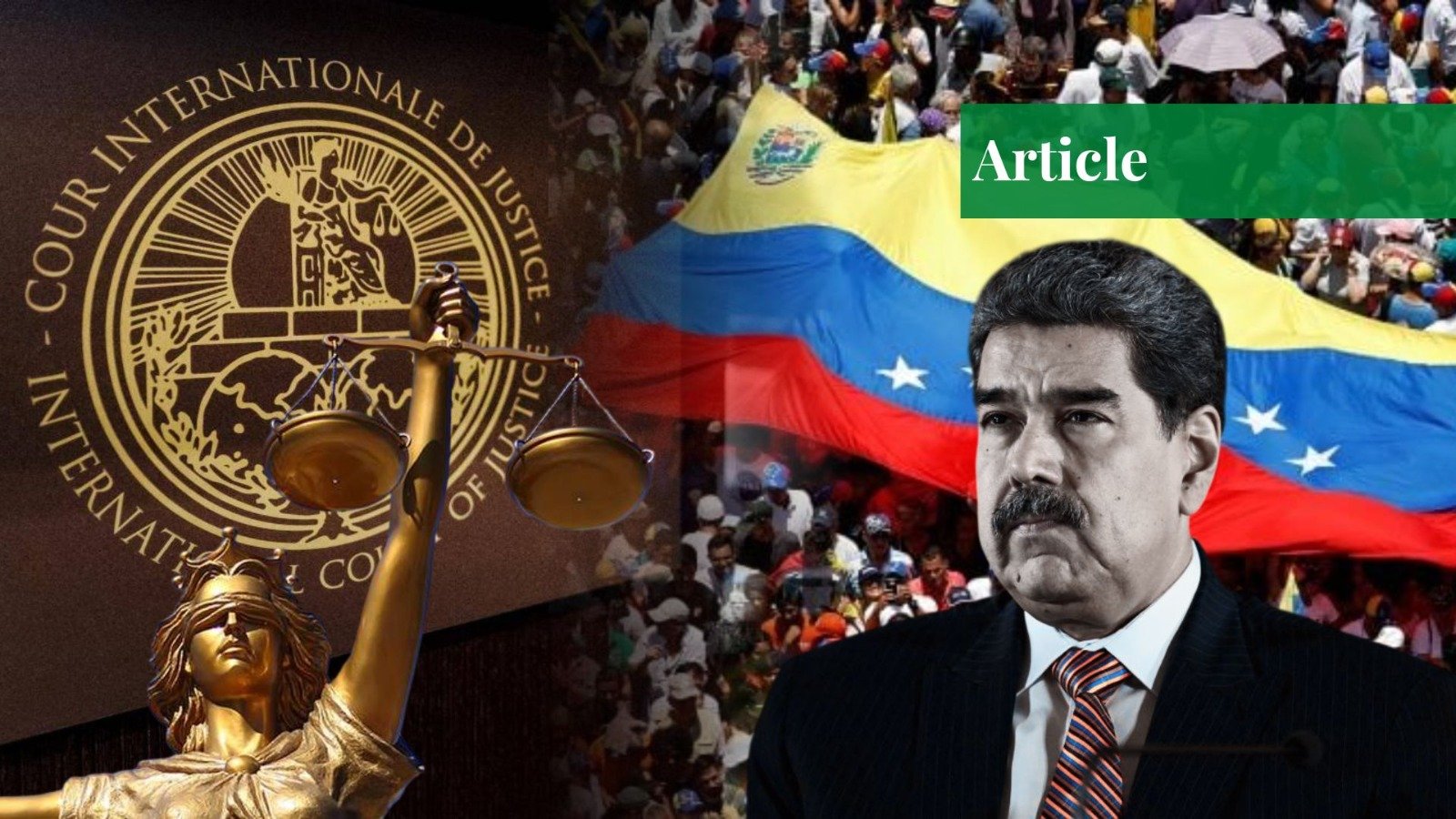
Under Operation Absolute Resolve, Nicolas Maduro and his wife were kidnapped by the US through a special military action, irrespective of the Venezuelan people’s determination. The so-called regime change operation was swiftly accomplished, and literally no one, not even Russia or China, came to Maduro’s assistance. All was either complete silence, vocal condemnation, or even supportive statements for the US. Is this the end of a rules-based order or the beginning of a new global disorder? Or is this a revival of Hobbesian law? What could be its regional and global repercussions? Let’s critically analyze how a single regime change event in Venezuela could trigger a domino effect all over the world.
Naked Power Play
The undercover operations against sovereign states have long been in line with American history. After all, this is what the US presidents do: regime change. From Latin America to West Asia, all cry over the same situation. Be it Iraq, Iran, Libya, or Guatemala, the US carried out dozens of regime changes, but in every one, it had hidden its hands so that it would be easier for the new puppet to fulfill American interests, known as plausible deniability of operations. The US knew the reality that the more open it is that the new setup was planted by a foreign power, the more difficult it would be for the US to give favors to its new setup. Thus, the big powers never made overt claims of regime change operations, providing some room for their puppets to dismiss the opponents as conspiracy theorists.
But what the world has witnessed this time, under President Donald Trump, is completely out of the question. President Trump is raising the rhythm of his power in such a reckless way that he is kidnapping the country’s serving president and taking credit for our brave forces having accomplished a feat that no one else can accomplish. Which was once covert and assumed to be insulting is now overtly practiced by the Trump administration, declaring it a daring act in the modern world. Recently, President Trump bluntly stated that we arrested Maduro, and Russia and China did nothing against the US military might. This is a clear predicament of transition from a rules-based to a might-makes-right order.
Power Limitation
The alleged operation against Venezuela is a feat that every country in the world can follow at any time against a country much weaker than itself. But this usually does not happen at all. Just imagine, if every powerful country in the world decides to only look after its own interests and will, and occupy as much of the geography around it as it can, a law of the jungle would rise. After Venezuela, the US could occupy Greenland and then Canada. Similarly, China and Russia may also follow suit. The PRC may occupy its claimed territories in the South and East China Seas. Russia may further pursue its revanchist ambitions in Eastern Europe, following Ukraine.
But no one, except the US, is following this path. This is because power has limitations. This limitation is revealed only when power is used. This includes the fact that, after power projection, how many of the preliminary aims have been achieved successfully. How much can it really control the outcome? This outcome-controlling ability is the real challenge, due to which states do not use power indiscriminately and insanely. A bunch of various short-term and long-term possibilities are assessed before any power play. It’s pretty evident that naked power never achieves those benefits that diplomacy and politics could. It creates more hatred and gives fewer results.
“The West won the world not by the superiority of its ideas or values or religion but rather by its superiority in applying organized violence. Westerners often forget this fact; non-Westerners never do.”
– Samuel Huntington
Failure of Intervention
The three prominent objectives that the Trump 2.0 administration wanted to achieve from Venezuela have become even more distant.
Regime Change
The primary objective was to bring about regime change in Venezuela. The pro-China/Russia government of Nicolas Maduro was to be toppled. Maduro’s United Socialist Party, or PSUV, should be replaced by a coalition government of his opponents and US supporters. But the results are opposite, and the ground situation is intact, with PSUV still in power, led by Vice President Delcy Rodriguez.
Energy Resources
The Trump administration wanted to control the Venezuelan energy resources, in particular the oil. But all the pillars of power have refused American demands. VP Delcy has openly declared Maduro’s kidnapping as a breach of Venezuela’s sovereignty. President Trump, as a result, has also warned her, but she is adamant. To defend Venezuelan territory, Delcy has mobilized armed militias known as ‘Colectivos’ – an anti-US militia group. These militias are continuously patrolling Venezuelan cities, taking serious actions against Maduro’s political opponents. Due to these security concerns, various multi-billion-dollar oil companies have refused or questioned their investments in Venezuela.
Great Power Influence
The Trump administration wanted to force Venezuela to distance itself from the Chinese and Russian influence. But in Venezuela, not a single authority is even signaling to cut off their strategic partnership with Russia or China. Currently, the main American demand is that whichever new Venezuelan government comes, or is planted, it should learn from the kidnapping of its current president, and without any agreement, consign agreements with Russia and China to the dustbin. Neither governmental authorities nor opposition parties are ready to cancel these billion-dollar agreements against American monopoly.
Perils and Pitfalls
For the US
- The failed regime change operation in Venezuela may have devastating implications for the United States itself. The unpredictability of the U.S. foreign policy, particularly about additional interventions, may weaken the image of the dollar as a haven and encourage some investors to move to other assets such as gold or other currencies.
- Greater deficits can cause greater issues with U.S. Treasury securities. When foreign investors begin to decrease their investments due to geopolitical risk considerations, the U.S. might have to deal with an increase in yields and less inflow of capital, which will weaken the dollar.
- The United States may find itself in a long-term security commitment equivalent to a quagmire: insurgency, proxy warfare of Russian/Iranian allies, and rebellious armed groups may suppress US troops and limit resources.
- Should this operation be met with the same fortunes as the ones in Iraq, Libya, etc., it can increase political polarization and damage the broader policy agenda and re-election of President Trump by fueling domestic political backlash and resistance.
For the Region
- Spillover from the operation could lead to instability across the region. That could bring millions more migrants, overrunning neighboring capacities in Colombia, Brazil, and Caribbean states.
- Public protests and calls from the top echelons of government for leniency would worsen anti-U.S. attitudes and fuel stories about American imperialism, potentially stoking hardline political movements throughout the continent.
- A newly intensified conflict will almost certainly exacerbate the already dire humanitarian conditions inside Venezuela, after years of economic collapse and mass migration.
For International Arena
- Unilateral monetary use of force against Venezuela without Security Council authorization may undermine the role of the U.N. Security Council in deterring interstate war, a factor that has kept a lid on war between nations since the end of World War II.
- The operation’s failure may also witness an increased level of geopolitical rivalry, whether through proxy forces or, even worse, direct conflict.
- Additionally, the existing political mess created by the Trump 2.0 government in relations not only with adversaries but even with allies may serve as an added factor to make them draw back relations with the US – it’s as if the whole world can ally against the Hitler of this generation.
- This might usher in an era in which the world order shifts from rules-based to might-makes-right and, in effect, the law of the jungle, where each man is against the other, with unpredictable consequences.
- Deterioration of international law with the US putting itself above the law. In the UNSC, the US has a veto power, whereas in the ICC, the US doesn’t recognize it. It appears as though the rules are there, but they do not pertain to the weak. Rules for you, power for us.
Conclusion
The dubious regime change operation in Venezuela by the US has once again raised alarms in international academic and strategic circles. In spite of the continuous experience from historical losses in nearly every covert operation, the US is once again using its mighty power without assessing long-term geopolitical risks in a multipolar world. It seems like the US has learned nothing from the past. The 21st-century geopolitics demands diplomacy as the only viable source of doing politics. The unlimited use of naked power would definitely disrupt the rules-based international system. The world is once again on the brink of world order collapse.
If you want to submit your articles and/or research papers, please visit the Submissions page.
To stay updated with the latest jobs, CSS news, internships, scholarships, and current affairs articles, join our Community Forum!
The views and opinions expressed in this article/paper are the author’s own and do not necessarily reflect the editorial position of Paradigm Shift.