
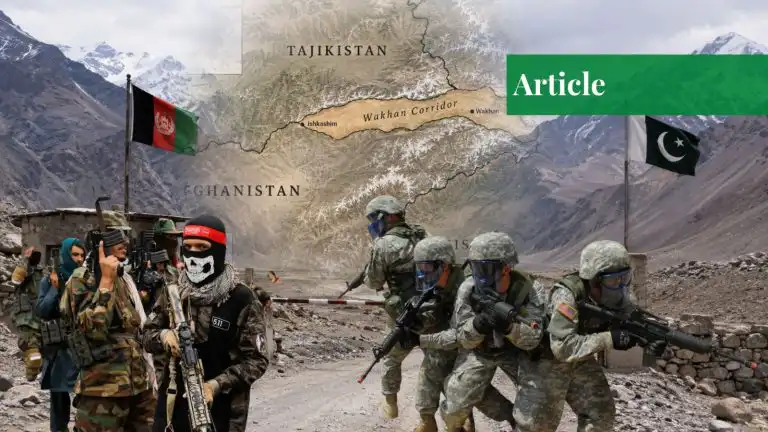
On October 4, the Taliban inaugurated a 121 km gravel road through the Wakhan Corridor that ends at the Chinese border. The project began under the previous government in 2019 and was completed after work resumed in 202. The road has four bridges and has an estimated cost of about US$ 5.6 million of Kabul’s own money. But the road Kabul built was met with a shut gate. No Chinese official attended the inauguration, and the border remains fenced and closed.
Those viewing the corridor through the Islamabad lens see it as a strategic loss. One Pakistani analyst has called the development “the most significant change to Pakistan’s northern geography in decades”, warning that it weakens Islamabad’s leverage over Kabul and its role as CPEC’s gateway. Others are framing it as a Taliban bargaining chip against Pakistan. These concerns do carry weight. Islamabad itself has described its conflict with Kabul as the worst since 2021. Although Pakistan remains Afghanistan’s fastest route to the sea, Afghan traders have shifted cargo to Iran’s Chabahar port and to Central Asian routes owing to the closure of major crossings post-October 2025 escalations between the countries.
Yet the Wakhan road is the latest reminder that connectivity in this region runs through counterterrorism. The project was meant to show that Kabul did not need Pakistan to reach China. What it showed instead is the imperative of curtailing terrorism activities from Afghan soil, a condition both Beijing and Islamabad share. A 2026 UN report places the East Turkestan Islamic Movement (ETIM) in Badakhshan, the province the road runs through. In November 2025, three Chinese citizens were killed in an armed drone and gun attack on a mining camp in Tajikistan, which was reportedly launched from the Afghan Territory. Chinese analysts see little reason to hurry. Zhu Yongbiao of Lanzhou University has said that the chances of the pass opening soon are “extremely low,” and one Chinese commentator put it bluntly: “China isn’t in a hurry; Afghanistan is.” The fence Kabul faces is a counter terrorism one, not an engineering one
This is the same request Islamabad has made time and again as it grapples with rising terrorism incidents since the 2021 Taliban takeover. On 15 October, China’s Foreign Minister Wang Yi said the Taliban must act against terrorist groups. Regarding Afghanistan, China and Pakistan are on the same page. Both want stable relations with Kabul and greater regional connectivity, and both want Afghan soil kept from being used against neighbours. At their trilateral meeting in Kabul in August 2026, the three states agreed to extend CPEC into Afghanistan. However, Pakistan’s Deputy Prime Minister and Foreign Minister, Ishaq Dar, noted that counter terrorism cooperation “continues to lag behind” political and commercial ties. The road does not route around Pakistan’s concerns. It runs straight into China’s, which are the same ones.
There is a counterargument: Pakistan’s decision to close its border has pushed a landlocked Afghanistan to look for alternatives. Voices within Pakistan have warned that an Afghanistan that is diversifying its routes raises the risk of Pakistan “losing its geostrategic advantage”, calling for closures to be treated as exceptional rather than routine. That is a fair analysis, and leverage built on closures was always a wasting asset. But leverage built on a security condition, and one that China shares as well, is durable. The real lesson of the road is that Pakistan’s strongest card is the condition it shares with China, not the border it can close.
With the Strait of Hormuz largely closed for most of this year, the case for regional connectivity has rarely been stronger, and South Asia remains, in the World Bank’s words, “the least integrated region in the world”. For that to change, connectivity should be made explicitly conditional on verifiable counter terrorism action through a standing China-Pakistan-Afghanistan mechanism. The starting step can be reviving the China-facilitated Urumqi talks in April 2026 as a permanent framework. At the same time, security disputes need to be kept separate from trade. The Afghan public should not be punished for the choices of the Taliban. Keeping trade open can help restore Pakistan’s position as the fastest route to sea.
South Asia has long been a region of volatility and of great connectivity opportunities at the same time. But every road in the region has a toll, and that toll is security. For regional connectivity to become sustainable, security must come first, and for now the onus of that responsibility lies with Afghanistan.
If you want to submit your articles and/or research papers, please visit the Submissions page!
To stay updated with the latest jobs, CSS news, internships, scholarships, and current affairs articles, join our Community Forum!
Find our FREE quizzes and MCQs here!
The views and opinions expressed in this article/paper are the author’s own and do not necessarily reflect the editorial position of Paradigm Shift.
Irtija Ahmad is an Assistant Research Officer at the Institute of Regional Studies, Islamabad. She holds an MSc in International Public Policy and Development from Royal Holloway, University of London (Distinction), and an MPA from Quaid-i-Azam University, Islamabad, where she graduated as Gold Medallist of the Class of 2022. Her work combines security analysis with policy-informed research on governance in Pakistan, examining why institutional commitments often fail to survive a change in government or the news cycle.