How Did Pakistan Begin Its Political Journey after Independence? (1947–1951)
The political history of Pakistan started with the formidable task of creating a functional state de novo after independence in August 1947. Jinnah was made the first governor-general of the country, whereas Liaquat Ali Khan was appointed as the first prime minister. Jinnah emphasized unity, faith, and discipline as essential for Pakistan, alongside unity and national discipline.
Liaquat Ali Khan played a major role in the nation’s political destiny after Jinnah’s passing in September 1948. On March 7, 1949, Liaquat offered the Objectives Resolution, which was adopted on March 12. The murder of Liaquat Ali Khan on October 16, 1951, was a significant watershed as it left Pakistan to face the political storm without its “leading political personality after the creation of Pakistan.”
For a detailed account of this period, read our full article here.
Why Did Pakistan Face Political and Constitutional Instability in the 1950s? (1951–1958)
The political instability that Pakistan had experienced since its formation was further complicated by the death of its first prime minister, Liaquat Ali Khan. Sir Nazimuddin took office as prime minister in 1953, followed by M. Ali Bogra. However, the political power of the governor-general increasingly undermined the political stability of the civilian government. The most significant development happened in October 1954 when Governor-General Ghulam Muhammad dismissed the Constituent Assembly from completing the task of writing the constitution.
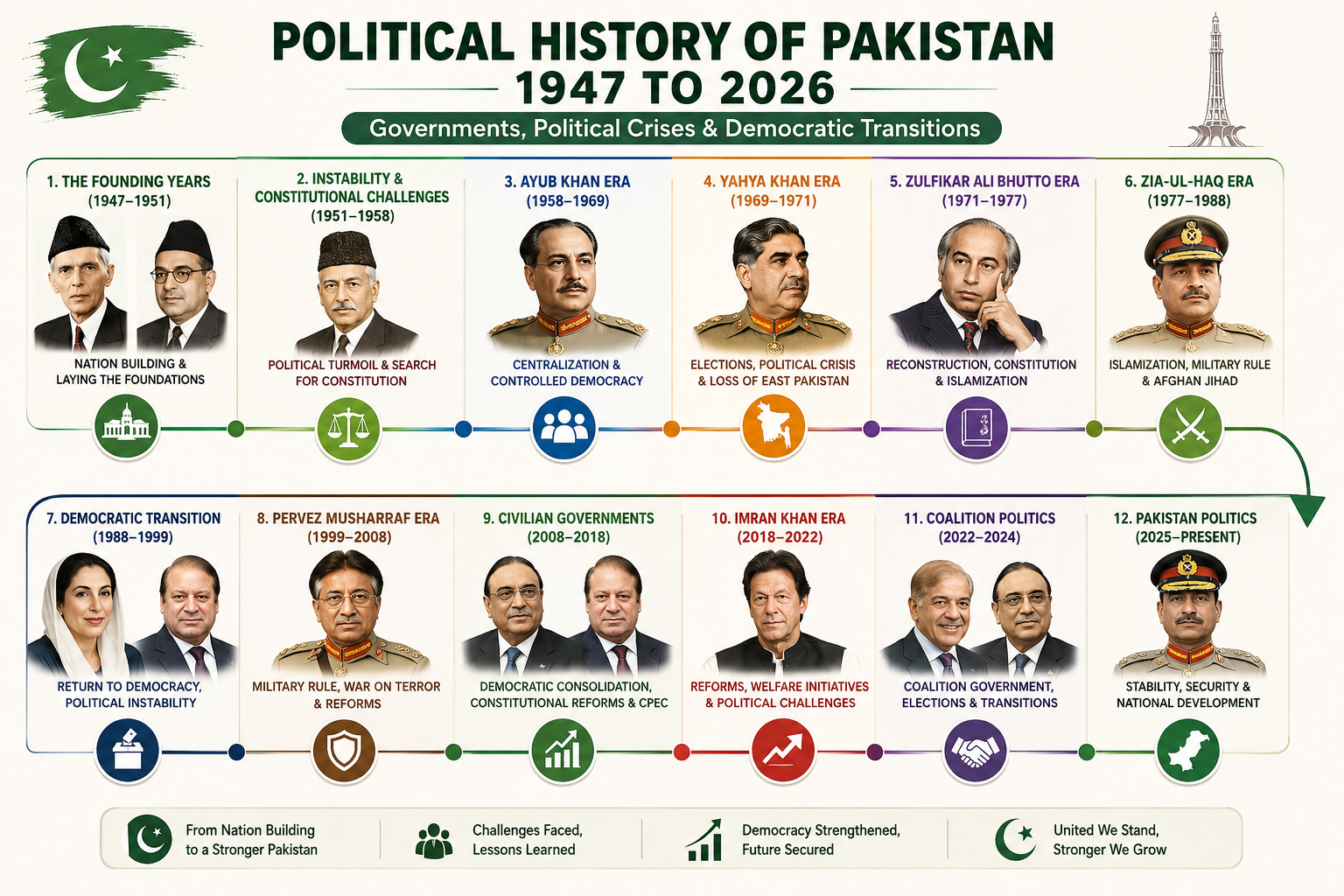
The challenge raised by the Speaker, Maulvi Tamizuddin Khan, succeeded in the Sindh High Court but failed in the Federal Court. The Bogra Formula was a proposal put forward by Muhammad Ali Bogra in order to solve the disagreement about representation between the two regions, East and West Pakistan, while the One Unit Scheme of 1955 created parity between the two regions through the unification of the western provinces. Eventually, the Second Constituent Assembly came up with the Constitution of Pakistan 1956 that created a parliamentary form of government and declared Pakistan as an Islamic Republic. The Constitution was abrogated by President Iskander Mirza on 7 October 1958.
For a detailed account of this period, read our full article here.
How Did Ayub Khan Transform Pakistan’s Political System? (1958–1969)
The era of Ayub Khan represented the period during which Pakistan experienced military rule for the first time, and its political system witnessed a radical transformation. Following the declaration of martial law by Iskander Mirza in October 1958, Ayub Khan overthrew him to become the president of Pakistan, bringing about a shift of power from the legislature to the executive. In 1959, he then established the system of Basic Democracies.
The constitution of 1962 substituted a presidential system for the parliamentary form and endowed him with vast powers in the presidency, whereas the elections were made indirect. His foreign policy was based on his friendly ties with the Western world, and the 1965 War between Pakistan and India and the Tashkent Declaration served as a political landmark for him. Later, due to huge mass protests on 25 March 1969, he stepped down in favor of General Yahya Khan.
For a detailed account of this period, read our full article here.
How Did Yahya Khan’s Rule Lead to the Separation of East Pakistan? (1969–1971)
The Yahya Khan regime started after martial law was imposed following the resignation of Ayub Khan, but in the end, it turned out to be the most traumatic period of the country’s political history. Yahya Khan abolished the One Unit system and initiated the Legal Framework Order (LFO), which set the stage for holding the first-ever general elections in the country based on adult suffrage and population.
On 7 December 1970, the general elections took place, where the Awami League won a clear majority in the National Assembly and the Pakistan People’s Party assumed dominance in West Pakistan. But disputes over the transfer of power gave rise to a political impasse, which later escalated into the battlefield, leading to military operations, civil war, and the involvement of India in the issue. The military surrender of Pakistan in December 1971 ended up in the formation of Bangladesh and marked the end of the regime of Yahya Khan.
For a detailed account of this period, read our full article here.
How Did Zulfikar Ali Bhutto Reshape Pakistan after 1971? (1971–1977)
Zulfikar Ali Bhutto’s era started when Pakistan was trying to come out of the shock of the 1971 war and the division of East Pakistan. An important landmark in the era was the Constitution of 1973, which had been unanimously approved by the National Assembly on 14 August 1973. Some other major landmarks in his era included nationalization and economic policies, where he took many industries and banks under the control of the government in an attempt to reduce economic disparities.
The policy in foreign affairs was mainly embodied in the Simla Agreement of 1972. In addition to strengthening the nuclear program and building ties with Muslim countries, such as through the Islamic Summit held in Lahore in 1974, Bhutto also faced political repression, economic problems, opposition from different groups, and the controversy over the election of 1977. All these factors made the political environment very unstable and led to a coup against Bhutto’s government on 5 July 1977.
For a detailed account of this period, read our full article here.
How Did Zia-ul-Haq Transform Pakistan’s Political System? (1977–1988)
This era during the time of Zia-ul-Haq is considered to be one of the longest eras in the history of Pakistan. Zia deposed the government of Bhutto in Pakistan on 5 July 1977 and imposed martial law in Pakistan by suspending the Constitution. The policy of Islamization was adopted by his regime in Pakistan. The invasion of Afghanistan by the Soviet Union in 1979 made Pakistan significant for Pakistan. This made Pakistan collaborate with Islamabad, Washington, and Saudi Arabia in the conflict in Afghanistan. It made Pakistan a frontline state during the Cold War era but, at the same time, left behind implications for security and societal nature in the long run.
Nevertheless, Zia organized an election on a non-party basis in 1985 and ended martial law, but the constitutional amendment expanded the powers of the president. Under the 8th Amendment, the President had the power to dissolve the National Assembly under Article 58(2)(b). It made the parliamentary system weak, and the dismissal of Prime Minister Muhammad Khan Junejo in May 1988 was proof of the dominance of presidential and military powers. The pendulum moved back from parliamentary democracy, but the demise of Zia in an air crash on 17 August 1988 marked the end of an era.
For a detailed account of this period, read our full article here.
How Did Democracy Return to Pakistan under Benazir Bhutto and Nawaz Sharif? (1988–1999)
Following Zia’s death in August 1988, Pakistan’s democratic transition started and restored competitive party politics to the country. Benazir Bhutto became Pakistan’s first female prime minister following the 1988 general elections. Nevertheless, her first administration was politically weak and, under Article 58(2)(b), was removed by President Ghulam Ishaq Khan in August 1990. In 1990, Nawaz Sharif was elected prime minister and started policies of economic liberalization and privatization.
However, disagreements with the president ultimately resulted in his removal from office in 1993. However, after the 1993 elections, Benazir Bhutto again became prime minister, but her government collapsed in 1996, when President Farooq Leghari disbanded her government. In 1997, Nawaz Sharif regained power with a substantial parliamentary majority. The 13th Constitutional Amendment was passed during his tenure, which stripped the President of his constitutional power granted in Article 58(2)(b) to dissolve the National Assembly.
Other significant events that occurred during the decade were the nuclear tests by Pakistan in 1998. However, the government of Nawaz Sharif became increasingly difficult for the military establishment in terms of relations. This became especially apparent after the Kargil conflict of 1999. Ultimately, there came a time of no return. On 12 October 1999, General Pervez Musharraf deposed Nawaz Sharif’s government through a military coup.
For a detailed account of this period, read our full article here.
How Did Pervez Musharraf’s Rule Reshape Pakistan? (1999–2008)
The era of General Pervez Musharraf started when his military regime took control of the government of Nawaz Sharif on 12 October 1999. The Devolution Plan of 2000 was introduced, which brought about some changes in the system of local government by making them responsible for some administrative affairs. Another significant development introduced by General Musharraf was the Legal Framework Order (LFO). The 9/11 attacks and the war on terror marked another milestone. Pakistan became an important ally in the US-led anti-terrorist movement.
The 2007 Lawyers’ Movement, which occurred after the dismissal of the Chief Justice Iftikhar Muhammad Chaudhry, marked another political crisis. The declaration of emergency rule by Musharraf made matters even worse. It was clear that Musharraf had no other way out but to resign from his presidential post in August 2008.
For a detailed account of this period, read our full article here.
How Did Civilian Governments Pursue Democratic Consolidation in Pakistan? (2008–2018)
Under the PPP administration that took office in the wake of the elections in 2008, there have been many constitutional changes made to the country, the most important of which has been the 18th Amendment that returned parliamentary supremacy and enhanced provincial powers. In addition, the 7th NFC Award increased the share of the provinces in the federal government income.
Nonetheless, the government was faced with some serious problems like terrorism, energy shortages, and inflation. The PML-N gained power in 2013 and thus became the first democratic transfer of power between elected governments in Pakistan. Tensions were high in politics due to the Panama Papers leak that led to the disqualification of Nawaz Sharif in 2017.
For a detailed account of this period, read our full article here.
What Changed in Pakistan under Imran Khan’s Government? (2018–2022)
The Khan administration marked a great political transformation in the form of Pakistan Tehreek-e-Insaf (PTI). Its “Naya Pakistan” policy was based on good governance and accountability with social welfare at its core. Programs like the Ehsaas Program, the Pakistan Citizen Portal, and Sehat Sahulat were developed in order to increase social protection and provision of public services.
The coronavirus pandemic added another layer of complexity to economic management, but Pakistan had taken a relatively moderate approach through its smart lockdown. In terms of foreign policy, Pakistan had enhanced its relations with China, Saudi Arabia, and Türkiye while trying to maintain a somewhat independent relationship with the US. Khan’s visit to Russia in February 2022 was highly controversial due to the Russia-Ukraine crisis. Political disputes led to his ouster by way of a no-confidence motion in April 2022.
For a detailed account of this period, read our full article here.
How Did Coalition Politics Reshape Pakistan from 2022 to 2024?
After the removal of Imran Khan through a vote of no confidence in parliament in April 2022, the era of coalition politics in Pakistan started in 2022 or 2024. In 2022, the Pakistan Democratic Movement, a coalition government, was formed under the leadership of Shehbaz Sharif. Later on, the 2024 elections failed to produce any political party winning an absolute majority. The political situation continued to remain highly divided. Shehbaz Sharif became the prime minister again through a coalition government by PML-N and PPP. In conclusion, the politics of coalition that took place from 2022 to 2024 in Pakistan proved the country’s ability to transfer power constitutionally.
For a detailed account of this period, read our full article here.
What Has Changed in Pakistan’s Politics Since 2025?
Starting from 2025, the politics of Pakistan have been influenced by attempts to enhance the stability of the political and institutional situation amid challenges to the economic and security situation in the country. The country has also been confronted by an India-Pakistan crisis in May 2025, which implies that the issues of national security and diplomacy in relation to neighboring countries have become an integral part of the country’s foreign policy. In addition, Pakistan has tried to build up strategic cooperation with Saudi Arabia, Türkiye, China, and other Middle Eastern states. In general, Pakistan’s political developments since 2025 have revealed a country struggling to maintain domestic stability, counter-terrorism, and a more active regional foreign policy approach.
For a detailed account of this period, read our full article here.
If you want to submit your articles and/or research papers, please visit the Submissions page.
To stay updated with the latest jobs, CSS news, internships, scholarships, and current affairs articles, join our Community Forum!
The views and opinions expressed in this article/paper are the author’s own and do not necessarily reflect the editorial position of Paradigm Shift.

Syed Hammad Ali is pursuing a BS in International Relations programme from the International Islamic University, Islamabad, and has a keen interest in research works, policy analysis, defence and strategic studies, and conflict resolution.