
Humor as a Psychological Shield
During moments of tension between states, official communication is expected to come in the form of statements, press briefings, and diplomatic language. Yet increasingly, another form of communication appears alongside them: humor. Recently, a widely circulated video skit portraying Afghans through exaggerated speech and the phrase “tandoor wala,” meaning “clay oven operator,” sparked discomfort and debate. But beyond approval or disapproval, the episode offers something else: a window into how societies emotionally process conflict.
From a folkloristic perspective, war is not only fought on borders but is also shaped through cultural practices and narratives that people use to interpret and navigate social realities. It is also interpreted through stories. Ordinary people rarely experience geopolitics as policy analysis. They experience it as fear, uncertainty, and anxiety. When the future feels unpredictable, communities instinctively seek narrative forms that make events understandable. Humor becomes one such form.
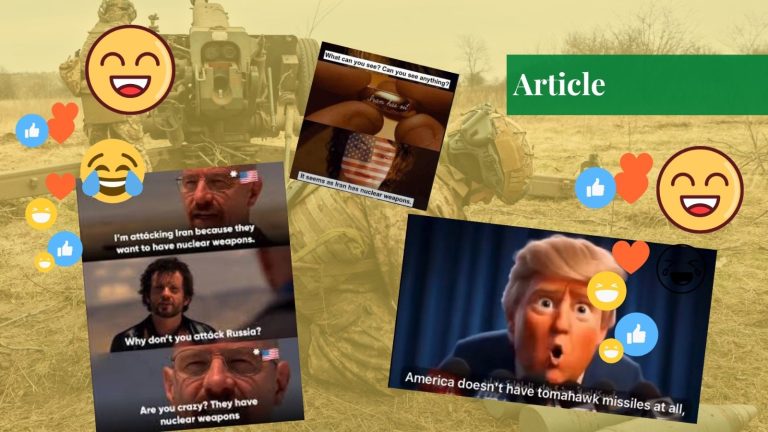
Humor in times of tension performs a psychological function; it reduces fear. A distant and unpredictable threat becomes a recognizable character. Laughter converts uncertainty into familiarity. In this sense, the meme is not only entertainment; it is a coping mechanism. Societies often domesticate danger by turning it into a caricature. The unknown becomes narratable.
Symbolic Compression and Othering
However, folklore works through symbols. Instead of explaining a complex society, it compresses identity into everyday markers such as food, dress, occupation, or accent. The phrase “tandoor wala” is an example of such symbolic compression. Bread-making is not unique to any single community, yet the term functions as an index: a quick signal identifying an imagined “other.” The accuracy of the label matters less than its recognizability.
This is where humor crosses into something more complicated. In folklore studies, imitation of speech and mannerisms is known as performative othering. It draws a boundary not through law or policy, but through narrative. By laughing together at a character, a group quietly defines who belongs inside and who stands outside. The intention may be comic, but the social effect is classificatory.
Yet the discomfort surrounding the video cannot be explained by offense alone. It emerges from a more complex reality: in this region, cultural boundaries do not fully coincide with political ones. Languages, kinship ties, and shared historical memory extend across the frontier. When a narrative attempts to simplify an external adversary into a single recognizable figure, some members within the same society may also hear themselves echoed in the portrayal.
Folklore often operates by reducing complexity into familiarity. Occupations, food, and everyday practices are chosen not because they are accurate, but because they are easily understood symbols. The baker, the trader, the villager—these are narrative roles as much as social realities. However, when such symbols circulate widely during political tension, they can unintentionally shift from describing an external other to suggesting differences in cultural familiarity and distance.
This reveals the dual nature of wartime humor. It comforts by drawing a boundary, yet it also tests the meaning of belonging. A message intended to unify a population against uncertainty may simultaneously raise quiet questions among those whose cultural world overlaps with the portrayed figure. The result is not simply disagreement but unease, the feeling that the line between neighbor and outsider has been narratively redrawn.
In border regions and culturally connected societies, this process becomes especially sensitive. Languages, kinship networks, and shared histories extend across frontiers. A narrative meant to address an external conflict may therefore also resonate internally. Some audiences hear reassurance and unity; others hear exclusion. The same joke can produce opposite meanings depending on who is listening.
Why would a state-associated message take such a form? Formal communication persuades rationally, but cultural communication stabilizes emotionally. Memes, skits, and humorous portrayals operate in the space between official messaging and everyday storytelling. They spread not as instructions but as shared expressions. People forward them not because they are ordered to but because they feel culturally familiar. In this way, humor becomes a modern form of oral tradition, a rapidly circulating narrative through which society explains events to itself.
The Long-term Impact on Cultural Memory
The problem is not simply offense. The deeper issue is memory. Wars are rarely remembered through policy documents. They are remembered through stories, songs, and jokes. Humor, while easing anxiety in the present, can harden perceptions in the long term. A caricature repeated enough times becomes a mental image inherited by people who never experienced the conflict directly.
Seen in this light, the video is less important as a political message and more significant as a cultural artifact. It shows how communities narrate uncertainty and how quickly identity boundaries can be drawn through everyday language. Folklore does not create conflict, but it shapes how conflict is emotionally understood.
The challenge for any society is therefore not to eliminate humor because humor is a natural human response to fear but to recognize its power. When laughter simplifies a neighbor into a symbol, it may offer immediate comfort, yet it also writes memory. And memories, once embedded in stories, often outlast the tensions that produced them.
If you want to submit your articles and/or research papers, please visit the Submissions page.
To stay updated with the latest jobs, CSS news, internships, scholarships, and current affairs articles, join our Community Forum!
The views and opinions expressed in this article/paper are the author’s own and do not necessarily reflect the editorial position of Paradigm Shift.

Kashif Farooqi is a development practitioner with more than 18 years of experience working on social inclusion, community participation, and engagement with marginalised groups across development initiatives in Pakistan. His academic background is in folkloristics and applied heritage studies, and he is currently pursuing doctoral research in archive and memory studies at Government College University Lahore. His writing explores how memory, storytelling, and public symbols shape social belonging in contemporary South Asia.