
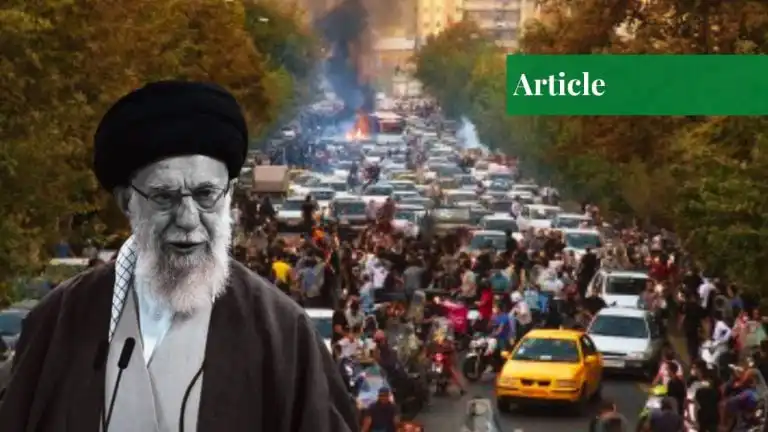
Iran is once again in the grip of nationwide protests, but this time the anger radiating through its streets seems heavier, more exhausted, more socially expansive than before. These demonstrations are not based on a single ideological slogan or a dramatic political event. Instead, they are embedded in the abrasion of everyday existence, playing out at a moment when Iran is facing acute economic implosion, renewed international ostracization, and increasingly clear messaging from the outside world that the unrest is an opening for regime change.
The immediate spark has been economic, but the fire is being fanned by a complex interaction of domestic fragility and foreign signalling. What is taking place is not just another cycle of protest, but a stress test on the Islamic Republic’s ability to govern under sustained pressure and resist external efforts to influence the political meaning of internal dissent.
At the centre of the current unrest is an economy that many Iranians now refer to as unlivable. The Iranian rial has lost a phenomenal percentage of its value, plummeting to historic lows against the dollar. Inflation has risen to the extent that it is effectively wiping out wages in real terms, while prices of basic goods – food staples, dairy products, medicine, fuel, rent – have been rising at a rate well above official statistics. For millions of households, income is no longer able to keep up with even the most minimal standard of living. What makes this moment different from past periods of hardship is that the room for adaptation is no longer there, and Iranians have suddenly become poorer.
The protests started in places that hold very deep symbolic and political weight. When shopkeepers in Tehran’s Grand Bazaar shut down their stores, it meant something more than being discontented. The bazaar has both historically been an economic artery as well as a political barometer. Bazaar merchants played a key role in the mobilization that brought about the revolution of 1979, and for decades after the revolution, they enjoyed an uneasy but durable alignment with the post-revolutionary state. Their entry into open protest is something that represents a break in that relationship. It suggests that economic distress has penetrated constituencies that were once buffered from the hardest of shocks and that traditionally looked out for stability rather than confrontation.
As demonstrations spread, students, workers, and lower-income people living in the urban areas joined in, turning what had started as localized economic protests into a nationwide phenomenon. In many cities, the first demands were limited to the issues of prices, wages, and employment. Yet as crowds continued to swell and state responses continued to be limited to a sense of reassurance rather than relief, chants in some places became political in nature. This change is not unusual in the Iranian context. When economic grievances go unredressed with no credible way of resolution, they tend to take on political meaning, even if regime change is not the original motivation.
The government’s response to the current cycle of protests has been markedly different from past cycles of protest. Senior officials, including President Masoud Pezeshkian, publicly recognized the legitimacy of economic grievances and stressed dialogue as opposed to confrontation. The resignation of the central bank governor and the appointment of a new economic leadership were to be seen as a sign of accountability. State media took a somewhat sober tone, at least in the first days, talking about the protests as a form of expression of hardship and not conspiracies.
This softer approach betrays an awareness in the system of the great risks of excessive repression. The memory of the 2019 fuel protests, met with great force and left hundreds dead, is still fresh, at home and abroad. So too does the 2022-23 protest movement, which brought large sections of society together and inflicted permanent reputational damage on the state. In the climate now prevailing, when the Iranians are under external military pressure and diplomatic isolation, any violent crackdown would add to an already volatile situation.
But the conciliatory attitude also has limits. Symbolic gestures will not undo structural economic decline, and changing technocrats is not the solution to deeper problems such as corruption, inefficient state monopolies, opaque financial networks, and a political economy molded by sanctions and securitization. Moreover, actual power in Iran is not entirely with the presidency. Decisions on security, foreign policy, and many of the economic levers are still concentrated in unelected institutions, which limit the scope of even political will.
As protests have continued, another dimension has become more and more apparent: the role of outside actors in framing, amplifying, and in some cases trying to redirect the unrest. Messaging from Israel and from opposition figures abroad, in particular Reza Pahlavi, has been closely watched within Iran. Israeli government officials and associated commentators have spoken openly on social media platforms about their support for Iranian protesters, presenting the protests as evidence that the Islamic Republic will soon collapse. Some messages have gone further, saying the internal unrest in Iran is weakening its regional posture and vindicating external pressure campaigns.
Now, from a mindset of domestic Iran, such messaging is deeply problematic. While many protesters are driven by pure economic desperation, overt foreign support, not least from Israel, the country widely seen inside Iran as a hostile foreign power-there is a risk of delegitimizing real grievances in the eyes of the wider society. It reinforces hardline narratives of where protests are externally-manipulated and justifies securitized responses. Even protesters who oppose the current system often reject the idea of foreign governments claiming ownership of their struggle.
The role of Reza Pahlavi, the son of the last Shah, is similarly complicated. Through frequent postings on X (formerly Twitter), he has tried to project himself as a unifying alternative to the Islamic Republic and to call on Iranians to continue their protests and to brand economic unrest as part of a broader revolutionary moment. While his messages are effective in some parts of the diaspora and among some of the protesters inside Iran, signs of mass support for the restoration of the monarchy are still limited. For many Iranians, memories of authoritarian rule before 1979, together with distrust of the exiled figures of the opposition, make for a lack of enthusiasm for a return to monarchy.
Nevertheless, there is the visibility of such messaging that matters. It contributes to a discursive shift whereby protests are increasingly being framed – both by outsiders and some domestic voices – not simply in terms of demands for economic relief – but in terms of steps towards regime change. This framing changes the stakes. When protests are treated as posing an existential threat, more so as social pressure, the threshold for repression is much lower.
This dynamic helps to explain the escalation of violence in protests that start peacefully. In many cases, escalation is not the result of a centralised plan but comes about by a confluence of factors: long-term frustration, failure to make any tangible concessions, strong policing at local levels, and the presence of small groups willing to provoke confrontations. Once clashes take place, the boundary between peaceful protest and disorder is blurred, and it allows authorities to justify wider crackdowns.
Iranian officials are very consistent in their insistence that there is a difference between what they call “legitimate protests” and “riots” or “sabotage.” They say that although the grievances of the people are legitimate in terms of economic issues, the attacks on public property, police stations, or on critically important infrastructure go beyond a red line. Critics argue that heavy-handed security responses tend to be part of the escalation, rather than stopping the escalation. There are some grains of truth in both claims. In a tense environment, even isolated incidents can snowball, especially when made to snowball by social media and commentary from outside the system.
The larger context in which these protests are taking place cannot be disregarded. Iran is passing through one of the most difficult periods in its post-revolutionary history. Years of sanctions have caused state capacity to hollow out, investment to be discouraged, and informal and rent-seeking economic behaviour to be incentivised. Recent wars, such as strikes blamed on Israel and the United States, have added a siege mentality to the political system. Meanwhile, revived threats from Washington (especially under Donald Trump’s combative posture toward Iran) have repeated fears of escalation instead of engagement.
This outside pressure generates a paradox. On the one hand, economic relief by easing sanctions would lead to substantial improvements in the living conditions and lower protest pressures. On the one hand, deep mistrust towards the United States and its allies makes negotiations politically risky. Many Iranians, including some who are critical of their own government, remember that Iran played by the nuclear deal only to see promised relief evaporate. This history breeds skepticism about any request for compromise, especially if done with military threats.
At the same time, sanctions are not the complete explanation for Iran’s predicament. Structural mismanagement, lack of transparency, and the concentration of economic power in semi-state institutions have exacerbated the effect of external shocks. Over time, sanctions have also become politically convenient, enabling elites to discard responsibility for failure at home. This distinction is not important for the everyday Iranians; the result is the same: the erosion of livelihoods and dignity.
What is especially sensitive in the present moment is the social makeup of the protests. These demonstrations are not limited to urban elites or political minorities taking active roles. They include workers, small traders, students, and the lower-income groups across several provinces. This breadth makes repression as well as reform more complicated. A heavy-handed crackdown runs the risk of alienating key constituencies whom the state has always projected itself to represent. Yet meaningful reform would entail redistributing resources, tackling entrenched interests, and possibly recalibrating foreign policy-all deeply contentious steps.
Speculation about regime change is inevitable at such moments. History provides us with mixed lessons. Iran has been through cycles of sustained protest before, with no systemic collapse. The state has a substantial amount of coercive power and institutional backbone. However, legitimacy is not a static concept. Repeated crises undermine the social contract, particularly when the younger generations lack any hope of things getting better. Regime change, if this is to happen, would probably not be due to one wave of protests, but rather to a cumulative delegitimation coupled with a fragmentation of the elite.
For now, Iran seems to be in a prolonged stalemate. The government is looking to manage unrest without international backlash or domestic rupture. Protesters are not seeking abstract political change, but rather just relief, yet they are asking themselves more and more if relief is even possible within the established system. External actors try to frame events to their benefit, sometimes causing more polarization, and not necessarily empowering Iranian society.
The danger is not so much that we will immediately collapse, but that instability will become normalized gradually. A situation in which a society alternates between protest and repression, hope and disappointment, is at risk of losing trust and cohesion in the long term. Economic misery becomes chronic, political participation shrinks, and from without, pressure consolidates internal divisions.
Ultimately, current protests represent a combination of structural forces and not a momentary outburst. They are formed by economic exhaustion, political rigidity, and geopolitical confrontation. Whether they will result in reform, repression, or protracted unrest will depend not only on decisions made in Tehran, but also on how the external powers decide to engage – or escalate.
What is clear is that the streets of Iran are again giving voice to a most basic demand: not ideology, not empire, but the basic right to live in security and dignity. How that demand is answered will determine the direction Iran may take far beyond this cycle of protests.
If you want to submit your articles and/or research papers, please visit the Submissions page.
To stay updated with the latest jobs, CSS news, internships, scholarships, and current affairs articles, join our Community Forum!
The views and opinions expressed in this article/paper are the author’s own and do not necessarily reflect the editorial position of Paradigm Shift.

Atiqullah Baig Mughul is an international relations graduate specializing in security studies, Middle East politics, diplomacy, and policy-oriented geopolitical research.