
The Middle East is considered one of the most volatile regions in the world. Even today, some of the world’s worst wars and insurgencies are going on in this region. Regarded as the cradle of civilizations, every state in the Middle East is vying for influence in one way or another. Among them, Yemen has long been the focal point of regional as well as international tensions, involving various stakeholders, insurgents, and rebels. The Muslim world, especially the Sunni-led governments, i.e., Saudi Arabia and its coalition, and the Shiite Iran, are the major rival factions influencing Yemen’s domestic political fabric.
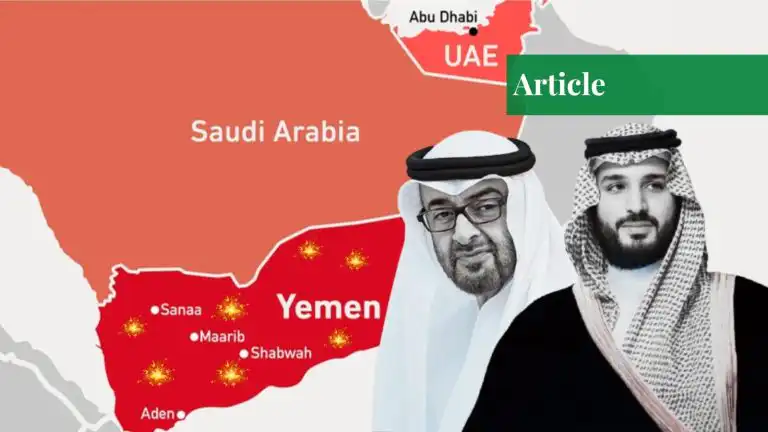
The deep-rooted involvement of these Muslim states not only benefits them but also the international players, including the US and Russia. Saudi Arabia and its coalition are the key allies of the US, whereas Iran and its proxies are a vital asset of influence for Russia. On 4 December 2025, after a long period of ceasefire, the UAE-backed militias expanded their control and seized various strategic territories in Yemen, confronting Saudi Arabia’s unified Yemen vision. This article critically analyzes the deep-rooted historical rift between different state and non-state actors operating in Yemen, the societal dynamics, and a new front of war opened between the KSA and the UAE.
Internal Fragmentation
- Ansar Allah – The Houthis
A group of religious Yemenis, initially calling themselves the ‘Believing Youth,’ are members of a Shiite Muslim sect called the Zaidis. Before the unification of Yemen, the Zaidi community was in the majority. But in the new unified Yemen, they became a minority. During the 1990s, Hussein al-Houthi joined this group after resigning from the government and soon became the father of the Houthi movement – the Ansar Allah. This group holds control of nearly all of northern Yemen, with expansions up to Sana’a and western Yemen. This group is anti-US, anti-KSA, and anti-Yemeni government, operating completely as the Iranian proxy in the region.
- Presidential Leadership Council (PLC)
The PLC is the government of Yemen, which is recognized internationally and considered legitimate. This group has complete Saudi backing in fighting the Houthis and other non-state actors in Yemen with international legitimacy. The PLC has been battling the Houthis, along with Saudi backing, to reestablish its government over the whole of Yemen and the capital, Sana’a, in particular.
- Southern Transitional Council (STC)
The STC is a separatist group in Southern Yemen. Their primary objective is to reinstate the southern state as it existed between 1967 and 1990. This group has strong backing from the United Arab Emirates against the Houthis and maintains a strong foothold in Southern Yemen. The STC is now comprised of various southern militias, including security belt forces, Hadrami elite forces, Shabwani elite forces, etc. – all backed by the UAE.
The Stalemate – 2022
By 2019, the conflict between various groups had attained the highest level of complexity. The Saudi forces supporting the previous government in the east in Yemen, the UAE supporting the STC in the south, the Houthis supported by Iran in the north, and Salafi jihadists (i.e., AQAP, ISYP, etc.) trying to acquire pieces of land were confronting each other. The fighting ceased in April 2022, when a ceasefire was brokered by the UN. Iran and the KSA began having diplomatic negotiations that were led by China, and tensions in the region began to dissipate. By 2023, Saudi Arabia and Iran reestablished diplomatic relations, raising the expectation that Iran does not support the Houthis. But the Israeli operation in Gaza once again compelled the stagnant proxies to revive their missions, with Iran providing immense military support to the Houthis.
The revival of the STC: KSA v/s UAE
On December 4, 2025, the STC seized strategic territories of the Hadramout region, which are oil-rich lands. This offensive move has destabilized the situation by reverting the years-long de facto stalemate. Moreover, the reduced presence of the United States in the region has provided a much larger space for regional entities to play their part overtly. This occupation by the STC is not just a military operation but a political signal of the changing regional dynamics, which is proving to be hazardous for Saudi Arabia. This move has rekindled the historically inactive regional local tensions between Saudi Arabia and the UAE. The UAE media is portraying the STC as a legitimate power, serving the cause of stability and security in the region, while the KSA is either talking cautiously or is silent.
The KSA and the UAE are now facing each other via their proxies in Yemen. In the case of Abu Dhabi, southern Yemen is a precious goldmine, which includes warm water ports, oil resources, sea route connectivity, and an entry point towards Africa and the Red Sea. The UAE could easily establish itself as a powerhouse in the region in case Southern Yemen is restored as an independent state. Conversely, it is getting worse in the case of Saudi Arabia. Conversely, it is getting worse in the case of Saudi Arabia. With the southern Yemen split, the Houthis would be in the majority in the north of Yemen – a threat to Saudi Arabia.
In this way, one of the strategic requirements of the KSA is a unified Yemen. This is, however, not the sole enmity between Saudi Arabia and the UAE. Oil decisions in OPEC, maritime disputes in the Red Sea, island disputes, proxy war in Sudan, influence in Africa, relations with Iran, and the Abraham Accords are all various fronts where both states are racing against each other. Moreover, the Israeli backing of the STC and close relationship with the government of the UAE are another major concern. Saudi Arabia is trying to become a regional hegemon by closely aligning with the United States. The latest F-35 deal and MBS’s promise to invest $1 trillion in the US are a clear threat to Israel. The Israeli government is taking complete advantage of the KSA-UAE enmity over influence in Yemen by supporting the UAE and the STC, creating a split between Saudi Arabia and the UAE. This would allow Israel to pursue its anti-Muslim mission in the region easily.
Conclusion
The recent offense by the UAE against the Houthis has once again created chaos in the region. Whenever there is a regional instability in the Middle East or the issue of the Muslim divide, one actor is always there – Israel. The recent UAE-KSA enmity over Yemen could develop into a firm stance where both states could directly confront each other. The regional stability, the domestic politics, and the division between Muslims are all upcoming dynamics in which Yemen is once again going to play a destabilizing role in the Middle East. A security dilemma would be created where an increase in the influence of one Muslim state becomes the insecurity of the other and an ample opportunity for anti-Muslim factions of the region to further their aims.
If you want to submit your articles and/or research papers, please visit the Submissions page.
To stay updated with the latest jobs, CSS news, internships, scholarships, and current affairs articles, join our Community Forum!
The views and opinions expressed in this article/paper are the author’s own and do not necessarily reflect the editorial position of Paradigm Shift.

He is pursuing a BS in International Relations programme from International Islamic University, Islamabad and has a keen interest in research works, policy analysis, defence and strategic studies and conflict resolution.