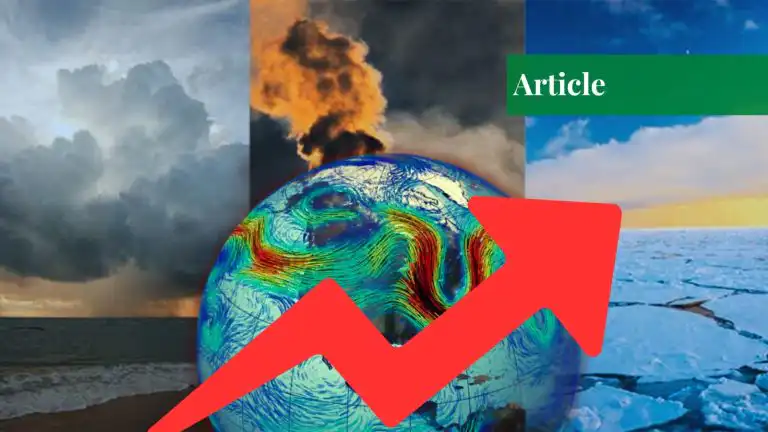

Did you know that 2016 was the hottest year for its time, having a high average of 14.8 degrees Celsius (56.8 degrees Fahrenheit), which was a dramatic and slightly concerning milestone? However, what’s even more concerning is the new record held by 2024 for the hottest year, having a slightly higher but even more concerning average of 15.1 degrees Celsius (59 degrees Fahrenheit).
One day, I remember talking to my father about global temperatures while I was preparing for my social studies test. My father told me that he was shocked when he found out that 2016 took the title of the hottest year. I was confused: I do not remember 2016 being significantly hot. In fact, at that time, my cousins and I played outside as if it were any other day, but my parents and grandparents could not stop talking about how much the weather had changed over the past years.
It is 2026 now, and we just passed the hottest year the globe has ever seen: 2024. The environment was not just hot, it was uninhabitable, and it was something the world had never seen before. But the most concerning fact wasn’t the heat: it was the lack of reaction people gave. Nobody bats an eye at the fact that the Earth is becoming slightly hotter than yesterday and the day before. Just because the rise per day is minimal does not mean it doesn’t exist. It is concerning that no one is concerned about it.
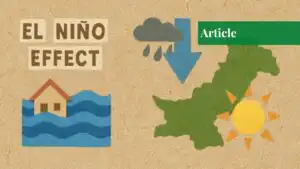
2016 was especially known for its grueling temperatures and foggy air. It was the hottest of its time, mainly due to human activities and the El Niño event, which is when parts of the Pacific Sea become hotter. It caused major heat waves, storms, floods, and wildfires. It also caused droughts in Ethiopia, Kenya, and Southeast Asia. This shocked the public. 2024, however, was a whole other story. The environment was even hotter, and temperatures reached new extremes, even without the natural El Niño event, making the small change in temperature more concerning. There were stronger heat waves, bigger fire seasons, and an increased number of record events in many regions. Areas such as Europe, the Middle East, Africa, South Asia, and parts of central Asia were affected.
| 2016 | 2024 |
| Hottest year of its time | Even hotter than 2016 |
| Strong El Niño year | Hot even without the natural El Niño event |
| Few extreme events | Much more extreme events |
This was mainly due to the persistent global temperatures.
2025 is in the top three hottest years. Since we were born in a hot climate, we wouldn’t feel too hot, would we?
So, what is the visible impact that is affecting the people? Health and heat-related illnesses. Heatstroke caused fatalities, especially among old people and young babies. This happened during the 2023 European heatstroke. It also caused respiratory problems. Smoke from wildfires in California triggered an asthma attack. Even recent global diseases such as COVID-19 were influenced by climate change. Higher temperatures increased the spread of zoological diseases, such as COVID-19. This made COVID-19 even more deadly, causing more deaths.
So, why is this happening? We know the reason behind climate change is GHGs. They are groups of gases that absorb heat and radiate it back to Earth. It is essential for life, but only in regulated amounts. Human activities such as urbanization, industrialization, burning of fossil fuels, and deforestation cause greenhouse gases to go into the atmosphere. This causes global warming. It melts ice caps, which try to slow down global warming by reflecting heat. This all contributes to the difference between 2016 and 2026. The amount of GHGs in the atmosphere in 2016 increased by 40% in 2026. In fact, 10% of all GHGs in the atmosphere were emitted from the period 2016- 2026, and the latter half (2020-2025) emitted more.
In response to this phenomenon, Barack Obama, the 44th president of the United States of America, said: “We are the first generation to feel the impact of climate change and the last generation that can do something about it.”
This perfectly represents the urgency of the situation. The climate is only getting worse, and if we don’t do something quickly, it might be too late. The action plan scientists are following is to reduce greenhouse gases in the atmosphere by 50% and reach near-zero emissions, through better agriculture practices, more renewable energy plants, more electric transport, and to reduce deforestation. As Ban Ki-Moon, former secretary of the United Nations, quotes: “There is no Plan B because there is no Planet B.”
As a part of humanity, we need to take care of our planet before it is too late to do anything. One single human cannot do anything, but if everybody, including the government, plays their part, we definitely can change the world’s environment for the better. Small Individual actions are needed, like turning off the lights when we leave the room, and switching to renewable energy. If we increase the amount of renewable energy resources, we could have a significant effect on global warming, as non-renewable energy causes 70% of all greenhouse gas emissions. We can also follow the three R’s -Reduce, Reuse, and Recycle- so we can limit the need for new goods created by fossil fuels.
In this blur, making a prediction is tricky, but not impossible. Ecologists believe that the global temperature will increase by 1.5 to 4 degrees Celsius by 2050. While this doesn’t seem like much, a small increase in temperature can impact the intensity of natural disasters. This is why it is crucial to mitigate climate change through waste management and the replacement of fossil fuels with renewable energy .
The average life expectancy in 2026 is 78. Your midlife is no longer your 50s. This is mainly because of climate change. Don’t you want to spend more happy moments with your loved ones? And when we eventually leave this world, in what condition should we leave it in, so the next generation can create happy memories just like we did?
If you want to submit your articles and/or research papers, please visit the Submissions page.
To stay updated with the latest jobs, CSS news, internships, scholarships, and current affairs articles, join our Community Forum!
The views and opinions expressed in this article/paper are the author’s own and do not necessarily reflect the editorial position of Paradigm Shift.

Student of Prep III C in The City School.