
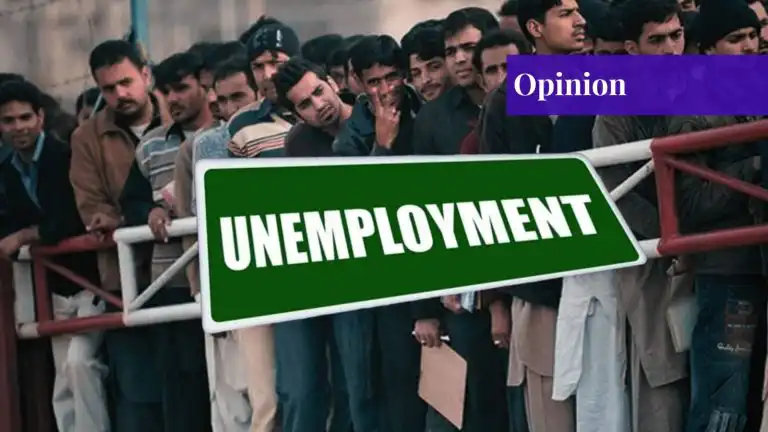

A Systemic Failure
Building roads and bridges does not build the nation. This line is not just to be heard, but it needs to be understood. Pakistan is one of the countries with the youngest population in the world, with nearly 26% of young people falling under the age bracket of 15 to 29 years, often described as a “demographic dividend” that propels the economy. Pakistan produces thousands of young graduates every year, and despite this, most employers feel the scarcity of “job-ready” talent. Adding to this dilemma, young people, particularly Gen Z, despite being educated and digitally aware, are far from opportunities and struggle to find employment.
According to the Labor Force survey, Pakistan’s unemployment rate is 7.1%, the highest since 2004, raising important questions about the underlying causes of this persistently high figure. The question that arises here is whether young people are not working hard enough. Young people are often criticized for their career choices as they are clustered into a narrow set of conventional fields despite the availability of over 700 academic and professional fields in Pakistan. This is not the fault of young people; in fact, it is a failure of the system. Our education system rarely provides structured guidance and exposure to new emerging fields. However, education at the university level is structured on cramming-based learning rather than critical thinking and adaptability, and it holds back young people in the job market.
The State’s Responsibility vs. Gen Z Realities
This reality was exposed in Finance Minister Muhammad Aurangzeb’s recent assertion, while addressing a seminar on population growth, that the government is not responsible for creating jobs. It is not suitable for a minister of finance to make such a comment. However, the government does not directly employ everyone; nevertheless, governments are unquestionably in charge of determining the circumstances that lead to job creation. The state controls whether companies grow or shrink through fiscal policies, regulations, and incentives. Adding to this critique, Dr. S. Akbar Zaidi, Executive Director of IBA Karachi, stated that the government needs to upskill young people since our demographic dividend has turned into a demographic nightmare with 3.5 million individuals joining the workforce each year in search of jobs. Zaidi’s argument recognized reskilling as a necessary feature that increases productivity and boosts employability. In this way, young people will pay more attention to skills to boost their long-term stability.
It is very politically convenient to blame Gen Z while the state remains reluctant to take responsibility. Today, it is a Gen Z issue, but tomorrow, it will be a state issue. I frequently hear people claim that young people are spoiled, which prevents them from working hard and taking advantage of opportunities. However, the reality is that they are rejecting opportunities that are disguised forms of exploitation, such as unpaid internships, contract-based work that stunts personal development, and salaries that fail to keep pace with rising inflation. Young people are increasingly turning to call centers and freelancing as an escape from low earnings and a lack of professional counseling.
Bridging the Gap
Ending the paradox of an educated yet unemployed generation will require a twofold approach. The government can’t be held accountable solely for this crisis, as every problem has many facets. Even in the face of many structural flaws and governmental failures, the importance of individual agency cannot be ignored. The state should work to expand opportunities for the new generation so that young people are encouraged enough to make better decisions about their careers and to work hard for them.
Such policies and reforms should be introduced to remove the so-called “class system” in society and provide equal access for people with different backgrounds, aligning with SDG-04 (quality education). Universities should focus on teaching practical skills rather than admitting students only to boost enrollment and revenue in the name of business. Instead of leaving students with degrees that are worthless in the marketplace, education should educate them for real careers. Students should be encouraged to participate in hybrid programs that will allow them to develop their skills and gain knowledge.
Paid internships should be introduced, especially for practical fields. They should spend at least a year working with startups that will help develop their skills and boost their careers. Universities should focus on R&D to publish and use the work and findings of students in the marketplace. Universities can become engines of useful solutions rather than merely degree factories by offering incentives and incubator support, which can spur innovation and help transform ideas into jobs.
It’s high time to stop idealizing civil service careers that keep students in training for a few public service positions each year. Instead of taking advantage of opportunities to gain experience and abilities, students wind up pursuing status. Young people should transform education into productive labor. A fresh graduate enters the job market with irrational expectations and is unaware of the ground realities of the job market. Youth must realize that starting from zero is crucial in creating an empire. Waiting for a dream job only increases the gap between education and employment.
Addressing unemployment requires efforts and policies by the state that hopes for the future growth of young people. Neither Gen Z is in shortage of degrees nor is the state in shortage of programs, but a culture of economic engagement is missing at both ends. It is the need of the hour to understand that information acquisition and holding degrees are not accomplishments; true success is found in the capacity to use that knowledge in a meaningful way. In the market, which is changing rapidly, the focus must move from gaining knowledge to using it in real-world situations. Without this change, education runs the risk of becoming an end in itself rather than a means of advancing both the youth and the national progress.
If you want to submit your articles and/or research papers, please visit the Submissions page.
To stay updated with the latest jobs, CSS news, internships, scholarships, and current affairs articles, join our Community Forum!
The views and opinions expressed in this article/paper are the author’s own and do not necessarily reflect the editorial position of Paradigm Shift.

Shahmir Khan is an accounting and finance graduate who is preparing for the CSS exam. He also works remotely for an international company.