

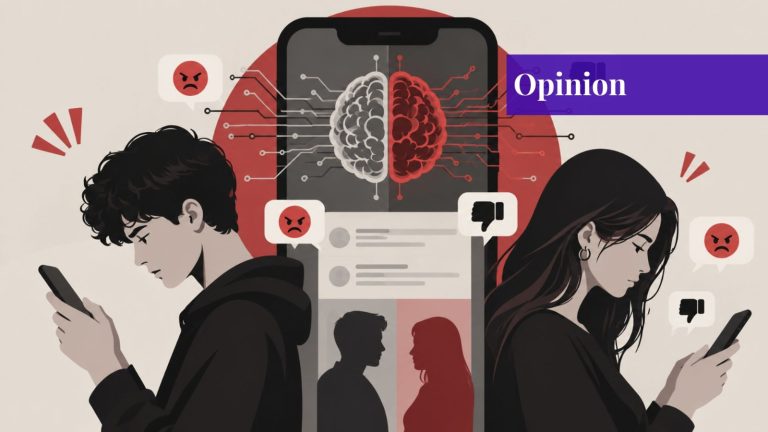
Have you ever come across online posts that portray “all men as cheaters” or women as “gold diggers”? You surely have. And if you enter the comment section of those posts, you might find that the majority of radical opinions conform to all these claims. Whenever I saw these posts and the subsequent comments, I wondered what the basis was for all these radical claims and gender stereotypes that exist almost everywhere digitally.
When I spoke with a few of my close friends who held the same notions and asked them how they had reached these conclusions, I was expecting an informed response based on real-world experiences or some concrete facts. Contrary to my expectations, however, their entire stance was influenced by what we call “doomscrolling” and confirmation bias.
Affective Polarization
This phenomenon has been categorized by the European Parliament as “affective polarization.” These algorithmic mechanisms are meant to optimize engagement and watch time by pushing highly emotive, sensational, and conflict-driven content.
Gender warfare (e.g., highly generalized attacks on men or women) serves as an effective trigger for this algorithmic architecture. Many cross-cultural studies have shown that such doomscrolling leads to an erosion of trust in a “just world” among people who encounter hostile gender discourse, leading to a shift in their internal baseline from viewing the opposite sex as individuals to viewing them as a collective threat.
The Manufacturing of a Fractured Reality
Human realities and interactions have always been complex and multilayered, involving a lot of factors and nuances. However, algorithmic bubbles, instead of showcasing a multifaceted human reality, offer ideological silos. A social media user who comes across a video highlighting a negative interaction involving a man will quickly find their entire feed populated with hyper-curated content suggesting that all men behave that way, creating a “fractured reality.”
This removes the complexities of human interactions and presents a simpler, more direct version of reality. Most social media users take this algorithmic pipeline’s push as the only reality and use it as the basis for their gender perceptions, leading to actions like resharing and reposting, which further contribute to this psychological feedback.
This phenomenon has led to the fragmentation of the commons, with Millennials and Gen Z being the most susceptible to this loop. Data show that 53% of Gen Z admit to doomscrolling. Sociological research shows that constant exposure has widened the ideological gulf between young men and young women.
Constant consumption of biased and emotionally charged content has caused distrust that is not based on any objective reality but on social media posts meant to generate engagement and ad revenue. These posts often display inaccurate content or misinformation, ignore the true complexity of any incident, and use sensational headlines or captions.
Fantasy-Industrial Complex
Another phenomenon, known as the “Fantasy-Industrial Complex,” involves radicalization that has simply evolved from spreading misinformation and lies to making users believe in a specific reality by regularly posting and displaying one-sided content and inducing hopelessness, fear, and anxiety as a means of generating revenue by directing users to paywalls. This profit model of panic relies heavily on gender anxiety and baits the most vulnerable users, particularly women.
A high level of online gender-based hostility leads to self-censorship, where women who fear or have faced harassment, as well as men who face blanket verification—a sociological and psychological concept in which an entire group of people is portrayed as inherently evil, harmful, or socially destructive based on the actions, traits, or statements of a few individuals—withdraw from social media platforms, leaving the discourse to be dominated by the most extreme voices.
Because 62% of Gen Z blame themselves for this negative content loop, platforms remain free from public pressure, but many academic and regulatory frameworks demand systemic overhauls. Emerging computational models, such as X’s Community Notes, help in creating a “bridging algorithm.” These systems, instead of rewarding content that gains the highest number of votes and thereby modeling partisan echo chambers, reward content that receives higher votes from users who traditionally hold opposing views, significantly decreasing polarization.
Frameworks like the EU’s Digital Services Act (DSA) are foundational steps toward forcing platform accountability. Researchers argue that true mitigation requires auditable algorithmic transparency, giving users the ultimate right to opt out of engagement-maximized feeds in favor of clean, unbiased, and fact-based feeds. Users must have the option to manipulate the algorithm or choose content rather than being driven by algorithms. Platforms must rethink their revenue models and find a middle ground to balance the promotion of radical discourse with engagement-based profit.
If you want to submit your articles and/or research papers, please visit the Submissions page.
To stay updated with the latest jobs, CSS news, internships, scholarships, and current affairs articles, join our Community Forum!
Find our FREE quizzes and MCQs here!
The views and opinions expressed in this article/paper are the author’s own and do not necessarily reflect the editorial position of Paradigm Shift.

Muhammad Maroof Hassan is a scholar of International Relations from the National University of Modern Languages (NUML), Islamabad. His research interests include South Asian politics, counterterrorism, and the dynamics of war and conflict. He writes on regional security, great-power competition, and the evolving foreign policy postures of South Asian states at India Decode and the Asian Consortium for Regional Studies.