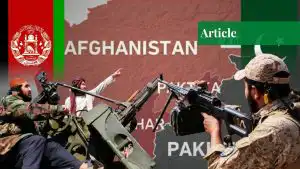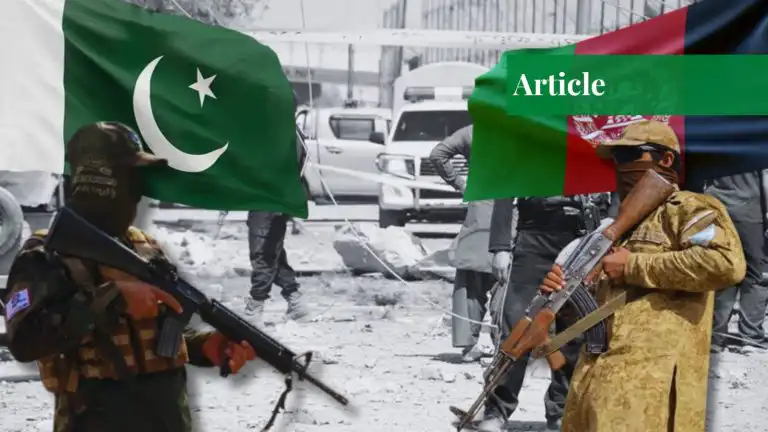


The October 2025 flashpoint between Kabul and Islamabad resulted in a dramatic escalation in cross-border terrorism, militancy, and a security crisis. The ceasefire temporarily halted the airstrikes; however, on 21 February 2026, the situation further escalated into a large-scale conflict. In February 2026, Pakistan launched airstrikes inside Afghanistan in retaliation for the resurgence of terror-driven activities and in response to ongoing cross-border activities since 2021, when the Taliban took over the office. Afghanistan has been a haven for militants’ operations by Tehreek-e-Taliban Pakistan (TTP), impacting security dynamics within Pakistan, marked by a rise in extremism and violence. Defence Minister Khawaja Asif declared the situation to be an open war between Kabul and Islamabad, with reports further confirming Islamabad’s strikes being targeted at militant positions.
Asymmetry and military imbalance are the defining features of this open war marked by Pakistan’s superiority on one hand and the Taliban’s strength in Guerrilla war on the other hand. Pakistan’s 600,000 active personnel overpower the Taliban’s less than 200,000 personnel. However, the Taliban’s reputation for guerrilla warfare, along with Terrain Advantage and about 170,000–172,000 fighters, adds to asymmetry in the conflict between Kabul and Islamabad. This imbalance has a dual impact on Pakistan and Afghanistan. For Pakistan, professional forces allow for conducting coordinated cross-border operations; however, the terrorism factor adds to the risk due to direct or indirect support given by the Taliban to Tehreek-e-Taliban Pakistan. Therefore, while the operation was to eradicate terrorism, this imbalance risks a rise in escalation. For Afghanistan, the imbalance adds to vulnerability both in infrastructure and the economy. Kabul’s already fragile economy could further be dampened due to trade interdependence with Pakistan for transit routes and ports. Therefore, the already collapsing economy under Taliban rule could further deteriorate.
The paradox of terrorism and TTP is the centre of conflict, with Pakistan’s stance reflecting security concerns. TTP operating from the soil of Afghanistan, making Kabul a sanctuary for terror-driven activities, and its failure to abide by the Doha Accords for preventing the use of Afghan soil for terrorism was a driving factor for Pakistan to launch the operation named Operation Ghazab lil Haq. Secondly, Pakistan’s security stance is India-centric. Since 2021, the Taliban led government has been engaging in diplomatic talks with Hindutva centric Indian government. This convergence adds to the threat to Pakistan’s strategic location and sovereignty. However, the operation Ghazab lil Haq and the Afghanistan-Pakistan open war have some pressing impediments for Pakistan concerning the TTP-TTA nexus, cross-border terrorism, and dual-front security dilemma.
Emerged as a Pakistani affiliate of the Afghan Taliban movement, both follow Deobandi jihadist ideology and share a sympathetic relationship. The present war dynamics alert for insurgency within Pakistan, opening avenues for strengthened militant mobilization for retaliatory attacks, further resulting in significant violence. Moreover, the present situation further spread the TTP propaganda of Jihad against Pakistan. Therefore, the situation strikes parallels with the 2007–2014 TTP violence cycle. Secondly, the war risks an increase in cross-border terrorism and disputes over the Durand Line. The threat is perceived regarding smuggling, refugee inflow, and militancy, resulting in regional instability and trade deficit. The 2026 Bajaur attack, which resulted in the killing of 11 security personnel and a dozen civilians, is the manifestation of this impediment. The last impediment refers to a situation of a two-front security dilemma for Pakistan with Afghanistan and India as its immediate neighbours. The recent diplomatic outreach between Kabul and New Delhi resulted in an unsettling situation for Islamabad due to concerns over strategic encirclement.
The full-scale confrontation between Pakistan and Afghanistan has serious implications for regional and global security dynamics. The war risks escalation, and if the conflict is prolonged, it could lead to the destabilization of South Asia and Central Asia. Secondly, it is a breeding ground for terrorism spreading over the region beyond the borders between Kabul and Islamabad. As it could strengthen militants such as Islamic State – Khorasan Province and Tehrik-e-Taliban Pakistan to operate more systematically in conflict zones. Secondly, on a humanitarian level crisis of refugees and the threat of displacement are significantly high. Thirdly, the economic cost of conflict is severely high, carrying constraints for regional connectivity because of Uzbekistan’s investment in the Termez–Mazar-i-Sharif–Kabul–Peshawar railway aimed at linking Central Asia to Pakistani ports for trade purposes. The escalation is resulting into delay due to militant spillovers.
To curb the impediments, it is recommended to follow the path of de-escalation via mediation and diplomatic channels. For this purpose, the United Nations and regional actors have been calling for restraint. To succeed in deescalation the second recommendation is for both Kabul and Islamabad to limit military operations and engage in negotiations through structured dialogues. Lastly, efforts need to be focused towards sustainable peace that requires confidence-building measures and third-party mediation for long term peace rather than mere tactical short term gains.
If you want to submit your articles and/or research papers, please visit the Submissions page.
To stay updated with the latest jobs, CSS news, internships, scholarships, and current affairs articles, join our Community Forum!
The views and opinions expressed in this article/paper are the author’s own and do not necessarily reflect the editorial position of Paradigm Shift.