


The intellectual pursuits of Russian thinkers have the same effect as the thinkers in the West upon the foundation of the geopolitical currents of our time. The seminal work of Isaiah Berlin, “Russian Thinkers,” introduces readers in the Anglophone world to the philosophical insights of the Russian civilization. It effectively reveals how Russian thinkers have addressed the enduring problems specific to their context through philosophical perspectives.
Philosophy is not only a system of thoughts explaining some ontological problems lying beyond the human ken, but it is also a rather intriguing process that galvanizes the very existence of the foundations of major institutions. The philosophical upbringing stemming from the Enlightenment in the 18th century still echoes in the Western space, extending its relevance to politics, economics, and attitudes toward human rights. The West’s ardor for free markets and the preservation of civil liberties owe their moral debt to the ideological underpinnings of Socrates to Mill.
Russia is a state with a twisted identity, which is neither Western nor Oriental. As Leibniz admonished Peter the Great once “Russia’s historical destiny lies in serving as a gateway between the West and East.” When aspirations filled with Marxist Leninist doctrines withered away amidst the doldrums of post-Soviet chaos, Russians eagerly looked for their historical destiny. Their call was answered soon by the rise of Vladimir Putin and the ideological vacuum left by the extinction of communism led the path to the mastery of Alexander Dugin, the leading ideologue of the Russian-speaking world.
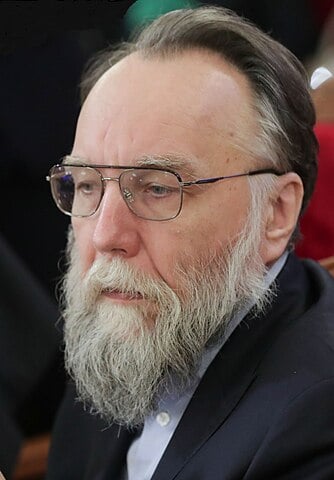
Alexander Dugin and his philosophical essence are antithetical to the liberal West as it denies the globalist agenda enunciated by the post-Cold War world. Today, Dugin is generally thought of as an enthusiastic war propagandist and neo-fascist who proposes to unite the global far right into an anti-Western alliance. The crux of Dugin’s philosophy is much subtler and philosophically worth examining than ignoring it as a fallacy. Buttressed by Russia’s unique religious and social consciousness, Dugin presents his philosophical ideas, which consist of three main layers. The unique character of Russian thought is that it is a mystical tradition that serves as a counter-answer to the British emperor tradition and the search for a Platonic-typed philosopher ruler. Finally, he also advocates for forming Eurasia under Russia’s orbit.
In contrast to the liberalism that often admires the existence of individual liberties along with the free markets, Dugin contends what if one does not choose both liberalism and communism? The Fourth Political Theory is the epitome of Dugin’s thought process explaining the alternatives available for humanity to confront the onerous world order that emerged in the post-Cold War context. The unipolar moment coined by Charles Krauthammer as a jubilant triumph of the US-led globalist order has been strictly denied by Dugin in the “ Fourth Political Theory.” The ideological struggles that erupted in the last century among liberalism, communism, and fascism continued curtailing the choices of the people until liberalism emerged triumphant at the end of the Cold War, which Dugin describes as the peak of the Third Political Theory. The phrase “Fourth Political Theory,” the subject of his philosophical corpus, refers to restoring civilizational values as the basis for the coming era. People create civilizations, and Dugin argues that political sovereignty rests in large civilizational spaces and blocs.
His conspicuous clarity distinguishing individuals from human beings is remarkable as it posits a different identity for the latter. Dugin claims the untamed authority of liberalism idealizing individuality is likely to threaten humanity, in which those who reject individualist ethos will be regarded as fascists. While making the palpable difference between the two, Dugin states “The individual is the product of subtraction of the personality from the human being, the result of the liberation of the human unit from any bonds and collective structures.”
Dugin’s Fourth Political Theory should be understood in its philosophical orientation, drawing on ideas ranging from the French thinker René Guénon to the last great philosopher of the Western world, Martin Heidegger. Dugin’s fascination with Guénon reveals the foundations of his support for the uniqueness of Russian orthodoxy. Inspired by Vedanta and Neo-Platonic philosophy, Guénon, a renowned French thinker in the late 19th century advocates that all civilizations and peoples should return to the spiritualism of their traditional cultural archetypes. Dugin’s primacy for Russian orthodoxy and constant denial of becoming a part of the globalist agenda, which he described as “Atlantism” is an offshoot of his wider reading of René Guénon.
In addition to his appetite for traditionalism, Dugin’s ideas align with the philosophy currently advocated by Russian President Vladimir Putin. Some may argue that his views justify Russian aggression in Ukraine through a strong nationalist lens; however, they can also be seen as part of an enthusiastic ideological project aimed at preserving Russia’s unique identity as a distinct civilization. This approach is distinctly different from Peter the Great’s efforts in the 18th century to emulate Western patterns or from Yeltsin’s monumental failures in the late 20th century.
Moreover, Dugin does not consider Russia’s destiny to be rooted in its Asiatic past, despite the country’s historical subjugation under the Mongols for centuries. Instead, his vision for Russia’s unique future is encapsulated in the concept of “Neo-Eurasianism,” which traces back to the 19th-century national awakening in Russian thought. To secure Russia’s victory over the globalist West, Dugin believes that the country should embrace a national idea that can guide all its policies. He has openly criticized Putin’s lack of initiative during the Crimean crisis in 2014, noting that Putin failed to mobilize effective propaganda. This critique is a central theme of Dugin’s 2012 book, Putin Versus Putin.
It is believed that wars are only fought with bullets and bombs—but the gravity of an idea can play a catalyst role in the events lying beyond the strength of soldiers. The ideology formed by Dugin is a bulwark promoting Russia’s encounter with the West. Two years ago, in Moscow, Daria Dugin was killed in an explosion, later it was found that Daria’s death was a political assassination, authorized by the Ukrainian Government and US intelligence believed that the real target was Alexander Dugin. It is a sheer surprise that Ukraine targets a simple philosopher in the middle of a war going on for the nation’s survival. The simple answer as to why is that the power of an idea embodied by the scholarly opinions articulated by Dugin is profoundly appealing with its bewitching charm to those who are looking for a path to challenge the globalist agenda and the ultimate victory of liberalism.
If you want to submit your articles and/or research papers, please check the Submissions page.
The views and opinions expressed in this article/paper are the author’s own and do not necessarily reflect the editorial position of Paradigm Shift.
Punsara Amarasinghe is a post-doctoral researcher affiliated with Scuola Superiore Sant Anna, Pisa. He is a PhD holder in Public International Law from the Institute of Law, Politics and Development at Scuola Superiore Sant Anna (Sant Anna School for Advanced Studies) in Pisa, Italy. He holds LL.M. from the South Asian University, New Delhi, and completed his undergraduate studies in law at the Faculty of Law, University of Colombo, Sri Lanka.
He completed another master's degree in international relations from the HSE, Moscow. He has held two visiting research fellowships at the Global Legal Studies Centre at the University of Wisconsin, Madison, and Sciences PO, Paris. He was affiliated with the Minerva Center for Strategic Studies at Hebrew University, Jerusalem for a brief period in 2019.