
Introduction
The bitterest truth that all strategists would reluctantly admit is that mastering grand strategies has won no major war in history. Rather, it was won by the complete manifestation of tenacity. What the Chinese are up to in the maritime domain that encompasses the West Philippine Sea and the South China Sea reminds us of the virtue of tenacity as their strongest plus point in the geopolitical fiasco looming in Southeast Asia. The growing tension in Southeast Asia, deteriorating its security architecture, has been a moot point to discuss among many security analysts and scholars.

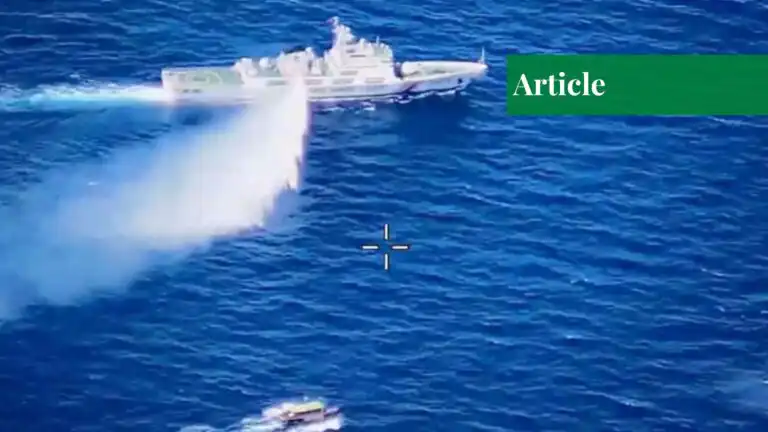
Some tend to argue the epicenter of the crisis is rooted in Sino-American power competition, which is indeed a superficial analysis overlooking how Beijing strives to dominate the region regardless of the international legal challenges it confronts. Since China declined to abide by the ruling of the Hague over the South China Sea dispute in 2016, Beijing’s actions in Southeast Asia have seen a robust increase in proxy warfare tactics/grey zone activities manifested through entities such as the China Coast Guard and the People’s Armed Forces Maritime Militia.
Philippines-US Ties and the Beijing Factor
Despite China’s intensified strategic efforts in the region, its advancement remains elusive due to the Philippines’ ongoing resistance to Chinese dominance. The Philippines is actively undermining China’s proxy warfare tactics by publicly exposing China’s aggressive behavior in the South China Sea. Since the standoff at Scarborough Shoal in 2012, Manila has expressed concerns over strengthening security ties with Washington, emphasizing the importance of the 1951 US-Philippines defense treaty, which serves as the foundation of the defense partnership between the two countries. Given the geopolitical entanglement over Taiwan between the US and China, Philippine President Marcos Jr. is aware of the inevitability of an escalation that his country needs to face sooner or later.
In addition to Manila’s assertive transparency, which involves publicizing China’s maritime activities through media briefings and surveillance footage, the Philippines’ defense partnership with the United States bolsters Manila’s strategy against Chinese incursions. The annual Balikatan military exercise took place for three weeks in April 2025, involving 14,000 soldiers and marking the first deployment of the Navy-Marines Expeditionary Ship Interdiction System (NMESIS). Notably, this development followed the US’s relocation of the mid-range capability (MRC), an offensive strategic mid-range fire system, to the Indo-Pacific region during the 2024 Balikatan drill, highlighting the shift toward conventional warfare amid escalating tensions.
It is a question beyond doubt that the US’s NMESIS and Typhon missile systems will create paranoia in Beijing due to their offensive nature, albeit they stand as an example of the Philippines’ deterrence strategy against Beijing. Yet this development begets new questions: Is the Philippines capable of defending itself from imminent threats? How can deterrence be sustained? On the face of it, Manila’s welcome of the US defense and missile system will rebuke China for a hostile reaction similar to China’s adverse action towards Seoul in 2017 when South Korea agreed to THAAD’s deployment. Deterrence can be fanciful with its bewitching charm, but it may come with a cost for a middle power like the Philippines. Both the 2023 and 2024 Second Thomas Standoffs embody rigorous approaches in solidifying their territorial claims, which made Manila vulnerable to rethinking its maritime strategy to counter Beijing’s maritime juggernaut.
Is China Isolating the Philippines?
Manila’s defense strategy should adopt a more cautious approach, as none of the military drills or partnerships with the US can guarantee complete security in light of China’s growing expansionism. Reports indicated that several Chinese vessels entered the West Philippine Sea ahead of the US-Philippines military drills last April. During that period, there was a peak of 555 vessels, with a daily average of 464 observed in Philippine maritime areas—an increase of 525 vessels and a daily average rise of 427 from the previous week.
On April 27th, 17 China Coast Guard (CCG) vessels and 15 People’s Liberation Army Navy assets were also noted. Furthermore, several Chinese research vessels were sighted in the Northern Luzon Command’s joint operational area, while a significant presence of the Chinese Maritime Militia was recorded in the Western Command, particularly around Recto Bank and Panganiban Reef. On April 25th, China’s state-run media, Global Times, reported that Coast Guard officers displayed a Chinese flag in Tiexian Jiao. These developments should not be viewed as isolated incidents; they can be linked to the US-Philippines military drill scheduled for May 2025.
While continuing its dogged activities amidst the risk of losing its international credibility as a persistent objector to international law, China engages in a much more dubious game in Asia by doing everything that it can to isolate the Philippines. China often portrays the Philippines as a state advocating anti-Chinese rhetoric driven by small nation syndrome, which is harmful to the regional equilibrium.
The recent comments made by Chinese strategist Ding Duo in the aftermath of the Shangri-La dialogue highlighted that the tense situation in the South China Sea is by no means a problem between Beijing and ASEAN. Rather, it is a conflict initiated by the Philippines through provocation and deception to pursue self-interest, in which the US aptly uses Manila to expand its footprint in the Asia-Pacific region. Such narratives stemming from China’s strategic thinking unfold how Beijing seeks to corner the Philippines in Asia.
At its core, the rest of the member states in ASEAN do not share disputes, at least in the legal sense, with China, which stands in favor of Beijing to bolster its anti-Philippines/US narrative within ASEAN. Simultaneously, China strives to discredit its international criticism while legitimizing its maritime presence under the guise of environmental monitoring, which serves as a central pillar of Beijing’s grey zone tactic in the South China Sea.
This movement may serve a dual purpose—to neutralize global diplomatic pressure over alleged environmental abuses tied to Chinese artificial island building in the West Philippine Sea and reinforce claims by establishing a pattern of documented foreign violations. Such a narrative supports Beijing’s broader strategy of legal warfare by enhancing its justification for increased maritime patrols, surveillance, and enforcement operations under the pretext of environmental protection.
Conclusion
The question arises regarding whether Manila’s deterrence strategy is sufficiently robust to confront China’s persistent challenges, especially amid the criticisms and pressures it faces. Furthermore, the apparent shortcomings in American policy in the region, marked by contradictions, could undermine the Philippines’ long-term deterrence strategy. While the Philippines places more trust in Washington than Americans do in their government, the reality is that Washington’s approach to the Asia-Pacific region is caught between the need to reassure allies like the Philippines in its efforts to counterbalance China and its America-first policy, which includes tariffs and other measures that erode the trust of its allies. Ultimately, it would be wise for a country like the Philippines, which has a constitutionally enshrined policy of renouncing war, to move beyond a complete reliance on deterrence in response to Chinese expansionism in its vicinity.
If you want to submit your articles and/or research papers, please visit the Submissions page.
To stay updated with the latest jobs, CSS news, internships, scholarships, and current affairs articles, join our Community Forum!
The views and opinions expressed in this article/paper are the author’s own and do not necessarily reflect the editorial position of Paradigm Shift.

Punsara Amarasinghe is a post-doctoral researcher affiliated with Scuola Superiore Sant Anna, Pisa. He is a PhD holder in Public International Law from the Institute of Law, Politics and Development at Scuola Superiore Sant Anna (Sant Anna School for Advanced Studies) in Pisa, Italy. He holds LL.M. from the South Asian University, New Delhi, and completed his undergraduate studies in law at the Faculty of Law, University of Colombo, Sri Lanka.
He completed another master's degree in international relations from the HSE, Moscow. He has held two visiting research fellowships at the Global Legal Studies Centre at the University of Wisconsin, Madison, and Sciences PO, Paris. He was affiliated with the Minerva Center for Strategic Studies at Hebrew University, Jerusalem for a brief period in 2019.