
Islamabad, December 4: Oral history and storytelling play a vital role in enriching Pakistan’s intellectual and policymaking traditions. Beyond the Files, a new anthology of memoirs, uncovers the lesser-known dimensions of Pakistan’s governance by documenting the lived experiences of veteran civil servants. The book preserves diverse perspectives, strengthens institutional memory, and offers future generations a more authentic understanding of the country’s administrative journey.
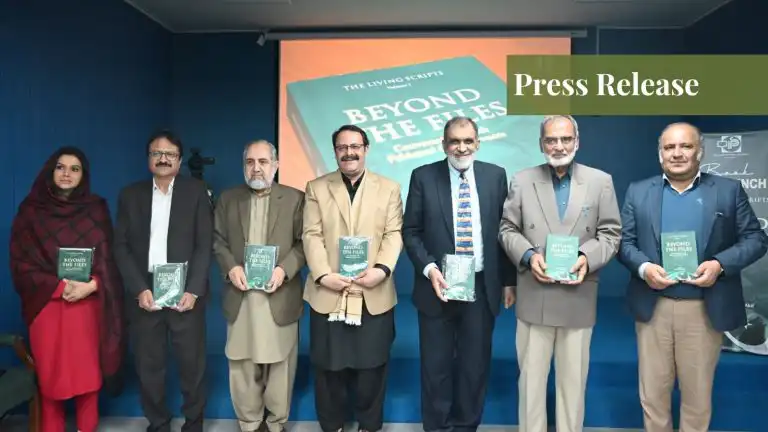
These views were expressed at the launch of the Institute of Policy Studies’ (IPS) latest book, Beyond the Files: Conversations with Pakistani Civil Servants. The event, held in collaboration with the National Book Foundation (NBF), Islamabad, brought together distinguished former civil servants, diplomats, policymakers, and academics.

The session was joined as a guest of honor by Prof. Dr. Mukhtar Ahmed, former chairman of the Higher Education Commission (HEC) and member of the IPS National Advisory Council (NAC), and also addressed by Khalid Rahman, chairman of IPS; Syed Abu Ahmed Akif, the book’s editor and member of the IPS NAC; Amb. (r) Syed Abrar Hussain, vice chairman of IPS; Amb. (r) Naghmana Hashmi; Dr. Mujeeb Afzal, assistant professor at Quaid-i-Azam University; and Murad Ali Mohmand, secretary of NBF.
Drawn from The Living Scripts, the flagship oral history initiative of IPS to document the life and times of veteran civil servants, this first volume of the series offers a rich tapestry of voices of those who served at the core of governance and shaped policies, managed crises, and navigated the country’s shifting political, social, and economic landscapes.

The oral histories showcased in this project were noted to be far more than personal memoirs. Collectively, they form a repository of institutional memory that offers future generations an inside view of Pakistan’s civil service culture, its challenges, and the complex decision-making environments officials have faced.
It was further noted that oral history is a uniquely engaging medium that captures multiple voices and lived perspectives across generations. However, participants emphasized the importance of supporting oral narratives with broader reference points to ensure balanced interpretation. Retired professionals, in particular, were urged to document their experiences, as their reflections offer invaluable contributions to Pakistan’s knowledge base.
Speakers stressed the crucial role of reading, reflection, and documentation in national development. While many civil servants hesitate to write due to fear of judgment, their proximity to key decisions provides insights that are vital to preserve. Encouraging a strong reading culture, particularly among youth, was highlighted as essential for intellectual growth and informed citizenship.
A consistent theme in the discussion was the need to record both positive and difficult experiences, ensuring that important lessons are not lost. Such documentation not only offers guidance to future civil servants but also enriches the broader national understanding of governance. Beyond the Files was thus described as essential reading for both aspiring and serving bureaucrats.

The conversation also underscored the value of reading with intent, to learn, grow, and bring meaningful improvement to personal and institutional practice. Honest self-reflection was highlighted as a critical trait for educators, policymakers, and public servants, especially in light of declining institutional and educational standards.
Concluding the session, Khalid Rahman noted that writing and documentation must reflect a distinctly Pakistani mindset rather than relying on external narratives or borrowed frameworks. He also underscored the importance of truth-telling, framed not as an exercise in negativity or criticism for its own sake, but as a fair, balanced, and honest engagement with national realities. This approach, he stressed, is equally essential for shaping Pakistan’s foreign policy, which must be informed by local experiences, indigenous thought, and on-the-ground realities rather than external influences.
If you want to submit your articles and/or research papers, please visit the Submissions page.
To stay updated with the latest jobs, CSS news, internships, scholarships, and current affairs articles, join our Community Forum!
The views and opinions expressed in this article/paper are the author’s own and do not necessarily reflect the editorial position of Paradigm Shift.

The Institute of Policy Studies (IPS) is an autonomous, not-for-profit civil society organization dedicated to promoting policy-oriented research, dialogue, and human & technological development for better governance. IPS provides a forum for informed discussion and dialogue on national and international issues. The contributions spanning over forty-three years and the overall impact signifies the importance of pragmatic research on policy issues. The institute highlights the role of think tanks in modern democratic polities.