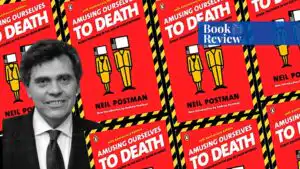


In the 1930s and 40’s, two dystopian fictions were rolled out by two of the most eminent writers, George Orwell and Aldous Huxley, that portrayed an altogether different picture of what they perceived to be the future of humankind under a powerful state. Orwell feared that truth would be concealed from us; Huxley feared that truth would be drowned in a sea of irrelevance. Orwell feared that a powerful state would ban books. Huxley feared that there would be no need to ban them because there would be no one to read them.

Unfortunately, literature too doesn’t remain immune to the biases of politics, which is precisely that despite how dead-on their prophecies were, one acquired fame and the other, despite pertaining more to the modern times, is slightly lesser known. Orwell’s “1984” was propagated immensely in the Cold War as part of the anti-Communist propaganda. On the contrary, Huxley’s Brave New World, a powerful account of contemporary fetishism, “was drowned in a sea of irrelevance”.
Plot
The world is a perfectly happy place; children are created in laboratories, raised in community centres, and divided into 5 groups of Alpha, Beta, Gamma, Delta, and Epsilon by the World state. But the class distinction is such that people love their places in the hierarchy. For instance, the Deltas are conditioned to hate books, the Betas to thank Ford (the “god” of Brave New World) for not making the Alphas, and the Epsilons to work in the countryside as labourers. The planet is distinguished into two areas: the “civilised” Brave New World and the “Savage” Reservation, an area yet to be exposed to the biases of civilisation.
Bernard, an Alpha from the civilised world, once decided to visit the savage reservation along with his friend Lenina, a Beta female. There, at the savage reservations, they discover Linda, a civilised woman who was deserted by the Director of Hatcheries at the Reservation while they were on a trip to the area. Linda, along with her son John, returns to the civilised world alongside Bernard and Linda. Since John has been raised entirely as a savage and has made no contact with the civilised world thus far, he comes to hate the Faustian bargain technological advancement has made in the Brave New World and asks to get out of it to ask God (who still existed in the Savage Reservations) for forgiveness. But his asceticism soon becomes a spectacle for the civilised world, which leads him to commit suicide.
A Critical Appraisal
In the 1920s, when the US emerged rich from the First World War and faced overproduction, it sought strategies to overcome a potential crisis of mismatch between production and consumption. The corporate companies reached out to Edward Bernays, nephew of Sigmund Freud, who would exploit the latter’s analysis of humans as beings driven by instincts rather than rationality. By tying emotions to an irrational desire through the use of mass media, the capitalists converted American workers into consumers, which initiated our journey to “feel good” through consumption. This empirical background of humans’ race to consumerism possibly provides Huxley with the background for this dystopian novel, written in 1932. What followed in the market was largely attributed to this ever-unfulfilled pursuit.
The material and soul have historically constituted human beings. The material being is obvious, and by the soul, I refer to family relations, religious beliefs, friendships, and basic human decency. With the unchecked proliferation of technology, we have slowly evidenced the gradual erosion of elements that constituted the soul. Family relations are ever-changing since the advent of the industrial revolution; God has been, to a large extent, diminished from human life, to which, alternatively, we are singing songs of technological advancement and human reason (the novel too celebrates and worships “Ford”, the father of technological revolution, rather than God, as we do technology presently). Relationships are becoming transactional, and the withering away of basic human decency and morality is justified by the axiom “Morality is subjective and evolving”. This described transaction of material with soul has a name for it, called “Faustian Bargain”. The novel captures this tragedy effectively, in which marriage and relationships are deemed heretical and primitive, and instant fulfilment of desires is celebrated.
But this training of impulses, of fulfilling instant desires, would require rigorous conditioning, something that is holistically carried out to ensure no space is left for contemplation. For this purpose, infants are made to hate books in the Neo-Pavlovian Conditioning Centre. As they grow older, they are subjected to fulfilling their sexual stimulus at an age as young as 10. And the process doesn’t stop here. Accordingly, games like centrifugal bumble-puppy and orgy porgy are devised that train your instincts. Thus, even the games and entertainment activities are designed by the World Government to make sure one doesn’t think too long. This has parallels with modern times. Kids are exposed to screens at an age as young as 2, which trains them in repulsion to books early on. Games like GTA, PUBG, and Free-Fire, etc., and “recreational” activities like doomscrolling are designed to make humans happy by instant dopamine release rather than making them think slowly.
In the novel, the World government didn’t allow you boredom, for it breeds circumstances that make you think and deliberate. For this purpose, a drug named Soma was distributed among the inhabitants, which would make you happy instantly, and once its effects had diminished, you would oscillate between various “recreational” games or retreat to the use of Soma. Our modern world portrays such a disturbing picture. Electronic media, precisely social media, has become our new Soma. Today, a poor man, who is crushed under the weight of economic exploitation, doesn’t contemplate his position in the larger economic structure. Rather, he would use social media to consume “feel-good” content. While this may alleviate his miseries for a while, it doesn’t emancipate his economic position. Once the effect is diminished, he feels pain stemming from his position and retreats to “soma” consumption. Sadly, this passive consumption isn’t confined to the poor only. We have all become accustomed to this new soma, evident by our ever-surging screen time, with the present number being 6-7 hours on average per day.
In Brave New World, what characterised an individual was consumption. The inhabitants were judged based on who consumes what and how often. The sadder part was that you couldn’t attempt to dive into an alternative perspective, or you risked being dubbed as primitive. This increases the relevance of Herbert Marcuse’s “One-Dimensional Man” philosophy, the notion that capitalism has become not only our economic system but also our social and political system as well. An individual is trained into the worldview that you are in a constant competition; you have limited resources and plenty of desires to fulfil. Thus, you have to work hard, accumulate economic resources, and spend them on your unmet desires. The criteria for being “successful” are a good lifestyle, a healthy bank balance, and other luxuries. Being suspicious of the system or choosing an alternative, ascetic lifestyle is deemed “naïve, parsimonious and heretic”; any inquiry into an alternative mode of living, and the scepticism towards the system, is seen as going against the flow.
Concluding Perspective
I have, throughout, with consistent referrals to modern times, maintained that the dystopia of Huxley has been realised more than that of Orwell. But since the latter was propagated more by various means and by sacralization of privacy that would be diminished under the clutches of a totalitarian state, we have been barely able to contemplate our position from the Huxleyian standpoint. And that we have been conditioned to react to our instincts rather than deliberation, instant dopamine achievement has become easy, which has made us proud and celebrant inhabitants of this brave new world that we presently inhabit. But this also leaves us with a question: as long as we remain happy and our desires (a deliberate non-usage of “needs” here) are being met, do we need thinking? Isn’t it the romanticising of traditions and contemplation, since humanity has perennially strived for comfort?
If you want to submit your articles and/or research papers, please visit the Submissions page.
To stay updated with the latest jobs, CSS news, internships, scholarships, and current affairs articles, join our Community Forum!
The views and opinions expressed in this article/paper are the author’s own and do not necessarily reflect the editorial position of Paradigm Shift.


N/A