

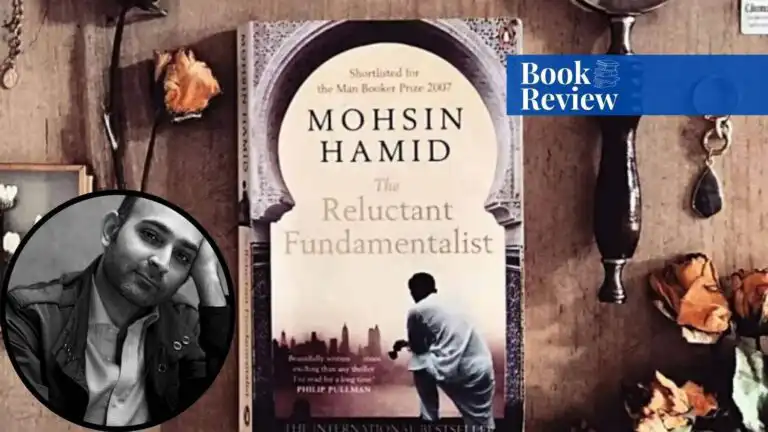
I was walking through a book fair in May 2025 at our university, when my gaze stopped at a section of novels where this book caught my attention. I had heard of this from my senior when I asked him back in the first semester about books to read. As I pushed through semesters, I read quite a few books, but this remained out of my view. I was additionally struck by the title, which convinced me to ponder how one could be a fundamentalist and reluctant, since the two words happen to be self-contradictory. These two reasons provided me with a rationale to give it a read. When I picked up the book, the seller, to convince me, said that it contains some post-colonial themes. And my friend who accompanied me provided his share of input by positing that Mohsin Hamid’s novels are said to be boring.
I would say, with a mix of conviction and reservation, that both of them aren’t right (and not wrong either). The book contained neo-imperialist and orientalist themes, but not precisely post-colonial. Similarly, Mohsin Hamid’s novels are boring, unless you are a social sciences student who loves to uncover the underlying themes of a script. Resultantly, both suppositions are just “not right.”
Mohsin Hamid’s characteristically assertive tone and the use of first person throughout the novel bring excitement as you stroll through the pages. The novel describes, palpably in first person, the journey of a young man to the United States as a student, his life through the dark period of 9/11 and the subsequent stigmatization, the dilemma of choosing identities, and his sentimental decision to retreat to his home country after having spent a hurtful life in pursuit of his “American Dream.”
Plot
The protagonist, named Changez, moves to Princeton University, USA, on a scholarship, where, after pursuing his degree, he starts a job in a famous firm named Underwood Samson. On his graduation trip to Greece, he grows admiration for a New York-based girl named Erica, who reciprocates it but finds it hard to recover from the death of her boyfriend, Chris. The protagonist continues to perform exceptionally well in his job and soon becomes the best recruit among the batch of six. He is quite happy with his job until the tragic events of 9/11 unfold, and he finds himself, alongside other Muslims, in a quagmire of unprecedented magnitude.
On one hand, his loss of connection with Erica saddens him, while on the other, the US bombing of Afghanistan, the profiling of Muslims, and his family’s state of helplessness in a possible war between Pakistan and India convince him to relinquish his pursuit of the American dream and return to his family in Pakistan. He continues his life in Pakistan as a professor in a local university, where he is politically active on campus, mobilizing students to question power structures.
Themes of the Book
The novel, though fictional, offers strong insights into some of the pressing political and social dilemmas faced by individuals of South Asian origin in the post-9/11 world. One of the dominant themes that surfaced in my mind while reading the story was that of brain drain from South Asia. Changez, like many young and bright individuals from this region, goes abroad in search of opportunities, knowledge, and success. He represents that generation of South Asians who, due to a lack of avenues back home, migrate to the Global North and become useful human capital in foreign economies. Yet, in spite of the success he gains at Underwood Samson, his inner sense of belonging remains troubled. This hints at the vacuum that is left behind, not only in the societies they leave but also within the individuals themselves.
Another powerful metaphor I couldn’t unsee was that of the janissaries, young boys taken from their lands, trained in foreign disciplines, and made to adopt the language, culture, and loyalties of an empire that was not theirs. Changez, in his corporate discipline, his grooming into efficiency, and his detachment from his cultural heritage at the peak of his career, reminded me of the Janissary system. He was, in many ways, turned into a cognitive tool of the empire. But unlike the original janissaries, he becomes conscious of the transformation and begins to resist.
The neo-imperialist tendencies of the United States are another major undercurrent. The novel does not loudly shout about imperialism, but through subtle narrative techniques, it brings forth the idea that capitalism, corporatization, and interventionist foreign policies serve as modern tools of empire. The firm’s obsession with “focus on the fundamentals” echoes a broader Western attitude of instrumental rationality, measuring nations, lives, and histories through the lens of profitability. The protagonist, though initially in awe of this model, slowly begins to feel alienated by it.
The stigmatization of Muslims after 9/11 is portrayed not as a political stance but as a lived experience. Changez’s growing beard, the stares at airports, and the general suspicion with which he is viewed form part of a broader pattern of scapegoating. Here, René Girard’s theory of scapegoating comes to mind, where societies, in moments of crisis, channel their collective anxieties onto a symbolic “other.” In post-9/11 America, the Muslim body became the scapegoat, blamed, policed, and excluded to restore a sense of order and security. Changez, despite his Ivy League education and professional excellence, cannot escape this symbolic exclusion.
His return to Pakistan is not merely a geographical reversal; it is emotional and political. It reflects the sentimental nationalism that still deeply exists in the subcontinent. His decision is not entirely rational but, in fact, is driven by a complex attachment to family, to identity, and to a nation he felt distanced from while chasing the American Dream. The nationalism portrayed here is not that of state propaganda. It is the quiet, often painful yearning for home and roots.
The title itself, The Reluctant Fundamentalist, invites layered interpretations. Changez is not a fundamentalist in the religious sense. He never embraces radical ideology or violence. But he becomes a kind of ideological fundamentalist in his rejection of the West, his embrace of resistance, and his decision to stand by his cultural identity. Yet even this “fundamentalism” is reluctant; it is not chosen out of hatred but born of disappointment, alienation, and a deep emotional rupture. The contradiction in the title mirrors the contradiction in the character, torn between admiration and disillusionment, belonging and exile, and identity and performance.
Conclusion
Literature, if read for amusement, provides you with amusement. However, change your lens to that of a critical reader, and you will witness a different underlying reality altogether. The Reluctant Fundamentalist is far more than a tale of personal disillusionment; it is a layered meditation on identity, belonging, and the silent violences of global power. Through the character of Changez, Mohsin Hamid crafts a narrative that confronts the reader with the uncomfortable realities of empire, cultural displacement, and the limits of assimilation.
This review has traced how the novel navigates themes such as brain drain, post-9/11 scapegoating, emotional nationalism, and neo-imperial rationality, all filtered through the protagonist’s conflicted lens. The contradictions embedded in the title are not accidental; they embody the unresolved tensions of a world divided between admiration and critique, inclusion and exclusion. By situating a personal story within a global context, Hamid invites us not only to read but to interrogate. The novel, much like Changez himself, leaves us suspended between understanding and unease, a space that demands reflection rather than resolution.
If you want to submit your articles and/or research papers, please visit the Submissions page.
To stay updated with the latest jobs, CSS news, internships, scholarships, and current affairs articles, join our Community Forum!
The views and opinions expressed in this article/paper are the author’s own and do not necessarily reflect the editorial position of Paradigm Shi