

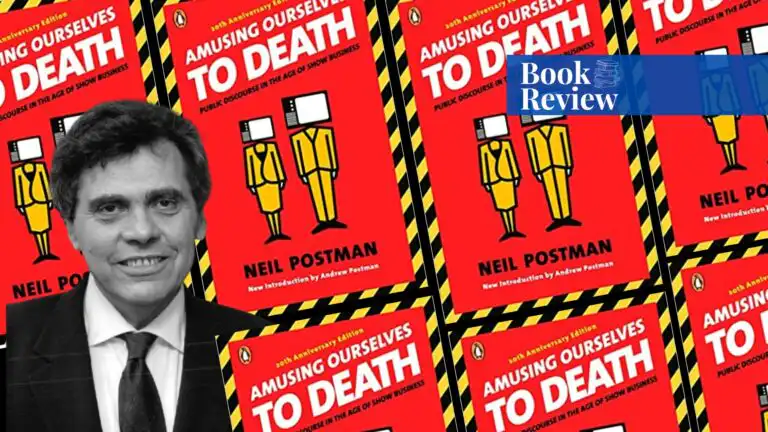
If I were to curate a thesis statement for this book, it would look like this:
“We think of technology as additive, i.e., it functions as status quo+1. However, we are taken aback by the ripples a new technology makes in the social structure. It then becomes evident to us that technology is, in fact, ecological. That is to say, it alters the social ecosystem altogether. Just as when ink is added to a glass of pure water and it diffuses to change the whole color, so does technology.”
Introduction
When 1984 came to a close, the populace of the US, still in the phase of the Cold War, pondered the dystopia painted by George Orwell in his famous novel 1984, where a totalitarian state would hold people in its clutches and manipulate the past to serve its needs. Americans, realizing they are far from remote to this possibility, sang songs of liberal democracy and the United States as a metaphor of the free world. However, the writer argues that in parallel to Orwell’s nightmare, there was another dystopia, slightly older and marginalized, called the “Brave New World” by Aldous Huxley. Orwell feared an externally imposed oppression, while Huxley argued that people would express affection for their oppression, with new technologies undermining their critical faculty under the guise of “progress.” Postman writes that this book proves Huxley right.
Synopsis of Amusing Ourselves to Death
To argue the case of TV’s impact on public discourse, Postman relies on the idea of epistemology, i.e., the study of knowledge. He describes two mediums that spread knowledge. The first one is print, which existed dominantly till the mid-19th century. Although the printed word still exists, and exists in greater numbers than before, before its gradual replacement, it had a monopoly over knowledge transmission. That is to say, there were no movies, radios, etc.
The second medium of knowledge highlighted in Amusing Ourselves to Death is electronic media, which, according to the writer, conducted an assault on print-based epistemology, beginning with the invention of the telegraph and later intensified by TV, a 20th-century innovation that combined speed-of-light news transmission with “out-of-context” images.
Every medium, Postman concedes, favors a specific form of discourse, which simultaneously insists upon and rules out a specific form of content and certainly, audience. Thus, print-based and media-based epistemologies had their own ecosystems, with the printed word favoring rational discourse, in-depth knowledge, thorough contemplation, and longer attention spans. Media-based epistemology “abuses” reason and what remains characteristic of the printed word. To solidify the case in favor of print-based epistemology, the writer gives the example of the Lincoln-Douglas debates, held before the telegraph had made ripples on the epistemological landscape. Courtesy of print being the only source of knowledge, people had all the prerequisite knowledge of the topic in question, including historical speeches, facts and figures, and the context in which the arguments were positioned.
Additionally, the audience would sit for hours at the debate, counter-arguments, and rebuttals, for they had longer attention spans and fused their business and intellectual life, which allowed a smooth transition of knowledge to the audience with unburdened minds. This was the time when both of the debate participants were less known, and Abraham Lincoln hadn’t run for the presidency.
This culture of discourse was to slowly erode when humans began thinking of “conquering spaces” to fuse different regions into a unified whole. This line of thinking facilitated the invention of the telegraph, which transmitted information at the speed of light. Overtly, this seemed to be a good innovation since it helped in gaining access to more information.
However, it significantly altered the epistemological terrain by starting the transmission of out-of-context information, for which the audience had to find a context since the transmitter was not obliged to do so. Additionally, since telegraphs had to keep sending information, they would continuously disseminate one that had, for the most part, no relevance to the receiver. This abundance of information led to a significant decline in the information-action ratio, a scale to judge the practical manifestation of information one has at hand. This scenario of information-glut, a term that circles the excess of information, can be best described by the saying “water everywhere but nothing to drink.”
This comparison of media of communication and their impacts on surroundings attests to the thesis statement that technology is ecological, i.e., with impacts on the whole environment. To add weight to this, the writer gives examples of how the very innovation has transformed some of the main public discourses, like religion and politics, into entertainment.
Talking about the relation of religion and TV, Postman argues that religion, which is meant to be a sacred element of life, is presented as entertainment. That is to say, everything that makes it sacred and provides enchantment, like the sacrilege of the space and mind, is no longer deemed a necessary prerequisite. While religious practices are meant to be conducted in a sacred place, TV strips this very fundamental characteristic from religion since you can even watch religious programs while in the kitchen. Additionally, and possibly most important of all, TV has a psychology of secularism; hence, the form of TV fundamentally is in contradiction with religion.
TV, Amusing Ourselves to Death argues, has had the most serious assault on politics. Democracy requires an individual to deliberate, refine their ideas, and make an informed judgment after having been through thorough contemplation. However, the media have significantly altered the very nature of this responsibility. TV is a medium that delivers “information” at light speed, packaged as entertainment.
That is to say, quick information sharing leaves little room for deliberation, and packed with entertainment, seriousness is lost in the background. This necessitates the spiraling down of rationality, an infrastructure that provides the grammar of democracy. And since we are constantly fed entertainment, we tend to blur the line between a politician and an entertainer, a development that facilitates the rise of “celebrity politicians.” People, when it comes to making their choices in elections, choose not based on political ideologies, party orientations, and manifestos, but rather on criteria that determine who has a better potential to amuse us. The pre-requisite of choice making, that is informed judgement, takes the backseat.
Modern Relevance
Some books are revolutionary at the time of their publication. John Locke’s “Two Treatises of Government” ignited the quest for liberalism. George Orwell’s “1984” warned us of how a strong totalitarian state would put veils on our rational faculty. But if viewed retrospectively, these excellent works lose their relevance for most of the part, and they become what we call “hostages of another time” as new books attempt to position themselves as relevant. However, the more time passes, the more relevance “Amusing Ourselves to Death” acquires.
Television has been replaced by new forms of “information” transmission media, like social media. Apart from social media as an epistemology source, the surge in online learning, which demands no prerequisites, no complexities, has a debilitating effect on students’ thinking capacity. What is possibly the most dangerous is the media’s impact on political discourse. Choices aren’t made on who is a better administrator, but on who has a better aura, can amuse and emotionally appeal to us in the media.
This negative development becomes one contributing factor to the rise of populism, a relatively recent phenomenon, running in parallel with the surge of media-based epistemology. Resultantly, rationality, which was required to be a responsibility of a democratic citizen, has undergone a downward trajectory.
Conclusion
Neil Postman, assuming he were alive, wouldn’t be surprised by these recent developments. Since he forecasted that technology is an ideology that believes in the idea of progress,and that every technology has an ecological effect. With the strong diffusion power of technologies, one like social media prefers “algorithm-based epistemology,” where individuals are trapped in echo-chambers of their own while assuming they have received the most information about the topic in question and are “well informed.” These consequences of technology on the social ecosystem make Amusing Ourselves to Death grow more prescient with time, with its relevance increasing with every passing day, corresponding to the growth of technology and our increasing pursuit of amusement.
If you want to submit your articles and/or research papers, please visit the Submissions page.
To stay updated with the latest jobs, CSS news, internships, scholarships, and current affairs articles, join our Community Forum!
The views and opinions expressed in this article/paper are the author’s own and do not necessarily reflect the editorial position of Paradigm Shift.