It is hard to imagine that war can be abolished, as human nature is inherently driven to pursue its interests. The word interest can vary from human to human, and if we zoom out this nature to the international level, we would observe that every state in this world is pursuing its national interests. States have fought wars, committed genocides, massacred entire populations, economically exploited, and even levelled cities to the ground, all in the name of national interests.
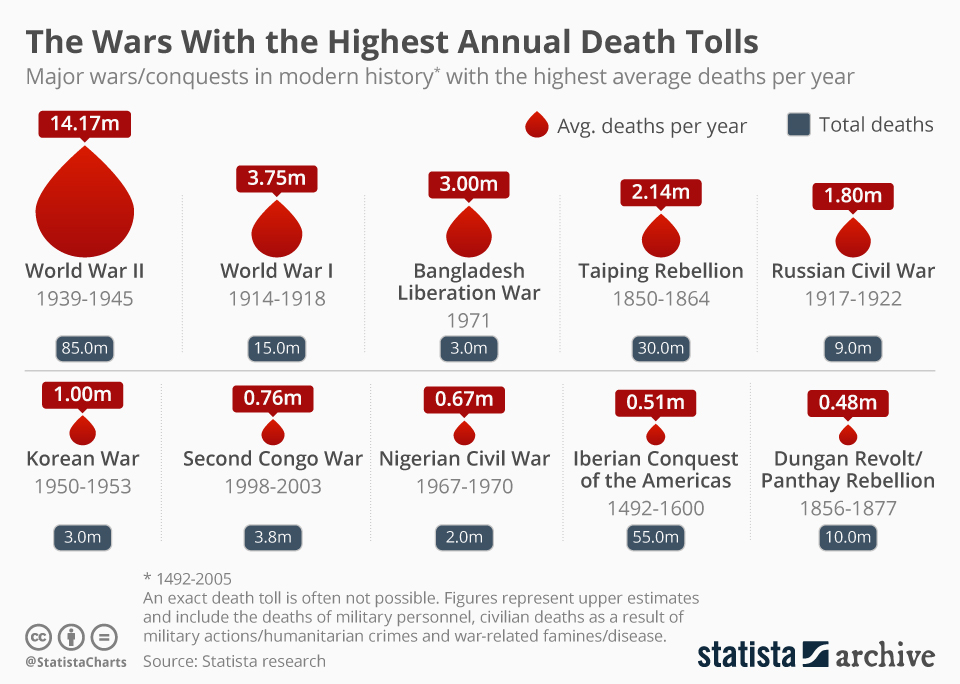 You will find more infographics at Statista
Politics – An Amoral Act
Realists argue that all states compete to achieve their national interests and politics, and international relations are completely based on “realpolitik.” A concept that politics is independent of moral principles and ideology. Realists like Hans Morgenthau emphasize its importance in his book “Politics Among Nations,” published in 1948. Hans introduced the “six iron laws” of political realism, in which he argued that interests are defined in terms of power, and power is the main currency in international politics. The meaning of interest can vary from state to state. Politics is governed by objective laws rooted in human nature. States pursue their national interests even if they conflict with moral principles. Moral aspirations cannot be imposed on political reality, and finally, politics is an autonomous sphere from other disciplines. States act on this concept and pursue their national interests.
For example, despite being an Islamic country, Pakistan has far more cordial relations with communist China as compared to its neighboring Islamic states, such as Afghanistan and Iran. This is not due to Pakistan showing hypocrisy, but because of the shared national interest with China. Those interests include economic cooperation, strategic interests, and, most importantly, a common neighboring enemy. India happens to be the main driving force between Pakistan and China in terms of security matters. Similarly, secular India has more cordial relations with the Islamic states of Afghanistan and Iran! There will eventually be war when these states pursue their conflicting national interests. States focus on enhancing their war capabilities as their last resort to secure their interests. These interests can virtually be anything. One prominent Chinese general, Sun Tzu, wrote in his book, The Art of War. He states in the very first line of his book:
“The art of war is of vital importance for the state. It is a matter of life and death, a road either to safety or to ruins.”
Popular Arguments by Liberals
Idealists argue that the threat of war can be eliminated through the interdependence between states. They tend to strengthen their argument using the “Democratic Peace Theory,” which states that democracies are less likely to go to war because their political leadership is subject to public scrutiny. A common citizen does not want wars. Such idealism is a hoax, as democracies can also initiate wars. Idealists ignore the internal dynamics of state politics that may include jingoistic politicians who will influence public opinion. They may prop up historic humiliation or unjustified peace treaties that may be perceived as threats to their former adversaries.
In contemporary times, many strongman populist leaders use this tactic to call for wars, and surprisingly, people rally behind such leaders. These leaders tend to manipulate people through social media and popular notions among the youth. History has shown that even democracies like Italy have been swallowed by fascism and later fought World War 2. In contemporary times, the world’s largest democracy, India, violated the sovereignty of Pakistan to pursue its national interests. Such national interests can easily climb the escalation ladder to a full-blown war that may pull other powers into the conflict, as happened in World Wars 1 and 2.
Evolution of Warfare
Additionally, the face of war has evolved through time. We wake up and observe a calm, usual day, the people going to their jobs or children playing in parks, but we might be at war simultaneously.
Traditionally, wars were fought on the battlefields with swords, but as technology and globalization progressed, they evolved to use tanks and aircraft. In contemporary times, wars are mostly fought in the shadows through the economy, information, non-state actors, etc. Though the threat of traditional warfare still looms large, “boots on the ground” has little appeal among people, and it is very expensive to pursue. After the catastrophic World War 2, states have primarily sought to focus on the economy rather than invest in weapons.
Idealists argue that economic dependency among states can mitigate the challenge of wars. States tend to perceive war as a “zero-sum game” If the economic factor is on the line. In contrast, the Evolution of warfare and the pessimistic view of human nature have rejected this notion. States with Economic Cooperation can also lead to aggression, as China does with Taiwan.
 You will find more infographics at Statista
Despite reaching a $165 billion trade volume in 2023, China has a vital Interest in incorporating Taiwan into its national territory. Similarly, China has been building artificial islands in the South China Sea, blatantly violating the sovereignty of ASEAN nations despite having a large trade volume with those nations. Making war inevitable in that region. This prompted the United States Navy to ramp up its regional presence while increasing its security cooperation with ASEAN nations.
Has War Always Been Bad for Humanity?
Additionally, people think wars are barbaric acts of violence committed by other states, but wars are also part of human nature. Realists argue that selfish and egoistic human nature pushes us towards war. Wars have also brought evolutionary changes throughout history, significantly bringing paradigm shifts and new ideas to the international system. For example, the Napoleonic Wars helped spread revolutionary ideals throughout Europe, and the Thirty Years War (1618-48) brought the concept of sovereignty and secularization of states.
Furthermore, wars have pushed humanity to innovate to conquer its adversaries and bring new technological advancements. The US military developed a secured communication system during the Cold War that ended up becoming the foundation stone for the Internet; the US Department of Defense first developed GPS to help navigate its missiles, which people now use on an everyday basis; and Uri Gagarin’s first trip to space will be cited for civilian space travel. Therefore, wars are not always bad for humanity but rather a part of it.
Conclusion
In conclusion, the question of whether war can be abolished is nothing but pure idealism. While wars can lead to tragic human loss, devastating the economy, and inflicting trauma on society, increasing advocacy to abolish war is a fool’s paradise. Until interests and animus dominandi (human lust for power) dominate the state’s interests, wars can never be abolished.
If you want to submit your articles and/or research papers, please visit the Submissions page.
To stay updated with the latest jobs, CSS news, internships, scholarships, and current affairs articles, join our Community Forum!
The views and opinions expressed in this article/paper are the author’s own and do not necessarily reflect the editorial position of Paradigm Shift.

He is studying international relations at the University of Central Punjab,