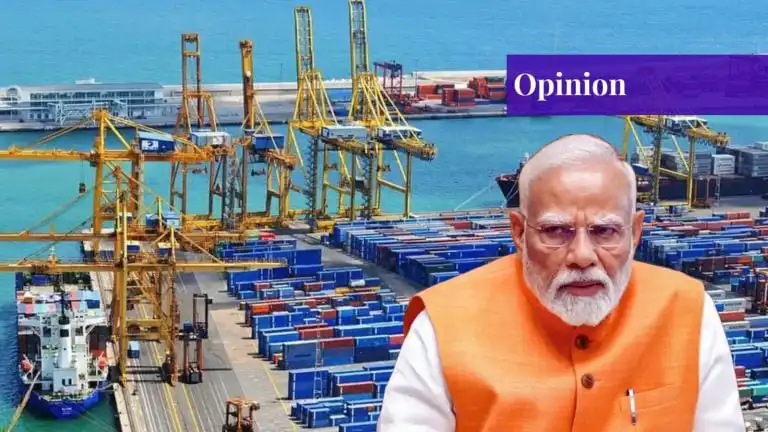

The recent news that India withdrew from Chabahar Port under US pressure is an opportunity for Pakistan. Despite a lack of official confirmation from India, it appears to be authentic in the backdrop of a changing regional geopolitical landscape. This has a direct impact on the maritime security, regional connectivity, and strategic calculus of Gwadar Port and China-Pakistan Economic Corridor (CPEC).

Indian interest in Chabahar port started in early 2000 to establish a direct strategic maritime-land route to Afghanistan and Central Asia, bypassing Pakistan. Subsequently, India pursued this option as a countermeasure to CPEC. India Ports Global Limited (IPGL) implemented this project, which was formalized in May 2016 as a trilateral agreement with Iran and Afghanistan. Although the arrangement became operational in Oct 2018 with its first consignment of wheat from India to Afghanistan via Chabahar, it remained entangled under a complex web of international sanctions. Later in May 2024, India signed a significant 10-year deal to operate Shahid Beheshti terminal by committing $ 370 million ($120 for upgrading port equipment & 250 million for development of port infrastructure).
Sanctions by the United States against Iran are a regular feature, but they have escalated dramatically in 2018 due to the cancellation of the Joint Comprehensive Plan of Action (JCPOA) by the US. However, there was an exception for Inda viz Chabahar Port, which was considered to contribute to the economic stability of Afghanistan and barely benefited the Iranian sanctioned sectors. Although it gave concessions to India in terms of restricted operational rights to the port ‘Shahid Beheshti’ terminal without contravening the larger sanctions regime, this political compromise was rather unstable from the beginning.
However, the United States withdrew its 2018 waiver of Chabahar on 29 Sep 2025 to continue its maximum pressure campaign against Iran. Consequently, cognizant of the worsening geopolitical relations between Iran and the US, coupled with a risk of future conflict, India adopted a cautious approach in spite of the US permission of a six-month transitional waiver (until 26 April 2026). In order to prevent US sanctions inspection, India sent specific funds to Iran, decreased its physical presence in the port, and oversaw board resignations. This operational retreat has put the Chabahar project on a strategic hold.
This Indian retreat can be considered a multilayer strategic failure mainly because the port is a very important connectivity point in the region, bypassing Pakistan. The said relocation process also implies considerable monetary and diplomatic expenses. Not to mention the loss of an important trade and transit route to Afghanistan and Central Asia, a major disinvestment with no possibility of recovery. Additionally, the strained relations with Iran and the loss of strategic autonomy under US pressure are surely a strategic setback for India.
These developments have opportunity for Pakistan. Gwadar is unlike Chabahar that functions within a comparatively isolated framework supported by the economic and political heft of China. Although CPEC does have its own security, financing, and perception management issues, it is not directly a focus of the US censure as Iranian projects are. This strengthens the long-term strategic resilience of Gwadar. Second, the lack of India in Chabahar will, in the short term, diminish the urgency of competition at Gwadar as an alternative port. Chabahar has been depicted over the years as a parallel or alternate maritime port to Gwadar. Third, the recent development puts into focus the centrality, but not the exclusivity, of maritime geopolitics in the Pakistani national security calculations. With India having no more options left due to sanctions pressure, Gwadar is the only option to define the future of the regional trade with Afghanistan, Central Asia, and China.
Although these developments provide opportunities to Pakistan, Pakistan is traditionally lagging in the development of hinterland connectivity, industrial zones development, etc., for translating Gwadar’s promise into tangible economic development. Maritime security and hinterland connectivity are the key for Gwadar development.
Further, a pragmatic engagement with Iran now, without alienating the US, can provide avenues and space for complementary rather than competitive regional port dynamics. US sanctions may provide an opportunity for Pakistan to fetch a better trade agreement with Iran within the limits of sanctions imposed, where practicable.
There are, however, challenges and opportunities. Increasing great power rivalry in our backyard may heighten the level of naval and strategic signaling along ports/sea lanes, thereby exposing the regional stability to risks. The Chabahar case is an eye-opener for Pakistan that ports cannot thrive solely on geopolitics. The nation that succeeds in aligning its maritime structure with credibility, long-term vision, and stability will reap the benefits of the maritime industry through the development of its ports, and Pakistan is not an exception.
Pakistan’s willful or unwilling choices at Gwadar will matter more than India’s difficulties at Chabahar in the longer run.
If you want to submit your articles and/or research papers, please visit the Submissions page.
To stay updated with the latest jobs, CSS news, internships, scholarships, and current affairs articles, join our Community Forum!
The views and opinions expressed in this article/paper are the author’s own and do not necessarily reflect the editorial position of Paradigm Shift.

Author is Director at National Institute of Maritime Affairs (NIMA) Islamabad and can be reached at [email protected]