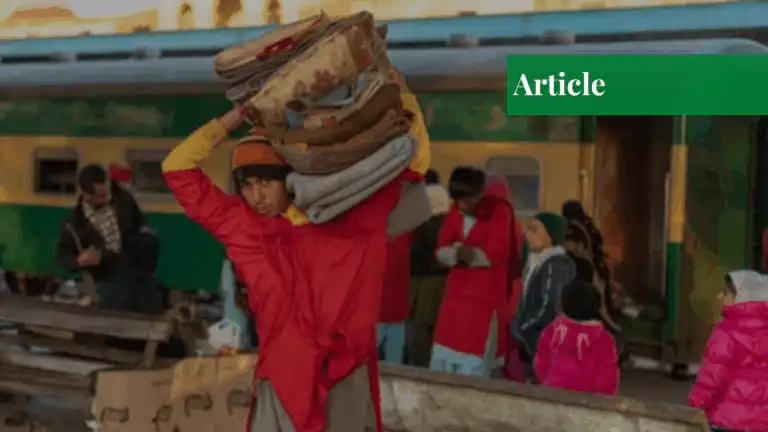

Of all the debates surrounding labor rights in Pakistan, one that remains untouched is the abysmal conditions of daily wage earners. Unskilled workers, mainly from the bottom tier of society, scattered across different industries, provide their labor in exchange for poor benefits. Among them are coolies at railway stations who stride all day just to get 30 percent of their daily earnings extracted by their contractors.
Origin of the term “coolie”
The term has a distinct colonial past, leading back to the indentured labor provided by the indigenous people of the subcontinent. The workers were contracted from India and China to work in the fields of Africa for their colonial masters in the 19th century. In the British Raj, the term was used in a derogatory way as a racial slur. In today’s world, the word is reserved for a manual laborer who carries heavy luggage on his head or neck and facilitates passengers at 625 Railway stations across Pakistan. This article analyzes how the basic rights of these laborers are being exploited by the contractors hired by Pakistan Railway, along with the complicity and slackness of the respective stakeholders.
Complicity of State in the Draconian Contractual System
Up until 2000, coolies used to acquire licenses from the railway department, for which they had to pay an annual fee. Pakistan Railway abolished this system and launched the hiring of workers through contractors. Contractors, through bidding, acquire licenses from the Railway department. As they would be considered coolies on contract now, the department has no liability to provide them with social security and Employees Old Age Benefits (EOBI). The current status quo is inherently exploitative in nature and in repugnance with constitutional provisions such as Article 18, which guarantees the right to pursue a lawful occupation.
Abysmal Working Conditions and Health Issues
Pakistan has been an active member state of the International Labor Organization (ILO) since 1947 and has ratified 36 conventions. Despite these ratifications, Pakistan has failed to introduce holistic legislation and enforcement mechanisms for manual laborers and their dire working conditions. Long working hours and poor working infrastructure have been the major causes of work-related diseases around the world, and these porters are no exception to these factors. They face severe occupational hazards during their working hours. Fundamentals of Occupational Health and Safety make it mandatory to have a preventive safety and health culture.
They do not have a fixed working schedule. Some work more than 15 hours because they live hand to mouth. Long work hours contribute to the risk of injuries, increased levels of stress, and poor eating habits. Sleep-deprived, burdened with 40 to 50 kg of luggage, they run from one station to another without any trolley assistance. Delaying in the arrival of trains makes this issue worse as they stay long hours. Another factor exacerbating this problem is the deduction of 30% commission from their daily earnings. Workers, in fear of this draconian tax, run extra miles for more hours to meet their ends!
Manual laborers mostly face musculoskeletal shoulder pain and high levels of disability. A recent study conducted among 80 coolies at Lahore Railway Station painted a bleak picture of this issue. Almost all of the respondents reacted positively to the questionnaire and authenticated every item required. These workers remain unaware of their pains and disabilities, potentially resulting in cumulative trauma syndrome in the long run. No coolie had sought medical attention in their lifetime and instead used home-based remedies to manage their pains. Multiple surveys have identified that these people are completely ignored by the contractors in case of any medical emergency or need for financial assistance.
Exposure to severe noise pollution at railway stations because of shunting operations, train horns, whistles, and passenger overcrowding results in hearing impairments of coolies and railway employees in general. They face hearing loss growth, which cumulatively affects their working efficiency. It is in derogation with their fundamental right to life as enshrined in Article 9 of the Constitution of Pakistan. Regular hearing assessments and mitigating risk factors must be introduced for these workers to protect them from major diseases related to auditory systems.
Relevant Legislation and Lacunas
Pakistan has no law to regulate the terms and conditions of contractual workers. There is no enforcement mechanism to provide them with just and humane labor as specified in Article 37 (e) of the Constitution of Pakistan, 1973. Factories Act,1934, and Industrial and Employment Ordinance, 1968 define the word worker as “Any person hired directly by an employer or through an agency” would be considered a factory worker. This definition has a major lacuna in it as employers subvert it by categorizing coolies as the workforce of Contractors rather than the Railway department. This gives them the space to exploit this vulnerable class of approximately 50000 coolies who provide vital service to the Railway department, which spends little to no money on management crews, cargo companies, loaders, trolleys, and proper infrastructure.
Contractors register coolies as daily wage earners and deprive them of pensions, old age benefits, and social protection. Supreme Court of Pakistan in Fauji Fertilizer Company Ltd. vs. National Industrial Relations Commission (2013 SCMR 1253) ruled that the workforce employed by the company’s contractors would be considered employees of the company rather than independent workers. However, this major opinion has not been implemented in regards to the legal standing of coolies. This patronized state-empowered brutality and exploitation will continue until the introduction of major reforms in legislation and implementation of court rulings.
Way-Forward
To address the aforementioned grievances, Pakistan needs to introduce reforms in consonance with international labor laws and occupational health and safety (OSH) standards. The Government of India has replaced the word “coolie,” which has a colonial legacy attached to it, with the “shayak” which means “madadgar.” This amendment is like a cool breeze in the South-Asian landscape because it is an affirmation of the worker’s dignity. There is no contractual system in India, as coolies have to acquire licenses from the railway department, and an annual fee is necessary for their renewal. Pakistan needs to adopt similar strategies.
The following major initiatives can be taken:
Daily wage workers need to be given protection through a broader legislative spectrum. Mere notifications of minimum wage without any respective enforcement mechanism make them vulnerable to exploitation at the hands of employees. Every province needs to introduce separate legislation for daily wagers, or the current laws shall be amended for their inclusion.
Policy implementation has to be taken seriously. Courts have repeatedly ruled out that labor laws need to be implemented in true spirit as mere recognition would do no benefit to the working class.
Abolishing the contractual system would be a major step toward a better future for coolies. As the present system extracts 30% of their earnings daily, abolishing this will seriously impact their quality of life. A centralized system would enhance their financial independence, further solving their health-related issues and providing better opportunities for their families. By recognizing them as regular employees of the Railway department, they will enjoy social security and Employee’s Old Age Benefits (EOBI).
Digitization has reformed lives and brought economic opportunities for the masses. Similarly, Introducing coolie profiles on railway apps and facilitating them with necessary digital education can change their financial dynamics. Passengers who use online apps for tickets will have direct access to coolie profiles along with their wage and availability status. Pre-hand bookings and online tracking of trains will save coolie’s time and reduce long work hours. Ultimately, this will uplift coolies economic and social status.
Adherence to the Punjab Occupational Safety and Health Act of 2019, with proper checks by government agencies, will lessen occupational hazards and workplace incidents. Regular workshops on safety standards and health issues must be conducted. A policy mechanism must be drawn by the railway department to ensure compensation for coolies injured during their course of work.
If you want to submit your articles and/or research papers, please check the Submissions page.
The views and opinions expressed in this article/paper are the author’s own and do not necessarily reflect the editorial position of Paradigm Shift.

Muhammad Naman is a fourth-year law student at Dr. Muhammad Iqbal Law School, Government College University, Lahore. He has interned at various law firms and welfare foundations, such as Khan & Associates, AUC | LAW, and The Citizens Foundation.