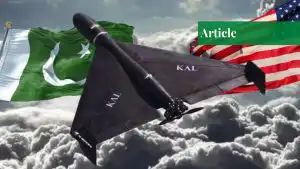

On May 7, 2025, news broke that sent ripples through the strategic community in South Asia as Pakistan had successfully shot down five Indian aircraft, including three of the much-celebrated Rafale jets, using a mix of conventional and electronic warfare (EW) capabilities. In the days that followed, more than 80 Indian drones were reportedly neutralized, not just through costly missile-based systems, but through “soft kills”, a term that points directly to the unseen hand of electronic countermeasures. The event marks not just a tactical victory but a strategic warning as the electromagnetic spectrum is now a battlefield in its own right.
What Is Electronic Warfare?
Electronic warfare, or EW, is all about controlling the electromagnetic spectrum, the space from Radio waves to Gamma rays, where communication signals, radar, GPS, and other tech tools live. If one can dominate that space, one can see the enemy without being seen, confuse their systems, and even bring down their aircraft or drones without firing a single bullet.
Electronic Warfare (EW) refers to the strategic use of the electromagnetic (EM) spectrum to detect, disrupt, or degrade enemy capabilities while protecting one’s friendly aircraft and systems. Broadly, EW can be divided into three interlinked categories:
Electronic Countermeasures (ECM): Offensive actions aimed at jamming, deceiving, or blinding enemy sensors and communications.
Electronic Counter-Countermeasures (ECCM): Defensive techniques that protect friendly use of the spectrum, such as frequency hopping or signal encryption.
Electronic Support Measures (ESM): Passive detection systems gather intelligence, identify threats, and cue attacks.
These categories often overlap in practice and can also be understood through another lens of Electronic Attack (EA), Electronic Protection (EP), and Electronic Support (ES), essentially, offence, defence, and reconnaissance within the electromagnetic domain, respectively.
Historical Background
Though often imagined as a high-tech novelty, electronic warfare has deep historical roots. In 1904, during the Russo-Japanese War, Russian forces jammed Japanese naval communications, which marked the first recorded instance of ECM in modern warfare. However, it was during World War II that electronic warfare became a game-changing factor. The “Battle of the Beams,” for instance, saw British forces using radio counter-signals to confuse German bombers, which were reliant on navigational beams to drop bombs. This tilted the battlefield in Britain’s favour and proved that signal mastery could shape victory. That lesson hasn’t been forgotten. It’s become even more central to the modern military strategy of the twenty-first century.
EW in Asymmetric Warfare
India has the edge over Pakistan in terms of raw numbers and conventional military might. India has a bigger economy, more aircraft, and more tanks. But war isn’t a numbers game anymore. It’s about asymmetric capabilities, finding smarter, cheaper, and faster ways to level the playing field.
The latest developments in South Asia demonstrate that Pakistan’s military doctrine has adopted electronic warfare as the core of its asymmetric conventional warfare with India. Against the backdrop of India’s numerical and technological superiority in conventional terms, EW offers Pakistan a force multiplier by neutralizing adversarial advantages at a fraction of the cost.
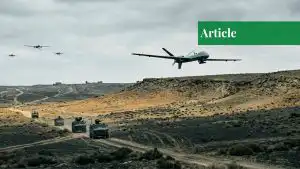
This asymmetric posture is particularly evident in Pakistan’s recent success in drone warfare. From May 7 to May 10, over 80 Indian drones were downed, not only through expensive missile interceptors but mostly via electronic “soft kills” by disrupting command links, jamming navigation signals, or spoofing positioning data. Not only is this cost-effective, but it also shows a mature EW strategy that leverages low-risk, high-yield operations. It shows the strategy that instead of matching India jet-for-jet, Pakistan is focusing on neutralizing tech before it becomes a threat.
One of the pillars of modern EW success is radar technology, especially Active Electronically Scanned Array (AESA) radars. Unlike older mechanical radars, AESA systems scan electronically, shift frequencies at lightning speed to resist enemy systems’ jamming efforts, and operate in multiple modes.
Pakistan’s JF-17 Block III and J-10CE jets are equipped with AESA radars. These platforms, armed with PL-15 beyond-visual-range air-to-air missiles, can track and engage multiple targets simultaneously, often without even turning on active sensors and using passive detection techniques instead. The fusion of EW and kinetic power here involves technical and strategic manoeuvrability.
China’s Role in Reshaping the Regional EW Landscape
Pakistan’s recent success cannot be fully understood without examining China’s influence. Over 80% of Pakistan’s defence imports, including aircraft, radars, and command systems, come from China. But it’s not just about equipment. It’s about architecture.
China began investing seriously in independent military-tech infrastructure following a wake-up call of the 1995–1996 Taiwan Strait Crisis. During that conflict, a sudden disruption in GPS signals led the People’s Liberation Army (PLA) to lose track of its ballistic missiles. The lesson was clear for China: reliance on foreign satellite navigation systems poses a strategic risk.
The result? The development of BeiDou, an indigenous satellite-based Positioning, Navigation, and Timing (PNT) system, now offers China and its allies an independent and secure spatial network. This development has not only increased China’s self-reliance but also enhanced Pakistan’s EW infrastructure.
A recent incident in December 2023 reported by the South China Morning Post highlights this. A U.S. EA-18 Growler, one of the most advanced electronic attack aircraft, reportedly faced severe signal disruption during a standoff with China’s Type 055 destroyer “Nanchang” in the disputed South China Sea region. The Type 055’s integrated radar and communication systems, supported by a distributed information network, enabled the Chinese vessel to form a kill-web, a digitally coordinated firing and sensor grid that outmanoeuvred the American aircraft.
This shows not just Chinese prowess but also a glimpse into the type of battlefield Pakistan is preparing for. This matters for Pakistan, too. It shows what’s possible when one integrates EW into every layer of one’s defence and not just tacks it on at the end.
In contrast, India faces a diverse and somewhat fragmented military-technical ecosystem. With systems sourced from Russia, France, Israel, and domestic manufacturers, achieving a fully integrated command and information network is challenging for India. This lack of harmonization often results in data latency, signal incompatibility, and coordination delays in the electromagnetic domain.
By comparison, Pakistan’s reliance on a coherent Chinese military ecosystem offers logistical simplicity and battlefield synergy. As electronic warfare becomes less about hardware and more about network coherence in this age of information warfare, this difference may prove decisive.
Conclusion
We are entering a new era in global and regional security, one in which victory will be decided less by bombs and bullets and more by bandwidth and beams. Electronic warfare is no longer just a tactical layer but a strategic pillar of modern defence policy. It’s arguably the most decisive part of modern conflict.
If you control the spectrum, you control the battle because it’s up to you to decide who sees what, when, and how. For countries like Pakistan, EW offers a way to counterbalance superior numbers with a superior signal strategy. And the side that masters the invisible will shape the future of warfare in South Asia and beyond.
If you want to submit your articles and/or research papers, please visit the Submissions page.
To stay updated with the latest jobs, CSS news, internships, scholarships, and current affairs articles, join our Community Forum!
The views and opinions expressed in this article/paper are the author’s own and do not necessarily reflect the editorial position of Paradigm Shift.

Onzila Aziz holds a Master’s degree in International Relations and has earned gold medals in both Bachelor’s and Master’s programs. She has a strong academic foundation and focuses on Asia-Pacific studies, strategic affairs, emerging technologies, arms races, and arms control. Onzila Aziz is particularly interested in how evolving military technologies are reshaping regional security dynamics and global power structures.