
“Prejudice is a burden that confuses the past, threatens the future, and renders the present inaccessible.”
Maya Angelou
A Diverse Balochistan
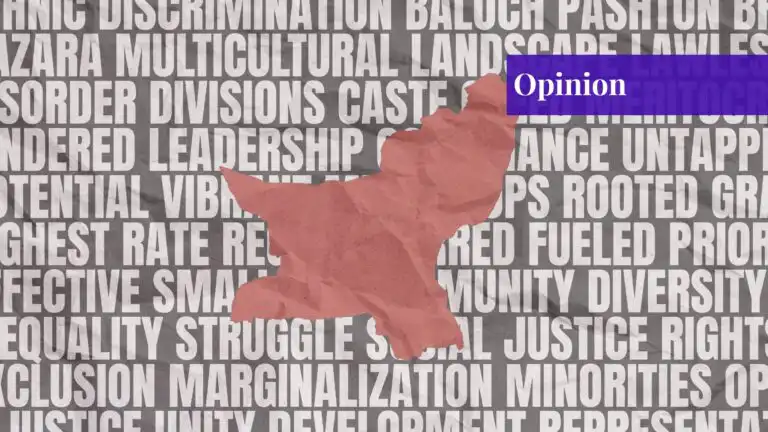
Why does Balochistan, despite being resource-rich, have the highest poverty rate among the provinces of Pakistan? Why is the region confronted with such unrest? What has deprived the region?. These questions often arise in the youth’s mind. To reach an answer, there are various aspects to be examined. However, core analyses of the questions may reveal ethnic discrimination as one of the root causes of all evils in Balochistan.

Balochistan, the largest but least populated province of Pakistan, is undoubtedly a beautiful, multi-colored umbrella inhabited by various ethnicities, including the Baloch, Brahui, Pashtun, Hazara, and many others. This multicultural feature portrays an insightful picture, offering a vibrant fabric of cultures and identities. However, a closer look reveals the reality of lawlessness and disorder due to the ethnic divisions and discrimination that have contributed to the political, economic, and social struggles of Balochistan. Before diving into depth, it would be insightful to have a closer look at the region, highlighting its historical and geographical significance.
Demographic Overview
Balochistan, home to diverse cultures, has a unique demographic profile. It consists of 6.85 percent of Pakistan’s population, with a population of approximately 14.9 million as of the 2023 census. As aforementioned, Balochistan is home to multiple ethnicities and cultures. The Baloch, the largest ethnic group, covering the western and southern regions, make up 39.9% of the population. Pashtuns come as the second largest group, consisting of 34.34% of the total population, mainly inhabiting the north, including the capital city, Quetta. The Brahui, on the other hand, primarily residing in the central areas, make up around 17.22% of the population.
Coming to the minorities, including the Hazara community, they have the least share in the region’s population. Moreover, the region’s multi-ethnic feature also portrays a beautiful multilingual culture. The major population speaks Balochi, Brahui, and Pashto. Other languages, which include Sindhi, Saraiki, Punjabi, and Urdu, are also spoken by a smaller population. However, while this multi-ethnic characteristic portrays a fascinating picture, at the same time, it has been a root cause of challenges within the region, making the conditions demanding to deal with.
A Glance at Balochistan’s Geography
Balochistan is the largest province of Pakistan, covering approximately 43 percent of the country. According to the 2023 census, the province is inhabited by approximately 14,894,402 people. More excitingly, the province presents multiple views at once, consisting of mountains (Sulaiman, Kirthar, Toba Kakar, and the Makran Coastal ranges), deserts (Chaghi and Kharan deserts), rivers (Bolan, Hingol, Dasht, and Nari rivers), and forests (Ziarat, Hingol, and Makran Coastal forests), making the region attractive for tourists. Similarly, the region has its own unique history.
From Ethnocentrism to Terrorism
Just as disease disturbs the entire functioning of a body, ethnocentrism deteriorates a nation from its roots. The gloomy days of the Abbasid Caliphate (9th to 13th century), a great power of its time, turned into a nightmare, portraying a horrific history. Of course, the ethnic issues and conflicts between Arabs, Persians, Turks, etc., paved the way for further deterioration of the situation, leading to a broader civil war and ultimately the decline of the empire.
As the saying goes, history repeats itself when it is forgotten; the ethnic biases in Balochistan have severely affected the functioning of democratic and liberal principles. The locals have often been observed to prioritize the political leaders based on caste and creed rather than examining their qualities and capacity for leadership roles. This selection of leaders undermines the principles of meritocracy.
Similarly, the leaders who occupy a legitimate room in the political house have been observed as representatives of a particular group that belongs to their caste, ignoring the diverse populace. The sardari system is an example where sardars (tribal chiefs), who have a dominant role in the political power of the region, are selected due to their tribal influence rather than their leadership qualities. They also represent specific communities. More significantly, these tribal leaders usually lack the qualities required to resolve national issues and make decisions.
Resultantly, economic conditions have been suffering a lot due to the flaws in leadership and governance, leaving long-lasting impacts on the sector. For instance, one of the largest deposits of copper has been found in Reko Dik, district Chaghi; in fact, they are believed to be greater than that of Iran’s “Sarcheshmeh,” which is known as the world’s second largest copper deposit. Likewise, the province is the largest producer of natural gas after Sindh. But unfortunately, these resources have been left unutilized due to ineffective leadership.
Moreover, favoritism based on caste and ethnicity has become another untold story behind all the destruction, particularly in sectors like administration and education, which are the core institutions for economic stability. Most of the time, if an interviewer is Baloch or Pashto, they keep the interview light for candidates belonging to their community, which results in the appointment of eligible candidates for office. At the same time, exposure to the conduct of examinations in rural areas like Kalat, Sindh, Punjgur, Lorelai, Zhob, and many more reveals serious conditions, as students in these areas are often allowed to cheat; in fact, they are given extra time for their attempts, due to which many brilliant students suffer in a marks-centric culture.
Last but not least, destruction in social conduct as a result of ethnic discrimination has been another setback to the development of Balochistan. The local fights among different ethnicities, acknowledging themselves as a superior caste, have spawned the germs of terrorism and foreign conspiracies. The social conditions in Balochistan portray the Machiavellian thought of “divide and rule,” where he suggests the prince foster divisions among the subjects to ensure power. However, the idea seems relevant to the international scenario as well, where opponent states benefit from opportunities like ethnic discrimination and do not lag behind in adding fuel to the fire.
Consequently, it bursts out in civil war, as Machiavelli advises in his book “The Prince,” to conquer a state or territory. As hatred blinds wisdom and destroys the ability to see reality, the locals quarrel with each other over petty things based on ethnic differences and overlook the foreign conspiracies. Thus, peace in Balochistan, unfortunately, has been under the chains of ethnocentrism.
In a nutshell, Balochistan, home to diverse cultures and ethnicities, has been the victim of ethnic discrimination. This nasty attitude has given rise to many other issues, like crises in leadership and governance, economic downfall, and societal unrest. This is an alarming situation that calls for immediate action to address the issue. Otherwise, these conditions will result in the province’s loss of self-rule and autonomy, like Aleppo, Syria.
“Racism is a grown-up disease, and we must stop using our children to spread it.”
Mary Stewart
If you want to submit your articles and/or research papers, please visit the Submissions page.
To stay updated with the latest jobs, CSS news, internships, scholarships, and current affairs articles, join our Community Forum!
The views and opinions expressed in this article/paper are the author’s own and do not necessarily reflect the editorial position of Paradigm Shift.

Tahreem Amanullah is an undergraduate student of international relations at BUITEMS, Quetta.