
The Anatomy of a Diplomatic Laundering Device
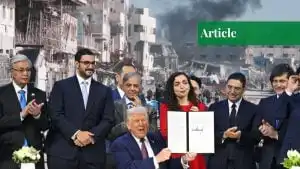
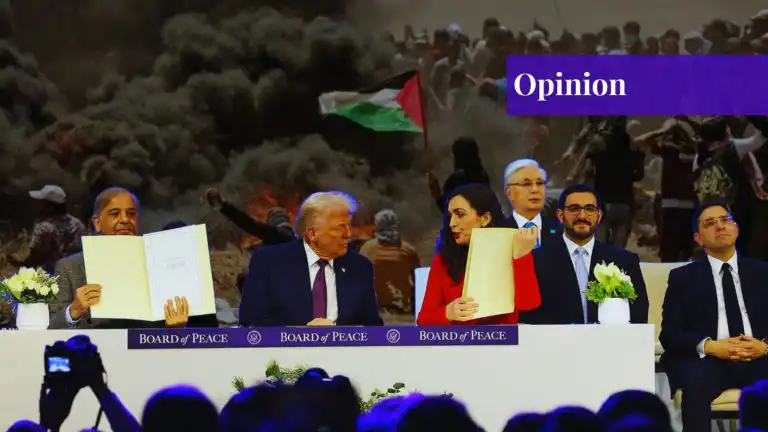
At a time when Pakistan is confronting a wave of terrorism and burying its martyrs, it simply cannot afford any ambiguity in foreign policy. States derive strength from clarity of principle, policy, and consequence. Pakistan’s decision to sign onto the Gaza Board of Peace (BoP) is, therefore, not a routine diplomatic commitment.
In its latest report, Human Rights Watch has renewed its charge that “Israel has carried out crimes against humanity, genocide, and ethnic cleansing in Gaza.” The Gaza War has seen 72,000 people killed, apart from an estimated 10,000 still buried under the rubble. The fatalities include 22,000 children, one child each hour of this genocide.
16th-century Europe was ruled by the doctrine of the divine right of kings that sanctified political absolutism. Violence was not restrained but legitimized. Accountability was heresy, and justice was shunned as an obstacle to stability. The danger of the Gaza Board of Peace lies not in the peace it offers but in the absolution it delivers.
The BoP is not a peace mechanism. It is a political laundering device that elevates Netanyahu, under investigation for war crimes, into more than a stakeholder in Gaza’s future. The architect of genocide is transformed from a criminal into an overlord of Gaza. This erases the foundational distinction of international law between the occupier and the occupied and that of the perpetrator and the victim. This is a precedent fraught with danger and injustice.
A genuine peace process begins with the admission of wrong, accountability of the perpetrator, and restoration of political agency to the victims. The BoP sanitizes the devastation and institutionalizes it. Gaza’s future is up for grabs without the Gazans, while Palestine’s self-determination is deferred indefinitely. This is evident from the mindset. In a meeting in Jerusalem with the US envoy Steve Witkoff last week, Netanyahu haughtily proclaimed that the Palestinian Authority would not be a part of post-war Gaza’s governance in any way.
A few days back, Israel’s Zionist finance minister, Bezalel Smotrich, said that Hamas would be given a two-month ultimatum to disarm. Israel, he declared, will not end the war until Hamas is destroyed militarily, politically, and socially. This is not the language of peace; it is the vocabulary of conquest.
The Geopolitical Cost of Compliance
Pakistan has drawn one red line. It has categorically refused to participate in the disarmament of Hamas. This is crucial. It rejects the familiar inversion whereby an occupied people are required to surrender arms while occupiers escape accountability. Disarmament without political resolution is not peacebuilding; it is enforced submission. This refusal, however, should not be the endpoint of Pakistan’s decades-long stand for the Palestinian cause.
Having lent its name, Pakistan cannot allow its association to be interpreted as consent for a framework that indefinitely postpones justice. Meanwhile, Israel blatantly continues to violate the ceasefire terms. Gaza health officials say that 556 Palestinians, including 130 children, have been killed since the ceasefire. Israel has banned Médecins Sans Frontières from treating Gaza’s sick and wounded. It has also threatened to bar 37 humanitarian organizations in Gaza. With such excesses, our silence shall be seized upon as complicit acquiescence.
The EU and Britain, Washington’s closest allies, have steered clear of the BoP. So has Narendra Modi, Netanyahu’s most ardent cheerleader. Apart from economic and strategic factors, a key driver was the sensitivities of India’s 210 million Muslims, who are highly sympathetic to the Palestinian cause. All the more telling, given that Modi is a Netanyahu clone.
India has secured a €9 billion trade agreement with the EU, a massive blow to our already beleaguered textile industry. It has also inked a deal with the US, with its tariffs slashed from 50 to 18 percent, all while carefully avoiding physical or diplomatic entanglement in Gaza.
Security Implications and the Kashmir Precedent
For Pakistan, the danger is not abstract or merely moral. It is immediate and internal. The country is confronting coordinated militant attacks aimed at undermining the state’s writ, particularly in Balochistan.
These are not symbolic one-off acts. They are, as analysts warn, sustained India-armed and sponsored attacks. The dastardly terror attack on an Imambargah in Tarlai, Islamabad, occurred during the visit of Uzbekistan President Shavkat Mirziyoyev. Both China and the UN, underscoring the fragility of the security environment, had warned of terrorism spilling into Pakistan.
Add to this the looming possibility of a US-Iran-Israel conflict. This shall radicalize narratives across the region, inflame sectarian fault lines, and create new theaters for proxy conflicts. Pakistan, bordering Iran and already overstretched to secure its 5,430-kilometer eastern and western border, shall be directly exposed. In this environment, foreign policy symbolism is never cost-free.
Militant recruitment does not thrive on deprivation alone. It feeds on narratives of betrayal, humiliation, and moral dissonance. Association with a Washington-engineered framework that shields Israel from accountability shall be relentlessly framed as complicity. This hands the terror sponsors a custom-made recruitment tool.
There is also a deeper strategic contradiction. Pakistan’s position on Kashmir rests on moral and legal clarity. Occupation is the core issue, and self-determination is non-negotiable. The BoP inverts this logic. Its framework suggests that occupation can be managed by rivieras and coercive control. India will seize it as a precedent. If Gaza can be stripped of accountability, Kashmir shall be reframed the same way.
Some argue engagement allows influence. This is an illusion. Pakistan will not shape the Gaza Board of Peace; it will only legitimize it. For now, at least, the die has been cast; stability without justice, reconstruction without sovereignty, and control without consent. A state battling terrorism cannot afford to partner with such contradictions that inflame the very forces it seeks to defeat.
Pakistan has lived this cataclysmic nightmare before. Earlier alignments with Washington-led adventures offered fleeting validation. We are still reeling under the ruinous fallout of radicalization, terrorism, and economic destitution. The scars remain visible in each security meeting and in every home that has lost loved ones. In this critical hour, Pakistan must choose moral and strategic clarity over what may be deemed as pernicious complicity. The cost of the latter is something that the nation can simply no longer pay.
If you want to submit your articles and/or research papers, please visit the Submissions page.
To stay updated with the latest jobs, CSS news, internships, scholarships, and current affairs articles, join our Community Forum!
The views and opinions expressed in this article/paper are the author’s own and do not necessarily reflect the editorial position of Paradigm Shift.

Mir Adnan Aziz is a freelance contributor.